

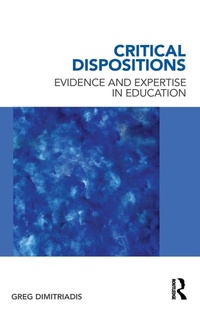
Critical Dispositions
Evidence and Expertise in Education
1st Edition
Published on 24. August 2011
Book
Hardback
158 pages
978-0-415-88564-5 (ISBN)
Description
Set against the current proliferation of global "difference" and economic realignment, Critical Dispositions explores the notions of "evidence" and "expertise" in times of material scarcity. Both have come to the forefront of national and international debate in education as "evidence" and "evidence-based" research and pedagogical practices continue as major trends in educational policy. Greg Dimitriadis maintains this debate is best understood as part of a broader rise in professional and managerial discourses in various aspects of educational research and practice. Each aims to control and contain some aspect of research and practice in ways that are increasingly specific and targeted.
As demonstrated through examples from critical intellectuals and artists outside the field of education, this current proliferation of specific, autonomous fields of inquiry and practice marks a much deeper ambivalence about our contemporary moment and how we understand it. Following Bourdieu and other theorists, Dimitriadis argues that educational researchers and practitioners today must be increasingly self-reflexive about the positions they take up in various fields of inquiry, what they allow us to see and to understand, what they blind us to. This kind of self-reflexivity, however, is becoming increasingly difficult today as material demands and dislocations are forcing educators to occupy particular fields in more specific ways. Unpacking this tension and offering alternative "thinking tools" is at the core of this volume.
As demonstrated through examples from critical intellectuals and artists outside the field of education, this current proliferation of specific, autonomous fields of inquiry and practice marks a much deeper ambivalence about our contemporary moment and how we understand it. Following Bourdieu and other theorists, Dimitriadis argues that educational researchers and practitioners today must be increasingly self-reflexive about the positions they take up in various fields of inquiry, what they allow us to see and to understand, what they blind us to. This kind of self-reflexivity, however, is becoming increasingly difficult today as material demands and dislocations are forcing educators to occupy particular fields in more specific ways. Unpacking this tension and offering alternative "thinking tools" is at the core of this volume.
Reviews / Votes
"This is an important book that provocatively raises challenges all sociologists of education should face. There is a welcome focus on big ideas from beyond the tunnel vision of much educational research." -British Journal of Sociology of EducationMore details
Language
English
Place of publication
London
United Kingdom
Publishing group
Taylor & Francis Ltd
Target group
College/higher education
Dimensions
Height: 235 mm
Width: 157 mm
Thickness: 13 mm
Weight
392 gr
ISBN-13
978-0-415-88564-5 (9780415885645)
Copyright in bibliographic data and cover images is held by Nielsen Book Services Limited or by the publishers or by their respective licensors: all rights reserved.
Schweitzer Classification
Other editions
Additional editions
E-Book
06/2012
1st Edition
Routledge
€69.99
Available for download
E-Book
06/2012
1st Edition
Routledge
€69.99
Available for download
Book
03/2012
1st Edition
Routledge
€75.60
Shipment within 15-20 days
Person
Greg Dimitriadis is Professor of Educational Leadership and Policy, University at Buffalo, SUNY.
Content
Preface
Acknowledgements
Introduction
1. Humanism and the Production of Expertise
2. Phenomenology, Evidence, and Aesthetics
3. Living Vulnerability in Neoliberal Times
4. On Never Getting It Right
5. Revisiting the Question of Evidence
6. Business Lessons
Moving Ahead: Final Thoughts
Acknowledgements
Introduction
1. Humanism and the Production of Expertise
2. Phenomenology, Evidence, and Aesthetics
3. Living Vulnerability in Neoliberal Times
4. On Never Getting It Right
5. Revisiting the Question of Evidence
6. Business Lessons
Moving Ahead: Final Thoughts