

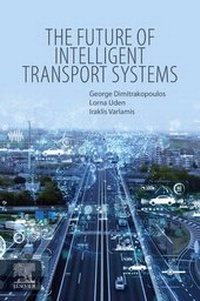
The Future of Intelligent Transport Systems
Published on 24. February 2020
Book
Paperback/Softback
272 pages
978-0-12-818281-9 (ISBN)
Description
The Future of Intelligent Transport Systems considers ITS from three perspectives: users, business models and regulation/policy. Topics cover in-vehicle applications, such as autonomous driving, vehicle-to-vehicle/vehicle-to-infrastructure communication, and related applications, such as personalized mobility. The book also examines ITS technology enablers, such as sensing technologies, wireless communication, computational technology, user behavior as part of the transportation chain, financial models that influence ITS, regulations, policies and standards affecting ITS, and the future of ITS applications. Users will find a holistic approach to the most recent technological advances and the future spectrum of mobility.
More details
Language
English
Place of publication
United States
Target group
Professional and scholarly
Researchers and postgraduate students in Intelligent Transportation Systems and Transport Engineering, Planning, Systems Management, and Networks; planning professionals, local governmental authorities, city administrations, city planners, transportation authorities
Dimensions
Height: 229 mm
Width: 152 mm
Weight
410 gr
ISBN-13
978-0-12-818281-9 (9780128182819)
Copyright in bibliographic data and cover images is held by Nielsen Book Services Limited or by the publishers or by their respective licensors: all rights reserved.
Schweitzer Classification
Other editions
Additional editions
George J. Dimitrakopoulos | Lorna Uden | Iraklis Varlamis
The Future of Intelligent Transport Systems
E-Book
02/2020
Elsevier
€109.00
Available for download
Persons
George Dimitrakopoulos is Assistant Professor at the Department of Informatics and Telematics of Harokopio University of Athens. His research interests include optimization and performance evaluation of wireless systems, applications of wireless networks, intelligent transport systems, autonomous driving and smart radio systems. He has authored more than 150 articles and is involved in research and development projects in transportation and urban mobility. Lorna Uden is Professor Emeritus in the Department of Computing at Staffordshire University in UK. Her research interests include learning technology, web engineering and technology, big data, knowledge management, and the Internet of Things. She has authored more than 200 papers and is on the editorial board of several international journals, including as the founder and editor-in-chief for the International Journal of Web Engineering and Technology, and the International Journal of Learning Technology. She has been invited as keynote speaker at many international conferences and visiting professor at many universities internationally. She is the conference chair for both KMO and LTEC. She also travels widely to give workshop on Problem Based Learning. Iraklis Varlamis is Associate Professor of Data Management at the Department of Informatics and Telematics at the Harokopio University of Athens. His research interests span data-mining and knowledge extraction from social media, to intelligent systems and machine learning with application in recommender systems and personalization. He has co-authored three books and more than 130 papers concerning graph and text mining, data analytics, intelligent systems and personalization and has more than 2000 citations on his work. He holds a patent from the Greek Patent Office and an application pending from the US patent office. He is been involved on several EU funded projects concerning intelligent systems, machine learning, and data mining on the industrial and automotive domain.
Content
PART ONE: ITS Technology enablers1. Sensing and perception systems for ITS2. Communication advances and ITS3. Computing technologies: platforms, processors and controllers
PART TWO: ITS users4. User requirements and preferences for ITS5. Co-creation of value for user experiences6. ITS and their users: classification and behavior7. User acceptance and ethics of ITS
PART THREE: ITS business models8. ITS and economic growth9. Impact of ITS advances on the industry10. ITS business and revenue models11. ITS and marketing12. Societal impact of ITS
PART FOUR: ITS regulations, policies and standards13. ITS and sustainability14. ITS standardization bodies and standards15. ITS programs and strategies worldwide
PART FIVE: The future of ITS applications16. Transportation network applications17. Autonomous Driving levels and enablers18. Intelligent Transport Systems and Smart Mobility19. Big Data Analytics for Intelligent Transportation Systems20. Personalized Mobility Services and AI21. Integrated mobility for smart cities22. ITS and blockchain23. Conclusions and way forward
PART TWO: ITS users4. User requirements and preferences for ITS5. Co-creation of value for user experiences6. ITS and their users: classification and behavior7. User acceptance and ethics of ITS
PART THREE: ITS business models8. ITS and economic growth9. Impact of ITS advances on the industry10. ITS business and revenue models11. ITS and marketing12. Societal impact of ITS
PART FOUR: ITS regulations, policies and standards13. ITS and sustainability14. ITS standardization bodies and standards15. ITS programs and strategies worldwide
PART FIVE: The future of ITS applications16. Transportation network applications17. Autonomous Driving levels and enablers18. Intelligent Transport Systems and Smart Mobility19. Big Data Analytics for Intelligent Transportation Systems20. Personalized Mobility Services and AI21. Integrated mobility for smart cities22. ITS and blockchain23. Conclusions and way forward