

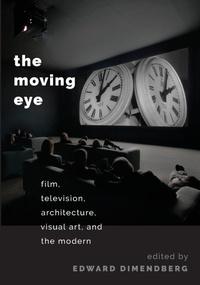
The Moving Eye
Film, Television, Architecture, Visual Art and the Modern
Published on 20. June 2019
Book
Paperback/Softback
184 pages
978-0-19-021844-7 (ISBN)
Description
Once the province of film and media scholars, today the moving image is of broad concern to historians of art and architecture and designers of everything from websites to cities. As museums and galleries devote increasing space to video installations which no longer presuppose a fixed viewer, urban space becomes envisioned and planned through "fly throughs," and technologies such as GPS add data to the experience of travel, moving images have captured the attention of geographers and scholars across the humanities and social sciences. Their practice of "mobility studies" is remaking how we understand a contemporary world in relentless motion. Media theorist and historian Anne Friedberg (1952-2009) was among the first practitioners of visual studies to theorize the experience of vision in motion. Her books have become key points of reference in the discussion of the windows that frame images and the viewers in motion who perceive them. Although widely influential beyond her own discipline, Friedberg's work has never been the subject of an extended study. The Moving Eye: Film, Television, Architecture, Visual Art and the Modern gathers together essays by renowned thinkers in media studies, art history, architecture, and museum studies to consider the rich implications of her work for understanding film and video, new media, visual art, architecture, exhibition design, urban space, and virtual reality. Ranging from early cinema, to works by Le Corbusier, Sergei Eisenstein, Gordon Matta-Clark, and Pierre Huyghe, to theories of the image in motion informed by psychoanalysis, theories of the public sphere, and animal studies, each of the nine essays in the book advances the lines of inquiry commenced by Friedberg.
Reviews / Votes
The best kind of tribute to a lifework's of pathbreaking scholarship, The Moving Eye brings together brilliant essays that develop Anne Friedberg's interdisciplinary approach to cinema, media, architecture, and visual perception. Building on Friedberg's major contributions, this collection shows how her fascination with the history of screens, windows, and virtual mobility has become even more relevant in contemporary digital culture. * Lynn Spigel, Frances E.S Willard Chair of Screen Cultures, Northwestern University * Marvelous, eloquent, and evocative, The Moving Eye takes up the pas de deux of image and envisioning across the domains of film, architecture, photography, and television. Its carefully curated essays offer an intellectually moving tribute to the generative powers of Anne Friedberg's legacy, and a critical interrogation of vision -- and a visual culture -- in motion. * William Uricchio, Professor of Comparative Media Studies, MIT *More details
Language
English
Place of publication
New York
United States
Target group
Professional and scholarly
Dimensions
Height: 254 mm
Width: 178 mm
Thickness: 10 mm
Weight
351 gr
ISBN-13
978-0-19-021844-7 (9780190218447)
Copyright in bibliographic data and cover images is held by Nielsen Book Services Limited or by the publishers or by their respective licensors: all rights reserved.
Schweitzer Classification
Other editions
Additional editions
Book
06/2019
Oxford University Press Inc
€214.00
Shipment within 15-20 days
E-Book
05/2019
1st Edition
OUP eBook
€26.49
Available for download
E-Book
05/2019
1st Edition
OUP eBook
€26.49
Available for download
Person
Edward Dimendberg is Professor of Humanities and European Languages at the University of California, Irvine. He is the principal of Dimendberg Consulting LLC.
Content
Introduction: Edward Dimendberg
Chapter 1. Moving Through Friedberg's Properly Adjusted Virtual Window: Tom Gunning
Chapter 2. Psychoanalysis Discovers Film Theory: Anne Friedberg and Close Up: Christa Bluemlinger
Chapter 3. Nicholas Ray's We Can't Go Home Again: Multiple Windows in a Delirious Time Machine: Patricia Pisters
Chapter 4. The Eisenstein Effect: Architecture and Narrative Montage in Eisenstein and Le Corbusier: Anthony Vidler
Chapter 5. Max Ophuls and Instant Messaging: Reframing Cinema and Publicness: Miriam Hansen
Chapter 6. The Open Box: Umberto Eco, Achille Castiglioni and the Architecture of Television: Sylvia Lavin
Chapter 7. Windows on a Broken World: Gordon Matta-Clark's photographs of public housing in New York: Gwendolyn Owens
Chapter 8. Sites of Screening: Cinema, Museum, and the Art of Projection: Giuliana Bruno
Chapter 9. Humans becoming Animals: On Sensorimotor Affection: Gertrud Koch
Bibliography of Writings by Anne Friedberg
Contributor Biographies
Index
Chapter 1. Moving Through Friedberg's Properly Adjusted Virtual Window: Tom Gunning
Chapter 2. Psychoanalysis Discovers Film Theory: Anne Friedberg and Close Up: Christa Bluemlinger
Chapter 3. Nicholas Ray's We Can't Go Home Again: Multiple Windows in a Delirious Time Machine: Patricia Pisters
Chapter 4. The Eisenstein Effect: Architecture and Narrative Montage in Eisenstein and Le Corbusier: Anthony Vidler
Chapter 5. Max Ophuls and Instant Messaging: Reframing Cinema and Publicness: Miriam Hansen
Chapter 6. The Open Box: Umberto Eco, Achille Castiglioni and the Architecture of Television: Sylvia Lavin
Chapter 7. Windows on a Broken World: Gordon Matta-Clark's photographs of public housing in New York: Gwendolyn Owens
Chapter 8. Sites of Screening: Cinema, Museum, and the Art of Projection: Giuliana Bruno
Chapter 9. Humans becoming Animals: On Sensorimotor Affection: Gertrud Koch
Bibliography of Writings by Anne Friedberg
Contributor Biographies
Index