

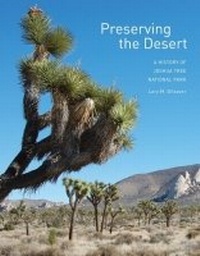
Preserving the Desert
A History of Joshua Tree National Park
Published on 28. February 2017
Book
Paperback/Softback
448 pages
978-1-938086-46-5 (ISBN)
Description
Beginning in 1872 with the establishment of Yellowstone, national parks were set aside to preserve for future generations the most spectacular and inspirational features of the country. The best representative examples were sought out of major ecosystems, such as Yosemite, geologic forms, such as the Grand Canyon, archaeological sites, such as Mesa Verde, and scenes of human events, such as Gettysburg. But one type of habitat-the desert-was overlooked until travel writers and the Automobile Age began to change Americans' perceptions about desert landscapes.
As the National Park Service began to explore the better-known Mojave and Colorado Deserts of southern California during the 1920s for a possible desert park, many agency leaders still held the same negative image of arid lands shared by many Americans-that they are hostile environments and largely useless. But one wealthy woman-Minerva Hamilton Hoyt, from Pasadena-came forward, believing in the value of the desert, and convinced President Franklin D. Roosevelt to establish a national monument that would protect the unique and iconic Joshua trees and other desert flora and fauna. Thus was Joshua Tree National Monument officially established in 1936, and when the area later was expanded in 1994, it became Joshua Tree National Park.
Since 1936 the National Park Service and a growing cadre of environmentalists and recreationalists have fought to block ongoing proposals from miners, ranchers, private landowners, and real estate developers who historically have refused to accept the idea that desert might be suitable for anything other than their consumptive activities. Joshua Tree National Park, even with its often-conflicting land uses, is more popular today than ever, serving more than one million visitors per year who find the desert to be a place worthy of respect and preservation.
As the National Park Service began to explore the better-known Mojave and Colorado Deserts of southern California during the 1920s for a possible desert park, many agency leaders still held the same negative image of arid lands shared by many Americans-that they are hostile environments and largely useless. But one wealthy woman-Minerva Hamilton Hoyt, from Pasadena-came forward, believing in the value of the desert, and convinced President Franklin D. Roosevelt to establish a national monument that would protect the unique and iconic Joshua trees and other desert flora and fauna. Thus was Joshua Tree National Monument officially established in 1936, and when the area later was expanded in 1994, it became Joshua Tree National Park.
Since 1936 the National Park Service and a growing cadre of environmentalists and recreationalists have fought to block ongoing proposals from miners, ranchers, private landowners, and real estate developers who historically have refused to accept the idea that desert might be suitable for anything other than their consumptive activities. Joshua Tree National Park, even with its often-conflicting land uses, is more popular today than ever, serving more than one million visitors per year who find the desert to be a place worthy of respect and preservation.
More details
Language
English
Place of publication
VA
United States
Target group
Professional and scholarly
Illustrations
64 photos, 37 colour and black & white maps, 1 diagram
Dimensions
Height: 229 mm
Width: 178 mm
Thickness: 24 mm
Weight
1027 gr
ISBN-13
978-1-938086-46-5 (9781938086465)
Copyright in bibliographic data and cover images is held by Nielsen Book Services Limited or by the publishers or by their respective licensors: all rights reserved.
Schweitzer Classification
Person
Lary M. Dilsaver is Professor Emeritus of Historical Geography at the University of South Alabama and a thirty-year volunteer researcher for the National Park Service. He has written more than forty articles and book chapters on national parks and historic landscapes, and he has authored or edited six books, including America's National Park System: The Critical Documents and Cumberland Island National Seashore: A History of Conservation Conflict (Virginia).