

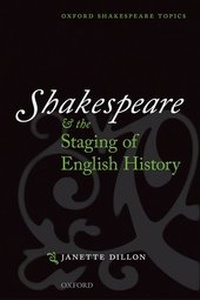
Shakespeare and the Staging of English History
1st Edition
Published on 5. April 2012
Book
Paperback/Softback
160 pages
978-0-19-959315-6 (ISBN)
Description
OXFORD SHAKESPEARE TOPICS
General Editors: Peter Holland and Stanley Wells
Oxford Shakespeare Topics provide students and teachers with short books on important aspects of Shakespeare criticism and scholarship. Each book is written by an authority in its field, and combines accessible style with original discussion of its subject.
This new study of Shakespeare's English history plays looks at the plays through the lens of early modern staging, focusing on the recurrence of particular stage pictures and 'units of action', and seeking to show how these units function in particular and characteristic ways within the history plays. Through close analysis of stage practice and stage picture, the book builds a profile of the kinds of writing and staging that characterise a Shakespearean history play and that differentiate one history play from another.
The first part of the book concentrates primarily on the stage, looking at the 'single' picture or tableau; the use of presenters or choric figures; and the creation of horizontally and vertically divided stage pictures. Later chapters focus more on the body: on how bodies move, gesture, occupy space, and handle objects in particular kinds of scenes. The book concludes by analysing the highly developed use of one crucial stage property, the chair of state, in Shakespeare's last history play, Henry VIII.
Students of Shakespeare often express anxiety about how to read a play as a performance text rather than a non-dramatic literary text. This book aims to dispel that anxiety. It offers readers a way of making sense of plays by looking closely at what happens on stage and breaks down scenes into shorter units so that the building blocks of Shakespeare's historical dramaturgy become visible. By studying the unit of action, how it looks and how that look resembles or differs from the look of other units of action, readers will become familiar with a way of reading that may be applied to other plays, both Shakespearean and non-Shakespearean.
General Editors: Peter Holland and Stanley Wells
Oxford Shakespeare Topics provide students and teachers with short books on important aspects of Shakespeare criticism and scholarship. Each book is written by an authority in its field, and combines accessible style with original discussion of its subject.
This new study of Shakespeare's English history plays looks at the plays through the lens of early modern staging, focusing on the recurrence of particular stage pictures and 'units of action', and seeking to show how these units function in particular and characteristic ways within the history plays. Through close analysis of stage practice and stage picture, the book builds a profile of the kinds of writing and staging that characterise a Shakespearean history play and that differentiate one history play from another.
The first part of the book concentrates primarily on the stage, looking at the 'single' picture or tableau; the use of presenters or choric figures; and the creation of horizontally and vertically divided stage pictures. Later chapters focus more on the body: on how bodies move, gesture, occupy space, and handle objects in particular kinds of scenes. The book concludes by analysing the highly developed use of one crucial stage property, the chair of state, in Shakespeare's last history play, Henry VIII.
Students of Shakespeare often express anxiety about how to read a play as a performance text rather than a non-dramatic literary text. This book aims to dispel that anxiety. It offers readers a way of making sense of plays by looking closely at what happens on stage and breaks down scenes into shorter units so that the building blocks of Shakespeare's historical dramaturgy become visible. By studying the unit of action, how it looks and how that look resembles or differs from the look of other units of action, readers will become familiar with a way of reading that may be applied to other plays, both Shakespearean and non-Shakespearean.
Reviews / Votes
I would recommend this book especially to those who have little access to professional productions of Shakespeare's plays and who find grasping links between page and stage challenging. They shall profit from Dillon's vivid description of stage pcitures, and even if they do not agree with these pictures, the book will stimulate imaginations about alternative probabilities. * Wai Fong Cheang, Comparative Drama * a book eminently suitable for students of performance studies as applied to the early modern theatre. ... This book is a welcome addition to the fascinating topic-led series of books on various important Shakespearean themes published by Oxford University Press. * Brian Schneider, Theatre Research International *More details
Series
Language
English
Place of publication
Oxford
United Kingdom
Target group
College/higher education
Professional and scholarly
Students and scholars of Shakespeare
Dimensions
Height: 203 mm
Width: 133 mm
Thickness: 9 mm
Weight
190 gr
ISBN-13
978-0-19-959315-6 (9780199593156)
Copyright in bibliographic data and cover images is held by Nielsen Book Services Limited or by the publishers or by their respective licensors: all rights reserved.
Schweitzer Classification
Other editions
Additional editions
Janette Dillon
Shakespeare and the Staging of English History
Book
04/2012
1st Edition
Oxford University Press
€131.50
Shipment within 15-20 days
Person
Janette Dillon is Professor of Drama at the University of Nottingham and author of The Language of Space in Court Performance, 1400-1625 (CUP, 2010), The Cambridge Introduction to Shakespeare's Tragedies (CUP, 2007), The Cambridge Introduction to Early English Theatre (CUP, 2006) and numerous other books and articles on medieval and early modern theatre
Content
1. Introduction ; 2. Pageants and Presenters ; 3. Stage picture: the horizontal axis ; 4. Stage Picture: the vertical axis ; 5. Symbolic Objects and the Ceremonial Body ; 6. Bodies and Objects in Domestic Space ; 7. Close-ups ; 8. History and Providence ; 9. The Power of the State ; Notes ; Further Reading ; Index