

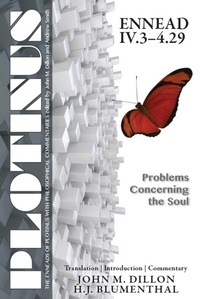
Plotinus Ennead IV.3-4.29
Problems Concerning the Soul
Will be published approx. on 30. March 2015
Book
Paperback/Softback
452 pages
978-1-930972-89-6 (ISBN)
Description
For Plotinus, the nature and status of the human soul is one of the central problems of philosophy. Ennead IV.3-4.29 constitutes his most pene-trating enquiry into this topic, addressing the issues of the relation of the individual soul to the World Soul, the descent of the soul into body, its relations with that body, problems of personal identity and the nature of memory, sense perception, and the true seat of the emotions -many of which still have a resonance today.
The treatise is an excellent example of Plotinus' distinctive method of inquiry: not dogmatic (though he is no skeptic), but worrying away at questions until he has uncovered their complexities to the best of his ability. Such a work requires detailed commentary, such as is provided here, to tease out fully the fascinating convolutions of his thought.
The treatise is an excellent example of Plotinus' distinctive method of inquiry: not dogmatic (though he is no skeptic), but worrying away at questions until he has uncovered their complexities to the best of his ability. Such a work requires detailed commentary, such as is provided here, to tease out fully the fascinating convolutions of his thought.
Reviews / Votes
The soul is the key doctrine in Plotinus, both as a topic and as justification for his methodology. For humans to turn to address the soul is for them to obey the Socratic injunction to 'know thyself'. It is the point of entry into a study that will open to all of reality, insofar as it can be known. As bequeathed from his predecessors Plato and Aristotle, the soul has two functions, to be the principle of life and unity for a body, but also to be a pivot of vision or realization that may turn either up or down"". - Heythrop JournalMore details
Series
Language
English
Place of publication
Las Vegas
United States
Dimensions
Height: 191 mm
Width: 127 mm
Thickness: 25 mm
Weight
522 gr
ISBN-13
978-1-930972-89-6 (9781930972896)
Copyright in bibliographic data and cover images is held by Nielsen Book Services Limited or by the publishers or by their respective licensors: all rights reserved.
Schweitzer Classification
Other editions
Additional editions
E-Book
03/2015
Parmenides Publishing
€50.99
Available for download
Persons
John Dillon is Emeritus Fellow and former Regius Professor of Greek at Trinity College Dublin, Ireland as well as founder and Director Emeritus of the Centre for the Study of the Platonic Trad-ition in Trinity College. He is the author of many books on the history of the Platonic tradition, including The Middle Platonists; Alcinous, The Handbook of Platonism; Iamblichus, De Anima; The Heirs of Plato: A Study of the Old Academy, 347-274 BC; and editor of three collections of essays on Platonism and Christianity and on the platonic heritage. In 2004 he was awarded the Academy Gold Medal in the Humanities by the Royal Irish Academy, and in 2010 he was elected a Corresponding Member of the Academy of Athens.