

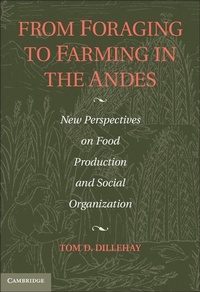
From Foraging to Farming in the Andes
New Perspectives on Food Production and Social Organization
Published on 14. February 2011
Book
Hardback
380 pages
978-1-107-00527-3 (ISBN)
Description
Archeologists have always considered the beginnings of Andean civilization from c.13,000 to 6,000 years ago to be important in terms of the appearance of domesticated plants and animals, social differentiation, and a sedentary lifestyle, but there is more to this period than just these developments. During this period, the spread of crop production and other technologies, kinship-based labor projects, mound-building, and population aggregation formed ever-changing conditions across the Andes. From Foraging to Farming in the Andes proposes a new and more complex model for understanding the transition from hunting and gathering to cultivation. It argues that such developments evolved regionally, were fluid and uneven, and were subject to reversal. This book develops these arguments from a large body of archaeological evidence, collected over 30 years in two valleys in northern Peru, and then places the valleys in the context of recent scholarship studying similar developments around the world.
Reviews / Votes
'... a seminal volume that will be referenced and discussed for decades ... Essential for any anthropologist, archaeologist, or botanist, interested in the origins of New World agriculture or domestic plants, as well as for model-building in this issue worldwide.' David Browman, Choice '[This book] brings us altogether closer to rooting our particular devil out of these emerging details. It will be required reading for those interested in the foundations of Andean civilisation, or indeed the origins of food production worldwide.' David Beresford-Jones, McDonald Institute for Archaeological Research, University of CambridgeMore details
Language
English
Place of publication
Cambridge
United Kingdom
Target group
Professional and scholarly
Illustrations
9 Tables, unspecified; 4 Plates, color; 15 Maps; 96 Halftones, unspecified
Dimensions
Height: 260 mm
Width: 183 mm
Thickness: 25 mm
Weight
915 gr
ISBN-13
978-1-107-00527-3 (9781107005273)
Copyright in bibliographic data and cover images is held by Nielsen Book Services Limited or by the publishers or by their respective licensors: all rights reserved.
Schweitzer Classification
Other editions
New editions
Tom D. Dillehay
From Foraging to Farming in the Andes
New Perspectives on Food Production and Social Organization
Book
10/2014
Cambridge University Press
€85.40
Shipment within 15-20 days
Additional editions
Tom D. Dillehay
From Foraging to Farming in the Andes
New Perspectives on Food Production and Social Organization
Book
10/2014
Cambridge University Press
€85.40
Shipment within 15-20 days
Tom D. Dillehay
From Foraging to Farming in the Andes
New Perspectives on Food Production and Social Organization
E-Book
05/2011
1st Edition
Cambridge University Press
€42.99
Available for download
Tom D. Dillehay
From Foraging to Farming in the Andes
New Perspectives on Food Production and Social Organization
E-Book
02/2011
Cambridge University Press
€35.49
Available for download
Person
Tom D. Dillehay is Rebecca Web Wilson University Professor and Distinguished Professor of Anthropology in the Department of Anthropology at Vanderbilt University. He has conducted numerous archaeological and anthropological projects in Peru, Chile, Argentina, and other South American countries and the United States. He is the author of Monuments, Empires, and Resistance: The Araucanian Polity and Ritual Narratives, as well as numerous other books and articles.
Content
Foreword Peter Kaulicke; 1. Introduction Tom D. Dillehay; 2. Research history, methods, and site types Tom D. Dillehay, Kary Stackelbeck, Jack Rossen and Greg Maggard; 3. Pleistocene and Holocene environments Patricia J. Netherly; 4. El Palto phase Greg Maggard and Tom D. Dillehay; 5. Las Pircas phase Jack Rossen; 6. Tierra Blanca phase Kary Stackelbeck and Tom D. Dillehay; 7. Preceramic mounds and hillside villages Tom D. Dillehay, Patricia J. Netherly and Jack Rossen; 8. Human remains John Verano and Jack Rossen; 9. Preceramic plant use Jack Rossen; 10. Faunal remains Kary Stackelbeck; 11. Material cultures Tom D. Dillehay, Greg Maggard, Jack Rossen and Kary Stackelbeck; 12. Forager and farming land use systems Tom D. Dillehay; 13. From foraging to farming and community development Tom D. Dillehay, Jack Rossen and Kary Stackelbeck; 14. Northern Peruvian early and middle preceramic agriculture in Central and South American context Dolores Piperno; 15. Conclusions Tom D. Dillehay; Appendix 1. Radiocarbon dates from the study area; Appendix 2. Dry forests and biomes of the coastal valleys and lower western slopes of northwestern Peru Patricia J. Netherly; Appendix 3. Stable carbon isotopes Patricia J. Netherly; Appendix 4. Faunal remains from all phases Kary Stackelbeck.