

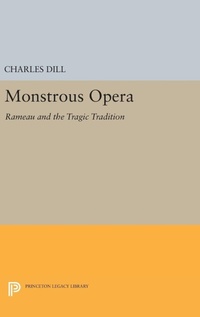
Monstrous Opera
Rameau and the Tragic Tradition
Will be published approx. on 19. April 2016
Book
Hardback
220 pages
978-0-691-63333-6 (ISBN)
Description
One of the foremost composers of the French Baroque operatic tradition, Rameau is often cited for his struggle to steer lyric tragedy away from its strict Lullian form, inspired by spoken tragedy, and toward a more expressive musical style. In this fresh exploration of Rameau's compositional aesthetic, Charles Dill depicts a much more complicated figure: one obsessed with tradition, music theory, his own creative instincts, and the public's expectations of his music. Dill examines the ways Rameau mediated among these often competing values and how he interacted with his critics and with the public. The result is a sophisticated rethinking of Rameau as a musical innovator. In his compositions, Rameau tried to highlight music's potential for dramatic meanings. But his listeners, who understood lyric tragedy to be a poetic rather than musical genre, were generally frustrated by these attempts. In fact, some described Rameau's music as monstrous--using an image of deformity to represent the failure of reason and communication. Dill shows how Rameau answered his critics with rational, theoretical arguments about the role of music in lyric tragedy.
At the same time, however, the composer sought to placate his audiences by substantially revising his musical texts in later performances, sometimes abandoning his most creative ideas. Monstrous Opera illuminates the complexity of Rameau's vision, revealing not only the tensions within the music but also the conflicting desires that drove the man--himself caricatured by his contemporaries as a monster. Originally published in 1998. The Princeton Legacy Library uses the latest print-on-demand technology to again make available previously out-of-print books from the distinguished backlist of Princeton University Press. These editions preserve the original texts of these important books while presenting them in durable paperback and hardcover editions. The goal of the Princeton Legacy Library is to vastly increase access to the rich scholarly heritage found in the thousands of books published by Princeton University Press since its founding in 1905.
At the same time, however, the composer sought to placate his audiences by substantially revising his musical texts in later performances, sometimes abandoning his most creative ideas. Monstrous Opera illuminates the complexity of Rameau's vision, revealing not only the tensions within the music but also the conflicting desires that drove the man--himself caricatured by his contemporaries as a monster. Originally published in 1998. The Princeton Legacy Library uses the latest print-on-demand technology to again make available previously out-of-print books from the distinguished backlist of Princeton University Press. These editions preserve the original texts of these important books while presenting them in durable paperback and hardcover editions. The goal of the Princeton Legacy Library is to vastly increase access to the rich scholarly heritage found in the thousands of books published by Princeton University Press since its founding in 1905.
More details
Series
Language
English
Place of publication
New Jersey
United States
Target group
College/higher education
Professional and scholarly
Product notice
Trade binding
Illustrations
22 music examples
Dimensions
Height: 240 mm
Width: 161 mm
Thickness: 17 mm
Weight
499 gr
ISBN-13
978-0-691-63333-6 (9780691633336)
Copyright in bibliographic data and cover images is held by Nielsen Book Services Limited or by the publishers or by their respective licensors: all rights reserved.
Schweitzer Classification
Other editions
Additional editions
E-Book
07/2014
1st Edition
Princeton University Press
€39.99
Available for download
Person
Charles Dill
Content
Preface ix Abbreviations xvii Chapter 1. Monstrous Opera 3 Chapter 2. Different Tragedies 31 Chapter 3. Rameau's Twins 57 Chapter 4. Rameau Mise-en-Scene 106 Chapter 5. In the Mirror 135 Notes 153 Sources Cited 183 Index 195