

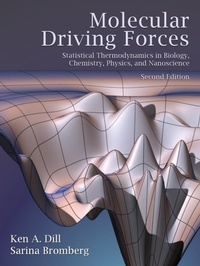
Molecular Driving Forces
Statistical Thermodynamics in Biology, Chemistry, Physics, and Nanoscience
2nd Edition
Published on 21. October 2010
Book
Paperback/Softback
784 pages
978-0-8153-4430-8 (ISBN)
Description
Molecular Driving Forces, Second Edition is an introductory statistical thermodynamics text that describes the principles and forces that drive chemical and biological processes. It demonstrates how the complex behaviors of molecules can result from a few simple physical processes, and how simple models provide surprisingly accurate insights into the workings of the molecular world.
Widely adopted in its First Edition, Molecular Driving Forces is regarded by teachers and students as an accessible textbook that illuminates underlying principles and concepts. The Second Edition includes two brand new chapters: (1) "Microscopic Dynamics" introduces single molecule experiments; and (2) "Molecular Machines" considers how nanoscale machines and engines work. "The Logic of Thermodynamics" has been expanded to its own chapter and now covers heat, work, processes, pathways, and cycles. New practical applications, examples, and end-of-chapter questions are integrated throughout the revised and updated text, exploring topics in biology, environmental and energy science, and nanotechnology. Written in a clear and reader-friendly style, the book provides an excellent introduction to the subject for novices while remaining a valuable resource for experts.
Widely adopted in its First Edition, Molecular Driving Forces is regarded by teachers and students as an accessible textbook that illuminates underlying principles and concepts. The Second Edition includes two brand new chapters: (1) "Microscopic Dynamics" introduces single molecule experiments; and (2) "Molecular Machines" considers how nanoscale machines and engines work. "The Logic of Thermodynamics" has been expanded to its own chapter and now covers heat, work, processes, pathways, and cycles. New practical applications, examples, and end-of-chapter questions are integrated throughout the revised and updated text, exploring topics in biology, environmental and energy science, and nanotechnology. Written in a clear and reader-friendly style, the book provides an excellent introduction to the subject for novices while remaining a valuable resource for experts.
More details
Edition
2nd edition
Language
English
Place of publication
Bosa Roca
United States
Publishing group
Taylor & Francis Inc
Target group
College/higher education
Professional and scholarly
Illustrations
690 s/w Abbildungen
690 Illustrations, black and white
Dimensions
Height: 280 mm
Width: 210 mm
Thickness: 42 mm
Weight
1879 gr
ISBN-13
978-0-8153-4430-8 (9780815344308)
Copyright in bibliographic data and cover images is held by Nielsen Book Services Limited or by the publishers or by their respective licensors: all rights reserved.
Schweitzer Classification
Other editions
Previous edition
Ken Dill | Sarina Bromberg
Molecular Driving Forces
Statistical Thermodynamics in Chemistry, Physics, Biology, and Nanoscience
Book
09/2002
CRC Press
€97.99
Article exhausted; check for reprint
Persons
Ken A. Dill
is Professor of Pharmaceutical Chemistry and Biophysics at the University of California, San Francisco. He received his undergraduate training at MIT, his PhD from the University of California, San Diego, and did postdoctoral work at Stanford. A leading researcher in biopolymer statistical mechanics and protein folding, he has been the President of the Biophysical Society and received the Hans Neurath Award from the Protein Society in 1998.
Sarina Bromberg
received her BFA at the Cooper Union for the Advancement of Science and Art, her PhD in molecular biophysics from Wesleyan University, and her postdoctoral training at the University of California, San Francisco. She writes, edits and illustrates scientific textbooks.
is Professor of Pharmaceutical Chemistry and Biophysics at the University of California, San Francisco. He received his undergraduate training at MIT, his PhD from the University of California, San Diego, and did postdoctoral work at Stanford. A leading researcher in biopolymer statistical mechanics and protein folding, he has been the President of the Biophysical Society and received the Hans Neurath Award from the Protein Society in 1998.
Sarina Bromberg
received her BFA at the Cooper Union for the Advancement of Science and Art, her PhD in molecular biophysics from Wesleyan University, and her postdoctoral training at the University of California, San Francisco. She writes, edits and illustrates scientific textbooks.
Content
1: Principles of Probability
2: Extremum Principles Predict Equilibria
3: Heat, Work & Energy
4: Math Tools: Multivariate Calculus
5: Entropy & the Boltzmann Law
6: Thermodynamic Driving Forces
7: The Logic of Thermodynamics
8: Laboratory Conditions & Free Energies
9: Maxwell's Relations & Mixtures
10: The Boltzman Distribution Law
11: The Statistical Mechanics of Simple Gases & Solids
12: What Is Temperature? What Is Heat Capacity?
13: Chemical Equilibria
14: Equilibria Between Liquids, Solids, & Gases
15: Solutions & Mixtures
16: The Solvation & Transfer of Molecules Between Phases
17: Physical Kinetics: Diffusion, Permeation & Flow
18: Microscopic Dynamics
19: Chemical Kinetics & Transition States
20: Coulomb's Law of Electrostatic Forces
21: The Electrostatic Potential
22: Electrochemical Equilibria
23: Salt Ions Shield Charged Objects in Solution
24: Intermolecular Interactions
25: Phase Transitions
26: Cooperativity: The Hexlix-Coil, Isling & Landau Models
27: Adsorption, Binding & Catalysis
28: Multi-site & Cooperative Ligand Binding
29: Bio & Nano Machines
30: Water
31: Water as a Solvent
32: Polymer Solutions
33: Polymer Elasticity & Collapse
34: Polymers Resist Confinement & Deformation
Appendices
2: Extremum Principles Predict Equilibria
3: Heat, Work & Energy
4: Math Tools: Multivariate Calculus
5: Entropy & the Boltzmann Law
6: Thermodynamic Driving Forces
7: The Logic of Thermodynamics
8: Laboratory Conditions & Free Energies
9: Maxwell's Relations & Mixtures
10: The Boltzman Distribution Law
11: The Statistical Mechanics of Simple Gases & Solids
12: What Is Temperature? What Is Heat Capacity?
13: Chemical Equilibria
14: Equilibria Between Liquids, Solids, & Gases
15: Solutions & Mixtures
16: The Solvation & Transfer of Molecules Between Phases
17: Physical Kinetics: Diffusion, Permeation & Flow
18: Microscopic Dynamics
19: Chemical Kinetics & Transition States
20: Coulomb's Law of Electrostatic Forces
21: The Electrostatic Potential
22: Electrochemical Equilibria
23: Salt Ions Shield Charged Objects in Solution
24: Intermolecular Interactions
25: Phase Transitions
26: Cooperativity: The Hexlix-Coil, Isling & Landau Models
27: Adsorption, Binding & Catalysis
28: Multi-site & Cooperative Ligand Binding
29: Bio & Nano Machines
30: Water
31: Water as a Solvent
32: Polymer Solutions
33: Polymer Elasticity & Collapse
34: Polymers Resist Confinement & Deformation
Appendices