

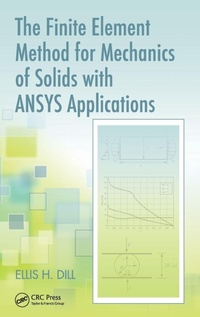
The Finite Element Method for Mechanics of Solids with ANSYS Applications
1st Edition
Published on 25. August 2011
Book
Hardback
508 pages
978-1-4398-4583-7 (ISBN)
Description
While the finite element method (FEM) has become the standard technique used to solve static and dynamic problems associated with structures and machines, ANSYS software has developed into the engineer's software of choice to model and numerically solve those problems.
An invaluable tool to help engineers master and optimize analysis, The Finite Element Method for Mechanics of Solids with ANSYS Applications explains the foundations of FEM in detail, enabling engineers to use it properly to analyze stress and interpret the output of a finite element computer program such as ANSYS.
Illustrating presented theory with a wealth of practical examples, this book covers topics including:
Essential background on solid mechanics (including small- and large-deformation elasticity, plasticity, and viscoelasticity) and mathematics
Advanced finite element theory and associated fundamentals, with examples
Use of ANSYS to derive solutions for problems that deal with vibration, wave propagation, fracture mechanics, plates and shells, and contact
Totally self-contained, this text presents step-by-step instructions on how to use ANSYS Parametric Design Language (APDL) and the ANSYS Workbench to solve problems involving static/dynamic structural analysis (both linear and non-linear) and heat transfer, among other areas. It will quickly become a welcome addition to any engineering library, equally useful to students and experienced engineers alike.
An invaluable tool to help engineers master and optimize analysis, The Finite Element Method for Mechanics of Solids with ANSYS Applications explains the foundations of FEM in detail, enabling engineers to use it properly to analyze stress and interpret the output of a finite element computer program such as ANSYS.
Illustrating presented theory with a wealth of practical examples, this book covers topics including:
Essential background on solid mechanics (including small- and large-deformation elasticity, plasticity, and viscoelasticity) and mathematics
Advanced finite element theory and associated fundamentals, with examples
Use of ANSYS to derive solutions for problems that deal with vibration, wave propagation, fracture mechanics, plates and shells, and contact
Totally self-contained, this text presents step-by-step instructions on how to use ANSYS Parametric Design Language (APDL) and the ANSYS Workbench to solve problems involving static/dynamic structural analysis (both linear and non-linear) and heat transfer, among other areas. It will quickly become a welcome addition to any engineering library, equally useful to students and experienced engineers alike.
Reviews / Votes
"... clearly written and addresses theory and solution of numerous example problems with the ANSYS software, including both ADPL and Workbench modules. ... a useful reference for practicing engineers and scientists in industry and academia."-John D. Clayton, Ph.D., A. James Clark School of Engineering, University of Maryland, College Park, USA
More details
Series
Language
English
Place of publication
Bosa Roca
United States
Publishing group
Taylor & Francis Inc
Target group
College/higher education
First year graduates in mechanical, aerospace, and civil engineering.
Illustrations
213 s/w Abbildungen, 30 s/w Tabellen
30 Tables, black and white; 213 Illustrations, black and white
Dimensions
Height: 240 mm
Width: 161 mm
Thickness: 32 mm
Weight
925 gr
ISBN-13
978-1-4398-4583-7 (9781439845837)
Copyright in bibliographic data and cover images is held by Nielsen Book Services Limited or by the publishers or by their respective licensors: all rights reserved.
Schweitzer Classification
Other editions
Additional editions
E-Book
08/2011
1st Edition
CRC Press
€225.99
Available for download
E-Book
08/2011
CRC Press
€225.99
Available for download
Person
Ellis H. Dill
Content
Finite Element Concepts. Linear Elasticity. Triangular Elements For The Plane Problem. The Four Node Quadrilateral and Other Elements. Plasticity. Viscoelasticity. Dynamic Analysis. Fracture Mechanics. Finite Displacements. Bending of Plates and Shells. Constraints And Contact. Heat Conduction in Elastic Solids. Appendix.