

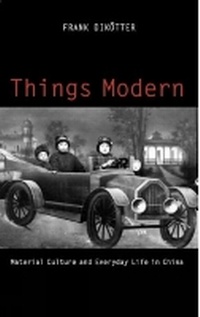
Things Modern
Material Culture and Everyday Life in China
Will be published approx. on 1. November 2006
Book
Hardback
397 pages
978-1-85065-815-3 (ISBN)
Description
How do people relate to things? Much has been written about social movements in modern China, but next to nothing is known about the revolution which transformed the texture of everyday life. This is the first book to map the many changes in the material landscape of China from the mid nineteenth century to the advent of communism in 1949. In the late nineteenth century anything local was increasingly rejected as a signifier of backwardness, while imported goods were embraced as prestige symbols. Modernity had to be brought home to propel the country into the world of 'civilised' nations and join a universal march towards progress. But contrary to other parts of the world, for instance Africa and Latin America, the material goods and technological innovations associated with foreign modernity were not merely imported for elite consumption; they were copied locally and rapidly made available to much larger sections of the population. Debunking the myth of 'hostility toward alien things' which is claimed to have slowed down China's inclusion in the global economy, Dikotter in this richly illustrated book analyses how a very pragmatic attitude towards material goods prevailed, as most consumers bought the new and discarded the old without misgivings. They not only embraced new commodities, but rapidly started producing them for an export market in the twentieth century: cheap goods made in China can be found everywhere today, just as porcelain made in China pervaded the world several centuries ago. If an essential element of a rapidly changing world is the capacity to innovate, could China be more in tune with modernity than Europe?
Reviews / Votes
'Writing as a historian of consumption rather than production, Frank Dikotter,in Things Modern, attacks the myth that the conservative Chinese rejected foreignconsumer goods. On the contrary, he insists, they embraced modernityand consumer goods with extraordinary enthusiasm. ... Dikotter's account ofthe growth of modern consumption in China is vivid, lively and compelling. His descriptions evoke the noise and bustle of Chinese markets and the eye-catching colour of their goods. ... Things Modern is beautifully produced on heavy paper with wide margins.' * Delia Davin, Times Literary Supplement * 'Once again Dikotter reveals himself as an historian with real vision ... this is one of his best books.' * William T. Rowe, Johns Hopkins University *More details
Language
English
Place of publication
London
United Kingdom
Target group
College/higher education
Illustrations
Illustrations
Dimensions
Height: 256 mm
Width: 196 mm
ISBN-13
978-1-85065-815-3 (9781850658153)
Copyright in bibliographic data and cover images is held by Nielsen Book Services Limited or by the publishers or by their respective licensors: all rights reserved.
Schweitzer Classification
Person
Frank Dikotter is Professor of the Modern History of China at SOAS. He is the author of The Discourse of Race in Modern China (1992), Crime, Punishment and the Prison in Modern China (2002), and co-author of Narcotic Culture: A History of Drugs in China (2004).