

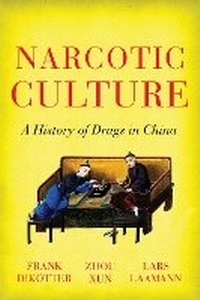
Narcotic Culture
A History of Drugs in China
Published on 5. May 2016
Book
Paperback/Softback
288 pages
978-1-84904-472-1 (ISBN)
Description
To this day, the perception persists that China was a civilisation defeated by imperialist Britain's most desirable trade commodity, opium - a drug that turned the Chinese into cadaverous addicts in the iron grip of dependence. But, as this new edition of Narcotic Culture brilliantly shows, the real scandal in Chinese history was not the expansion of the drug trade by Britain in the early nineteenth century, but rather the failure of the British to grasp the consequences of prohibition. They reveal that opium actually had few harmful effects on either health or longevity; in fact, it was prepared and appreciated in highly complex rituals with inbuilt constraints preventing excessive use. Opium was even used as a medicinal panacea in China before the availability of aspirin and penicillin. But as a result of the British effort to eradicate opium, the Chinese turned from the relatively benign use of that drug to heroin, morphine, cocaine, and countless other psychoactive substances. The transition from a tolerated opium culture to a system of prohibition produced a 'cure' that was far worse than the disease. Delving into a history of drugs and their abuses, Narcotic Culture is part revisionist history of imperial and twentieth-century Britain and part sobering portrait of the dangers of prohibition.
Reviews / Votes
'[An] informative, scholarly and dispassionately fascinating book. ... Narcotic Culture explodes various myths surrounding the use of opium in nineteenth and early twentieth century China.' * Justin Wintle, The Independent *More details
Language
English
Place of publication
London
United Kingdom
Target group
College/higher education
Professional and scholarly
Dimensions
Height: 216 mm
Width: 138 mm
ISBN-13
978-1-84904-472-1 (9781849044721)
Copyright in bibliographic data and cover images is held by Nielsen Book Services Limited or by the publishers or by their respective licensors: all rights reserved.
Schweitzer Classification
Persons
Frank Dikotter is Chair Professor of Humanities at the University of Hong Kong and the author of nine books about the history of China, including Mao's Great Famine, which won the BBC Samuel Johnson Prize for Non- fiction in 2011. Zhou Xun is a research fellow at the University of London's School of Oriental and African Studies. Lars Laamann is a research fellow at the University of London's School of Oriental and African Studies.