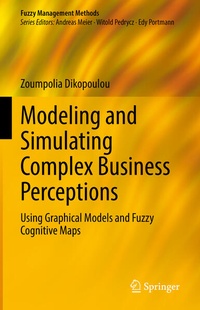
Fuzzy cognitive maps (FCMs) have gained popularity in the scientific community due to their capabilities in modeling and decision making for complex problems.This book presents a novel algorithm called glassoFCM to enable automatic learning of FCM models from data. Specifically, glassoFCM is a combination of two methods, glasso (a technique originated from machine learning) for data modeling and FCM simulation for decision making. The book outlines that glassoFCM elaborates simple, accurate, and more stable models that are easy to interpret and offer meaningful decisions. The research results presented are based on an investigation related to a real-world business intelligence problem to evaluate characteristics that influence employee work readiness.Finally, this book provides readers with a step-by-step guide of the 'fcm' package to execute and visualize their policies and decisions through the FCM simulation process.
Series
Edition
Language
Place of publication
Publishing group
Springer International Publishing
Target group
Professional and scholarly
Illustrations
1 s/w Abbildung, 44 farbige Abbildungen
XXV, 154 p. 45 illus., 44 illus. in color.
Dimensions
Height: 241 mm
Width: 160 mm
Thickness: 16 mm
Weight
ISBN-13
978-3-030-81495-3 (9783030814953)
DOI
10.1007/978-3-030-81496-0
Schweitzer Classification
Dr. Zoumpolia Dikopoulou
received the MSc degree in Computer Science from Ionian University, Corfu, Greece and was awarded with the academic degree of Doctor of Sciences: Computer Science from Hasselt University, Belgium. She is the author and co-author of scientific published papers, books and book chapters. In addition, she is a developer of the 'fcm' package in the R programming language. She has research experience working at various national and European projects and she currently works as a Senior data analyst at the AiDEAS company, Talin, Esthonia under the H2020 EU project. Finally, her research interests are focused on probabilistic graphical models, machine learning, graph theory, fuzzy cognitive maps, decision support systems and aggregation methods.
Chapter 1. Introduction.- Chapter 2. Data Analysis.- Chapter 3. Fuzzy Cognitive Maps.- Chapter 4. Data Modeling.- Chapter 5. Network analysis, accuracy and stability of the job-satisfaction structures.- Chapter 6. The proposed data-driven glassoFCM method.- Chapter 7. Thesis Conclusions.