

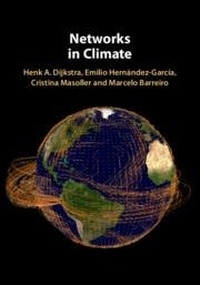
Networks in Climate
Published on 28. February 2019
Book
Hardback
282 pages
978-1-107-11123-3 (ISBN)
Description
Over the last two decades the complex network paradigm has proven to be a fruitful tool for the investigation of complex systems in many areas of science; for example, the Internet, neural networks and social networks. This book provides an overview of applications of network theory to climate variability, such as the El Nino/Southern Oscillation and the Indian Monsoon, presenting recent important results obtained with these techniques and showing their potential for further development and research. The book is aimed at researchers and graduate students in climate science. A basic background in physics and mathematics is required. Several of the methodologies presented here will also be valuable to a broader audience of those interested in network science, for example, from biomedicine, ecology and economics.
More details
Language
English
Place of publication
Cambridge
United Kingdom
Target group
Professional and scholarly
College/higher education
Product notice
sewn/stitched
Cloth over boards
Illustrations
50 Plates, color; 89 Halftones, black and white; 25 Line drawings, black and white
Dimensions
Height: 252 mm
Width: 182 mm
Thickness: 20 mm
Weight
742 gr
ISBN-13
978-1-107-11123-3 (9781107111233)
Copyright in bibliographic data and cover images is held by Nielsen Book Services Limited or by the publishers or by their respective licensors: all rights reserved.
Schweitzer Classification
Other editions
Additional editions
Henk A. Dijkstra
Networks in Climate
E-Book
02/2019
Cambridge University Press
€93.99
Available for download
Henk A. Dijkstra | Emilio Hernandez-garcia | Cristina Masoller
Networks in Climate
E-Book
02/2019
Cambridge University Press
€112.99
Available for download
Persons
Henk A. Dijkstra is a Professor of Dynamical Oceanography at the Institute for Marine and Atmospheric Research within the Department of Physics and Astronomy at the University of Utrecht, The Netherlands. His research focuses mainly on the stability of the ocean circulation and on the physics of climate variability. He is author of the books Nonlinear Physical Oceanography, (Second edition, 2005), Dynamical Oceanography (2008), and Nonlinear Climate Dynamics (Cambridge, 2013). He is a member of the Netherlands Royal Academy of Arts and Sciences (KNAW). He was awarded the Lewis Fry Richardson Medal from the European Geosciences Union in 2005, and he was elected a Fellow of the Society for Industrial and Applied Mathematics (SIAM) in 2009. Emilio Hernandez-Garcia is a research professor at the Institute for Cross-Disciplinary Physics and Complex Systems (IFISC), a joint research center of the Spanish Research Council (CSIC) and the University of the Balearic Islands (UIB) in Mallorca, Spain. His research in complex systems, statistical physics and nonlinear dynamics includes ocean Lagrangian transport and network techniques in biology and the geosciences. He co-authored the book Chemical and Biological Processes in Fluid Flows (2009). Cristina Masoller is an Associate Professor in the Physics Department of the Universitat Politecnica de Catalunya, Spain. Her research interests are interdisciplinary and cover a wide range of topics including neurons, lasers, complex networks, climate and biosignals. Her main research focus in on the development of novel data analysis tools for the study of complex systems (symbolic analysis, complex networks). Specific interests include novel methods for the analysis of climatological data (climate networks) and complexity measures for the classification and characterisation of complex images. In both 2009 and 2015 she received the ICREA Academia Award from the Catalan Institution for Research and Advanced Studies (ICREA). In 2015 she was elected a Fellow of the Optical Society (OSA). Marcelo Barreiro is a Professor of Climate Dynamics at the Institute of Physics of the Universidad de la Republica, Uruguay. His research focuses on large-scale ocean-atmosphere interactions and climate predictability on seasonal to decadal time scales. He received the Edward Lorenz Award from the International Center for Theoretical Physics, Italy in 2009, where he is now an associate.
Content
Preface; Acknowledgments; 1. The climate system; 2. Climate variability; 3. Climate data analysis; 4. Climate networks: construction methods and analysis; 5. Computational tools for network analysis; 6. Applications to atmospheric variability; 7. Applications to oceanic variability; 8. Climate tipping behaviour; 9. Network-based prediction; References; Index.