

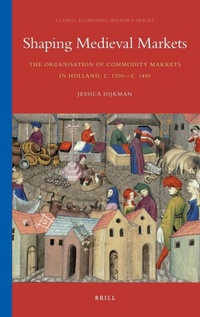
Shaping Medieval Markets
The Organisation of Commodity Markets in Holland, c. 1200 - c. 1450
Published on 11. August 2011
Book
Hardback
464 pages
978-90-04-20148-4 (ISBN)
Description
The late Middle Ages witnessed the transformation of the county of Holland from a peripheral agrarian region to a highly commercialised and urbanised one. This book examines how the organisation of commodity markets contributed to this remarkable development. Comparing Holland to England and Flanders, the book shows that Holland's specific history of reclamation and settlement had given rise to a favourable balance of powers between state, nobility, towns and rural communities that reduced opportunities for rent-seeking and favoured the rise of efficient markets. This allowed burghers, peasants and fishermen to take full advantage of new opportunities presented by changing economic and ecological circumstances in the late fourteenth and early fifteenth centuries.
Reviews / Votes
"[Shaping medieval markets] deepens our understanding of the economy of Holland. But more than that, Dijkman has succeeded in presenting an original and valuable contribution to the ongoing debates on the institutional preconditions for economic growth in the late middle ages and early modern era." - Job Weststrate, in: Economic History Society, Vol. 66, No. 2 (2013), pp. 664-665"[...] Shaping medieval markets [is] een meer dan voorbeeldige studie [...], perfect op het kruispunt van theorie en bron, en een bijzonder inspirerende leidraad voor verder onderzoek naar de oorzaken van economische groei en stagnatie binnen en buiten de Nederlanden." - Jord Hanus, in: Tijdschrift voor Sociale en Economische Geschiedenis / The Low Countries Journal of Social and Economic History (t-seg), Vol. 9, No. 4 (2012), pp. 83-85
More details
Series
Language
English
Place of publication
Leiden
Netherlands
Target group
Professional and scholarly
Product notice
sewn/stitched
Cloth over boards
Illustrations
10 Tables, black and white; 15 Illustrations, black and white
Dimensions
Height: 246 mm
Width: 165 mm
Thickness: 30 mm
Weight
885 gr
ISBN-13
978-90-04-20148-4 (9789004201484)
Copyright in bibliographic data and cover images is held by Nielsen Book Services Limited or by the publishers or by their respective licensors: all rights reserved.
Schweitzer Classification
Person
Jessica Dijkman, Ph.D. (2010) in History, Utrecht University, is a postdoc researcher at the department of Economic and Social History in Utrecht. She publishes on institutions regulating trade and production in the Middle Ages.
Content
List of Tables
List of Illustrations
List of Abbreviations
Preface
1. Introduction
PART I: THE INSTITUTIONAL FRAMEWORK: TRADE VENUES
2. Fairs
3. Rural markets c. 1200 - c. 1350: a late start?
4. New institutions for rural trade (c. 1350 - c. 1450)
5. The Dordrecht staple
PART II: THE INSTITUTIONAL FRAMEWORK: RULES AND PRACTICES
6. Weighing and measuring
7. Contract enforcement
PART III: MARKET PERFORMANCE: QUANTITATIVE TESTS
8. Market integration
9. Market orientation
10. Conclusions
APPENDICES
Appendix A. Survey of fairs
Appendix B. Rural weigh houses in the north of Holland around 1400
Appendix C. Charters of urban liberties
Appendix D. Wheat prices
References
Index
List of Illustrations
List of Abbreviations
Preface
1. Introduction
PART I: THE INSTITUTIONAL FRAMEWORK: TRADE VENUES
2. Fairs
3. Rural markets c. 1200 - c. 1350: a late start?
4. New institutions for rural trade (c. 1350 - c. 1450)
5. The Dordrecht staple
PART II: THE INSTITUTIONAL FRAMEWORK: RULES AND PRACTICES
6. Weighing and measuring
7. Contract enforcement
PART III: MARKET PERFORMANCE: QUANTITATIVE TESTS
8. Market integration
9. Market orientation
10. Conclusions
APPENDICES
Appendix A. Survey of fairs
Appendix B. Rural weigh houses in the north of Holland around 1400
Appendix C. Charters of urban liberties
Appendix D. Wheat prices
References
Index