

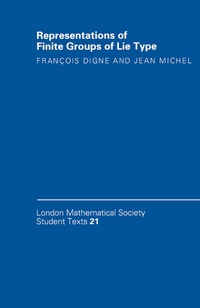
Representations of Finite Groups of Lie Type
Published on 26. April 1991
Book
Paperback/Softback
168 pages
978-0-521-40648-2 (ISBN)
Description
This book is based on a graduate course taught at the University of Paris. The authors aim to treat the basic theory of representations of finite groups of Lie type, such as linear, unitary, orthogonal and symplectic groups. They emphasise the Curtis-Alvis duality map and Mackey's theorem and the results that can be deduced from it. They also discuss Deligne-Lusztig induction. This will be the first elementary treatment of this material in book form and will be welcomed by beginning graduate students in algebra.
Reviews / Votes
"...clearly written, well-organized, and has proofs wherever possible. There are also many examples illustrating the theory." Bhama Srinivasan, Mathematical ReviewsMore details
Series
Language
English
Place of publication
Cambridge
United Kingdom
Target group
Professional and scholarly
Product notice
Paperback (trade)
Illustrations
Worked examples or Exercises
Dimensions
Height: 234 mm
Width: 157 mm
Thickness: 17 mm
Weight
368 gr
ISBN-13
978-0-521-40648-2 (9780521406482)
Copyright in bibliographic data and cover images is held by Nielsen Book Services Limited or by the publishers or by their respective licensors: all rights reserved.
Schweitzer Classification
Other editions
New editions
Francois Digne | Jean Michel
Representations of Finite Groups of Lie Type
Book
03/2020
2nd Edition
Cambridge University Press
€60.00
Shipment within 15-20 days
Additional editions
Francois Digne | Jean Michel
Representations of Finite Groups of Lie Type
E-Book
07/2013
1st Edition
Cambridge University Press
€43.99
Available for download
Persons
Content
Background results; 1. Bruhat decomposition; 2. Reduced subgroups of maximal rank, centralisers and semisimple elements; 3. Rationality, Frobenius maps, Lang's theorem; 4. Generalized induction associated with a bimodule; 5. Mackey's theorem; 6. Harish-Chandra theory; Complements on RGL; 7. Duality of characters; 8. Steinberg characters; l-adic cohomology; 9. Deligne-Lusztig induction; 10. Character formulae and their complements in Deligne-Lusztig induction; 11. Geometric conjugation, Lusztig series.