

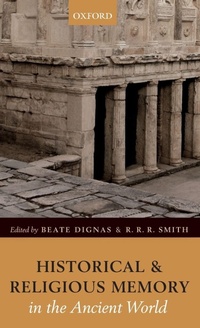
Historical and Religious Memory in the Ancient World
1st Edition
Published on 15. March 2012
Book
Hardback
360 pages
978-0-19-957206-9 (ISBN)
Description
Historical and Religious Memory in the Ancient World examines how religious and historical memory was fashioned, distorted, preserved, or erased in ancient societies - and what wide-ranging effects these actions had on the historical process. The volume is interested in how memory intersects with and shapes religious traditions and cultural identities. Its twelve case studies explore different aspects of the memory layers that make up ancient history (social, religious, cultural), and looks at how these layers are represented and refracted in different contexts of the written and material remains of antiquity. The process has its beginnings in the dim pasts of ancient communities, and continues in the later Greek and Roman periods where our most articulate ancient evidence lies. It is a process that continues, in a different way, in contemporary scholarship which draws on selected evidence and a variety of contrasting representations.
The three parts of the book vary the lens through which the impact of religious and cultural memory can be grasped. Part I looks at the commemoration of religious tradition in the context of cultural interaction - Greek, Roman, Jewish, and Christian. Part II focuses on how religious identities are defined and how homogenous-looking cultures engage in elaborate selective dialogue with their own past. In Part III, contested versions of the past are interpreted in studies of Roman historiography and of religiously motivated behaviour in late antique Asia Minor.
This interdisciplinary book highlights and celebrates the work of Simon Price, an important thinker and pioneer in this kind of wider historical research in ancient cultures and religions.
The three parts of the book vary the lens through which the impact of religious and cultural memory can be grasped. Part I looks at the commemoration of religious tradition in the context of cultural interaction - Greek, Roman, Jewish, and Christian. Part II focuses on how religious identities are defined and how homogenous-looking cultures engage in elaborate selective dialogue with their own past. In Part III, contested versions of the past are interpreted in studies of Roman historiography and of religiously motivated behaviour in late antique Asia Minor.
This interdisciplinary book highlights and celebrates the work of Simon Price, an important thinker and pioneer in this kind of wider historical research in ancient cultures and religions.
Reviews / Votes
Wide-ranging, yet tightly interrelated, the papers collected in this volume are a fi tting tribute to the scholarship of Dr Simon Price * David Saunders, Journal of Lady Margaret Hall, Oxford *More details
Language
English
Place of publication
Oxford
United Kingdom
Target group
College/higher education
For academics and students interested in the study of ancient history, archaeology, and classical and early religious studies.
Illustrations
52 in text illustrations
Dimensions
Height: 222 mm
Width: 145 mm
Thickness: 23 mm
Weight
584 gr
ISBN-13
978-0-19-957206-9 (9780199572069)
Copyright in bibliographic data and cover images is held by Nielsen Book Services Limited or by the publishers or by their respective licensors: all rights reserved.
Schweitzer Classification
Persons
Beate Dignas is Fellow and Tutor in Ancient History at Somerville College and Lecturer in Ancient History at Trinity College, Oxford University.
R. R. R. Smith is Lincoln Professor of Classical Archaeology and Art at Oxford University, and was elected Fellow of the British Academy in 2010.
R. R. R. Smith is Lincoln Professor of Classical Archaeology and Art at Oxford University, and was elected Fellow of the British Academy in 2010.
Content
PREFACE; LIST OF ILLUSTRATIONS; LIST OF CONTRIBUTORS; PART I: RELIGIOUS PASTS AND RELIGIOUS PRESENT; PART II: DEFINING RELIGIOUS IDENTITY; PART III : COMMEMORATING AND ERASING THE PAST