

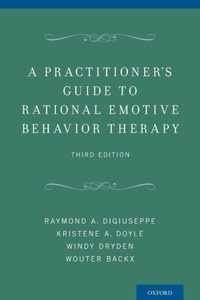
A Practitioner's Guide to Rational-Emotive Behavior Therapy
3rd Edition
Published on 15. August 2013
Book
Paperback/Softback
416 pages
978-0-19-974304-9 (ISBN)
Description
Extensively updated to include clinical findings over the last two decades, this third edition of A Practitioner's Guide to Rational-Emotive Behavior Therapy reviews the philosophy, theory, and clinical practice of Rational Emotive Behavior Therapy (REBT). This model is based on the work of Albert Ellis, who had an enormous influence on the field of psychotherapy over his 50 years of practice and scholarly writing.
Designed for both therapists-in-training and seasoned professionals, this practical treatment manual and guide introduces the basic principles of rational-emotive behavior therapy, explains general therapeutic strategies, and offers many illustrative dialogues between therapist and patient. The volume breaks down each stage of therapy to present the exact procedures and skills therapists need, and numerous case studies illustrate how to use these skills. The authors describe both technical and specific strategic interventions, and they stress taking an integrative approach. The importance of building a therapeutic alliance and the use of cognitive, emotive, evocative, imaginal, and behavioral interventions serves as the unifying theme of the approach. Intervention models are presented for the treatment of anxiety, depression, trauma, anger, personality disorders, and addictions. Psychologists, clinical social workers, mental health counselors, psychotherapists, and students and trainees in these areas will find this book useful in learning to apply rational-emotive behavior therapy in practice.
Designed for both therapists-in-training and seasoned professionals, this practical treatment manual and guide introduces the basic principles of rational-emotive behavior therapy, explains general therapeutic strategies, and offers many illustrative dialogues between therapist and patient. The volume breaks down each stage of therapy to present the exact procedures and skills therapists need, and numerous case studies illustrate how to use these skills. The authors describe both technical and specific strategic interventions, and they stress taking an integrative approach. The importance of building a therapeutic alliance and the use of cognitive, emotive, evocative, imaginal, and behavioral interventions serves as the unifying theme of the approach. Intervention models are presented for the treatment of anxiety, depression, trauma, anger, personality disorders, and addictions. Psychologists, clinical social workers, mental health counselors, psychotherapists, and students and trainees in these areas will find this book useful in learning to apply rational-emotive behavior therapy in practice.
Reviews / Votes
With its step-by-step approach and many clinical examples, this excellent book is extremely practical, providing clinicians with many therapeutic tools. It should be in the libraries of practitioners interested in cognitive-behavioral type therapies. * Gary B. Kaniuk, Doody's Notes * Full of useful therapeutic guidance * Journal of critical psychology, counselling & psychotherapy *More details
Edition
3rd Revised edition
Language
English
Place of publication
New York
United States
Target group
Professional and scholarly
Edition type
Revised edition
Dimensions
Height: 234 mm
Width: 156 mm
Thickness: 25 mm
Weight
698 gr
ISBN-13
978-0-19-974304-9 (9780199743049)
Copyright in bibliographic data and cover images is held by Nielsen Book Services Limited or by the publishers or by their respective licensors: all rights reserved.
Schweitzer Classification
Other editions
Additional editions
Raymond A. Digiuseppe | Kristene A. Doyle | Windy Dryden
A Practitioner's Guide to Rational Emotive Behavior Therapy
E-Book
07/2013
3rd Edition
OUP eBook
€73.99
Available for download
Persons
Raymond A. DiGiuseppe, PhD, is Professor and Chair of Psychology at St. John's University in New York City. He is also on the professional training faculty at the Albert Ellis Institute and is President-Elect of the Division of Psychotherapy of the American Psychological Association.
Kristene A. Doyle, PhD, is the Director of the Albert Ellis Institute in New York City and an Adjunct Professor of Psychology at St. John's University.
Windy Dryden, PhD, is Professor of Psychotherapeutic Studies at Goldsmiths, University of London.
Wouter Backx, drs Psych, is Founder and Director of the Dutch Institute for REBT in The Netherlands.
Kristene A. Doyle, PhD, is the Director of the Albert Ellis Institute in New York City and an Adjunct Professor of Psychology at St. John's University.
Windy Dryden, PhD, is Professor of Psychotherapeutic Studies at Goldsmiths, University of London.
Wouter Backx, drs Psych, is Founder and Director of the Dutch Institute for REBT in The Netherlands.
Author
Professor and Chair of PsychologyProfessor and Chair of Psychology, St. John's University, New York, New York State, USA
DirectorDirector, Albert Ellis Institute, New York, New York, USA
Professor of Psychotherapuetic StudiesProfessor of Psychotherapuetic Studies, Goldsmiths University, London, UK
Founder and DirectorFounder and Director, Dutch Institute for REBT, Tillburg, The Netherlands
Content
Foreword to the Second Edition by Albert Ellis ; Preface ; About the Authors ; Part I Basic Introduction to REBT ; 1. Albert Ellis and the Philosophy of REBT ; 2. Rational-Emotive Behavior Theory ; 3. The Irrational and Rational Beliefs ; Part II General Therapeutic Strategies ; 4. The A-B-C Model and Teaching Clients the B to C Connection ; 5. Getting Therapy Off to a Good Start ; 6. Basic Therapy Skills ; Part III The A-B-C's of REBT: Assessment ; 7. Identifying the A ; 8. The C: The Emotional and Behavioral Consequences ; 9. Assessing the B ; Part IV Therapy: Getting Down to D - Disputation, and E -the New Effective Response ; 10. Cognitive Change Strategies ; 11. Challenges to Specific Irrational Beliefs ; 12. The Effective New Belief (EB) ; 13. Evocative, Imaginal, and Behavior Change Strategies ; 14. Problems and Solutions in Challenging Irrational Beliefs ; 15. Therapeutic Styles: the How not the What in Disputing Beliefs Using an Active Directive Style ; Part V The Therapeutic Whole ; 16. Homework Assignments ; 17. Comprehensive Rational-Emotive Behavior Therapy ; 18. The Course of Therapy and Beyond ; Appendix ; References ; Index