

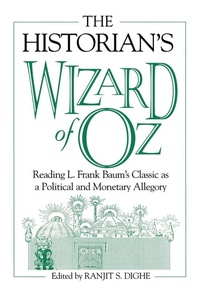
The Historian's Wizard of Oz
Reading L. Frank Baum's Classic as a Political and Monetary Allegory
Published on 30. June 2002
Book
Paperback/Softback
180 pages
978-0-275-97419-0 (ISBN)
Description
The Historian's Wizard of Oz synthesizes four decades of scholarly interpretations of L. Frank Baum's classic children's novel as an allegory of the Gilded Age political economy and a comment on the gold standard. The heart of the book is an annotated version of The Wizard of Oz that highlights the possible political and monetary symbolism in the book by relating characters, settings, and incidents in it to the historical events and figures of the 1890s, the decade in which Baum wrote his story. Dighe simultaneously values the leading political interpretations of Oz as useful and creative teaching tools, and consolidates them in a sympathetic fashion; yet he rejects the commonly held, and by now well-debunked, view that those interpretations reflect Baum's likely motivations in writing the book. The result is a unique way for readers to acquaint themselves with a classic of children's literature that is a bit different and darker than the better-known film version.
Students of history and economics will find two great stories: the dramatic rise and fall of monetary populism and William Jennings Bryan and the original rendering of a childhood story that they know and love. This study draws on several worthy versions of the Oz-as-Populist-parable thesis, but it also separates the reading of Baum's book in this manner from Baum's original intentions. Despite an incongruence with Baum's intent, reading the story as a parable continues to provide a remarkable window into the historical events of the 1890s and, thus, constitutes a tremendous teaching tool for historians, economists, and political scientists. Dighe also includes a primer on gold, silver, and the American monetary system, as well as a brief history of the Populist movement.
Students of history and economics will find two great stories: the dramatic rise and fall of monetary populism and William Jennings Bryan and the original rendering of a childhood story that they know and love. This study draws on several worthy versions of the Oz-as-Populist-parable thesis, but it also separates the reading of Baum's book in this manner from Baum's original intentions. Despite an incongruence with Baum's intent, reading the story as a parable continues to provide a remarkable window into the historical events of the 1890s and, thus, constitutes a tremendous teaching tool for historians, economists, and political scientists. Dighe also includes a primer on gold, silver, and the American monetary system, as well as a brief history of the Populist movement.
Reviews / Votes
[e]ven though the story does not really work all that well as an allegory, the allegory works well as a tool for teaching the history. * Science Fiction Studies * [a] useful resource for Oz scholars and teachers, with its helpful historical background information, bibliographic references, selection of contemporary images, and excellent overview of academia's Populist-parable theory. * Utopian Studies * [A] very useful and engaging book that introduces and explains the context under which Baum's book was written and provides some of the basis for the economic and political interpretations that have emerged over the years. The wonderful Wizard of OZ can be read for pure delight by a child or alternatively can become part of a scholarly debate over the events and significance of economic and public policy- a testimony to the power of words and the importance of metaphors to understanding complex relationships. For students and teachers, for novice and seasoned scholars alike, I heartily recommend Dighe's interesting and entertaining book. * EH.Net book Review *More details
Language
English
Place of publication
United States
Publishing group
Bloomsbury Publishing Plc
Target group
College/higher education
Professional and scholarly
Interest Age: From 7 to 17 years
Dimensions
Height: 229 mm
Width: 152 mm
Thickness: 11 mm
Weight
270 gr
ISBN-13
978-0-275-97419-0 (9780275974190)
Copyright in bibliographic data and cover images is held by Nielsen Book Services Limited or by the publishers or by their respective licensors: all rights reserved.
Schweitzer Classification
Person
RANJIT S. DIGHE is Assistant Professor of Economics at the State University of New York at Oswego. His specialty is American macroeconomic history, and he has written extensively on American labor markets between the world wars.
Content
Preface
Introduction: The Colors of Money
"If I Only Had a Brain": A Primer on Gold, Silver, and the American Monetary System
"Populism Will Put Them to Sleep": A Shory History of the Populist Movement of the 1890s
L. Frank Baum's The Wonderful Wizard of Oz, With Annotations
Appendix A: Another Fiat-Money Metaphor, From The Marvelous Land of Oz
Appendix B: William Jennings Bryan's "Cross of Gold" Speech
Appendix C: The Quantity Theory of Money
Bibliography
Index
Introduction: The Colors of Money
"If I Only Had a Brain": A Primer on Gold, Silver, and the American Monetary System
"Populism Will Put Them to Sleep": A Shory History of the Populist Movement of the 1890s
L. Frank Baum's The Wonderful Wizard of Oz, With Annotations
Appendix A: Another Fiat-Money Metaphor, From The Marvelous Land of Oz
Appendix B: William Jennings Bryan's "Cross of Gold" Speech
Appendix C: The Quantity Theory of Money
Bibliography
Index