

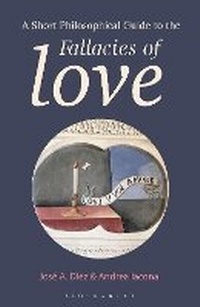
A Short Philosophical Guide to the Fallacies of Love
Published on 10. December 2020
Book
Hardback
152 pages
978-1-350-14090-5 (ISBN)
Description
What can epistemology tell us about love? Here two philosophers use their training in arguments and reasoning to uncover the role of ungrounded beliefs when we fall in love.
This not a self-help book, it is a philosophy book. Free of advice, methods and strategies for being successful in love, it does not offer solutions for problems. What it gives us instead is a reading of love as it actually is. The authors illustrate the fallacies of love by drawing on personal experiences, literary characters and imaginary individuals. They provide examples of ungrounded beliefs in Aesop's Fables, Cinderella and Don Giovanni amongst others, and illustrate love as an inexhaustible source of misperceptions, misunderstandings and misconceptions.
By tackling those characteristic and all-too familiar ways in which ungrounded love beliefs arise, the book forces us to question why baseless beliefs are maintained and reinforced, showing us that many love beliefs are built on anything but logic.
This not a self-help book, it is a philosophy book. Free of advice, methods and strategies for being successful in love, it does not offer solutions for problems. What it gives us instead is a reading of love as it actually is. The authors illustrate the fallacies of love by drawing on personal experiences, literary characters and imaginary individuals. They provide examples of ungrounded beliefs in Aesop's Fables, Cinderella and Don Giovanni amongst others, and illustrate love as an inexhaustible source of misperceptions, misunderstandings and misconceptions.
By tackling those characteristic and all-too familiar ways in which ungrounded love beliefs arise, the book forces us to question why baseless beliefs are maintained and reinforced, showing us that many love beliefs are built on anything but logic.
Reviews / Votes
[A Short Philosophical Guide to Fallacies of Love] would be useful for anyone who wants to explore the intersection of informal logic, epistemology and love. * Teaching Philosophy * Love is one of the strongest emotions we experience, and it is a key driver of our actions. Love makes us write poetry, compose sonatas, and climb mountains, and can drive us to despair, up to the point where we kill in jealous rage. If you have ever wondered how we come to know about love - our own and others' - and whether the feelings that drive our actions are justified, then this is the book for you. Diez and Iacona offer an authoritative discussion of the epistemology of love and provide a compelling analysis of its fallacies. It's a must-read both for novices and veterans in matters of love. * Roman Frigg, Professor of Philosophy, London School of Economics and Political Science, UK * Love is the object of libraries of books, many of which bemoan or celebrate its illusions, follies and deceptions en bloc. Diez and Iacona, on the other hand, itemize, for the first time, the main forms of the illusions to which love is heir. Each is clearly described, anatomized and illustrated. Few readers will fail to experience the shock or click of recognition on reading one or more of these portraits. They neither preach nor praise. They simply describe, one after another, the different illusions of lovers and the beloved. They write lucidly. The philosophical distinctions they employ are introduced with a light touch and deftly deployed. Their book is for everyone interested in understanding one of the most important parts of life - but perhaps not for lovers. * Kevin Mulligan, Honorary Professor of Analytic Philosophy, University of Geneva, Switzerland * It is said that people don't pay much attention to philosophy because philosophy doesn't pay much attention to people. Fallacies of Love is a rare example of philosophers giving what we care about its due, setting analytic acumen to work on real-life ways we all fall into traps in affairs of the heart. * Richard Davies, Professor of Philosophy, University of Bergamo, Italy * Acute and stylishly written, this book is one of the best I have ever read on love. Diez and Iacona's elucidation of love's epistemology is interesting and illuminating. Their book opens up fresh perspectives and it is sure to become a reference point in future debates of this topic * Vera Tripodi, Adjunct Professor, University of Turin, Italy * Diez and Iacona's book is a fun-to-read inquiry into one of the most common sources of misjudgments: love. Although poets and thinkers have considered the fallacies of love, the idea of the authors of fathoming love's misguiding nature through the means of analytic epistemology is new, entertaining and instructing. * Giuliano Torrengo, Associate Professor of Philosophy, University of Milan, Italy * A provocative, enlightening and entertaining book. Through vivid and amusing examples, Diez and Icona use the tools of logic and epistemology to deconstruct the myth of romantic love, which has always been a tool of social control and a powerful anaesthetic. * Eulalia Perez Sedeno Professor of Science, Technology and Society, Spanish Center for Science and Research, Spain *More details
Language
English
Place of publication
London
United Kingdom
Publishing group
Bloomsbury Publishing PLC
Target group
College/higher education
Dimensions
Height: 198 mm
Width: 129 mm
Weight
272 gr
ISBN-13
978-1-350-14090-5 (9781350140905)
Copyright in bibliographic data and cover images is held by Nielsen Book Services Limited or by the publishers or by their respective licensors: all rights reserved.
Schweitzer Classification
Persons
Jose A. Diez is Professor in the Department of Logic, History and Philosophy of Science at the University of Barcelona, Spain.
Andrea Iacona is Professor of Logic in the Department of Philosophy and Education at the University of Turin, Italy.
Andrea Iacona is Professor of Logic in the Department of Philosophy and Education at the University of Turin, Italy.
Content
Chapter 1: Basic Ideas about Love
What we talk about when we talk about love
Some fundamental properties of love
Truth, justification, and knowledge
The fallacies of love
Sex, gender, and stereotypes
Some final remarks
Chapter 2: The Invention of Reasons
Rationalization
The you-you fallacy
The virtue fallacy
Purported sour grapes
Lost love's labours
Inference to the worst explanation
Chapter 3: The Power of Desire over Belief
The glasses of love
Belief without evidence
Evidence without belief
Love is blind
The diamond fallacy
Chapter 4: Wanting it all
Complex cases of cognitive mistakes
The divided lover
The princess
The Don Juan
The emotional terrorizer
Chapter 5: When Love Goes Away
The end of love
The sunk costs fallacy
The sweet lemons fallacy
Inertia and uncertainty
Desamor
Index
What we talk about when we talk about love
Some fundamental properties of love
Truth, justification, and knowledge
The fallacies of love
Sex, gender, and stereotypes
Some final remarks
Chapter 2: The Invention of Reasons
Rationalization
The you-you fallacy
The virtue fallacy
Purported sour grapes
Lost love's labours
Inference to the worst explanation
Chapter 3: The Power of Desire over Belief
The glasses of love
Belief without evidence
Evidence without belief
Love is blind
The diamond fallacy
Chapter 4: Wanting it all
Complex cases of cognitive mistakes
The divided lover
The princess
The Don Juan
The emotional terrorizer
Chapter 5: When Love Goes Away
The end of love
The sunk costs fallacy
The sweet lemons fallacy
Inertia and uncertainty
Desamor
Index