

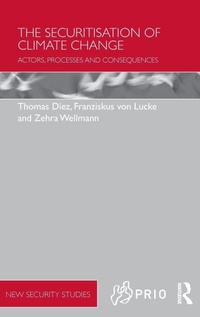
The Securitisation of Climate Change
Actors, Processes and Consequences
1st Edition
Published on 10. May 2016
Book
Hardback
206 pages
978-1-138-95634-6 (ISBN)
Description
This book provides the first systematic comparative analysis of climate security discourses.
It analyses the securitisation of climate change in four different countries: USA, Germany, Turkey, and Mexico. The empirical analysis traces how specific climate-security discourses have become dominant, which actors have driven this process, what political consequences this has had and what role the broader context has played in enabling these specific securitisations. In doing so, the book outlines a new and systematic theoretical framework that distinguishes between different referent objects of securitisation (territorial, individual and planetary) and between a security and risk dimension. It thereby clarifies the ever-increasing literature on different forms of securitisation and the relationship between security, risk and politics. Whereas securitisation studies have traditionally focused on either a single country case study or a global overview, consequently failing to reconstruct detailed securitisation dynamics, this is the first book to provide a systematic comparative analysis of climate security discourses in four countries and thus closes an empirical gap in the present literature. In addition, this comparative framework allows the drawing of conclusions about the conditions for and consequences of successful securitisation based on empirical and comparative analysis rather than theoretical debate only.
This book will of interest to students of climate change, environmental studies, critical security, global governance, and IR in general.
It analyses the securitisation of climate change in four different countries: USA, Germany, Turkey, and Mexico. The empirical analysis traces how specific climate-security discourses have become dominant, which actors have driven this process, what political consequences this has had and what role the broader context has played in enabling these specific securitisations. In doing so, the book outlines a new and systematic theoretical framework that distinguishes between different referent objects of securitisation (territorial, individual and planetary) and between a security and risk dimension. It thereby clarifies the ever-increasing literature on different forms of securitisation and the relationship between security, risk and politics. Whereas securitisation studies have traditionally focused on either a single country case study or a global overview, consequently failing to reconstruct detailed securitisation dynamics, this is the first book to provide a systematic comparative analysis of climate security discourses in four countries and thus closes an empirical gap in the present literature. In addition, this comparative framework allows the drawing of conclusions about the conditions for and consequences of successful securitisation based on empirical and comparative analysis rather than theoretical debate only.
This book will of interest to students of climate change, environmental studies, critical security, global governance, and IR in general.
Reviews / Votes
'The Securitisation of Climate Change is a welcome and important contribution to the literature. The authors provide detailed empirical analysis of the way securitisation practices play out in a range of national settings, and make the important point that the different forms of linking climate change and security are crucial to the types of practices securitisation encourages. In the process, this book not only provides much needed empirical depth and theoretical nuance to literature on climate security, it also makes a broader contribution to debates about the construction of security- and the normative implications of this construction- in international relations.' -- Matt McDonald, University of Queensland, Australia'In addressing the great challenge of our time, The Securitisation of Climate Change brings unprecedented analytical sensitivity, nuance and breadth to the politics of climate change. Reflecting the fascinating diversity of securitizations exposed in their comparative study, the authors compellingly advance the conceptual and ethical frontiers of securitization theory.' -- Stefan Elbe, University of Sussex, UK
'The Securitisation of Climate Change is a great read for anyone seeking to understand how and why climate change gets connected to ideas of security. Cross-country comparisons provide a sophisticated look at the variation in ways that climate change-security links are made by actors in different political, economic and social contexts. The authors provide some much-needed depth to existing debates while remaining accessible to readers.' -- Nicole Detraz, University of Memphis, USA
More details
Series
Language
English
Place of publication
London
United Kingdom
Publishing group
Taylor & Francis Ltd
Target group
College/higher education
Illustrations
5 s/w Zeichnungen, 2 s/w Tabellen
2 Tables, black and white; 5 Line drawings, black and white
Dimensions
Height: 240 mm
Width: 161 mm
Thickness: 17 mm
Weight
508 gr
ISBN-13
978-1-138-95634-6 (9781138956346)
Copyright in bibliographic data and cover images is held by Nielsen Book Services Limited or by the publishers or by their respective licensors: all rights reserved.
Schweitzer Classification
Other editions
Additional editions
Thomas Diez | Franziskus von Lucke | Zehra Wellmann
The Securitisation of Climate Change
Actors, Processes and Consequences
Book
05/2016
1st Edition
Routledge
€65.00
Shipment within 10-20 days
Thomas Diez | Franziskus von Lucke | Zehra Wellmann
The Securitisation of Climate Change
Actors, Processes and Consequences
E-Book
04/2016
Routledge
€65.99
Available for download
Thomas Diez | Franziskus von Lucke | Zehra Wellmann
The Securitisation of Climate Change
Actors, Processes and Consequences
E-Book
04/2016
Routledge
€65.99
Available for download
Persons
Thomas Diez is Professor of Political Science and International Relations at the University of Tuebingen, Germany. He is author/editor of numerous books, including, most recently, A Different Kind of Power? The EU's Role in International Politics (2014).
Franziskus von Lucke is Researcher in the Department of Political Science at the University of Tuebingen, Germany.
Zehra Wellmann is Researcher in the Department of Political Science at the University of Tuebingen, Germany.
Franziskus von Lucke is Researcher in the Department of Political Science at the University of Tuebingen, Germany.
Zehra Wellmann is Researcher in the Department of Political Science at the University of Tuebingen, Germany.
Content
1 Introduction
2 Analysing climate security discourses
3 The United States: climate change as danger to the state
4 Germany: ambivalent forerunner in individual security
5 Mexico: A case of politicised securitisation?
6 Turkey: no climate for change?
7 Conclusion: the politics of securitising climate change
2 Analysing climate security discourses
3 The United States: climate change as danger to the state
4 Germany: ambivalent forerunner in individual security
5 Mexico: A case of politicised securitisation?
6 Turkey: no climate for change?
7 Conclusion: the politics of securitising climate change