

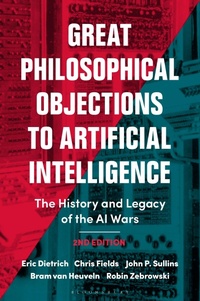
Great Philosophical Objections to Artificial Intelligence
The History and Legacy of the AI Wars
2nd Edition
Will be published approx. on 8. January 2026
Book
Paperback/Softback
376 pages
978-1-350-49941-6 (ISBN)
Description
An entertaining introduction to the clashes between philosophy and AI over the last 70 years, from claims and counter-claims about the ability to implement consciousness, to arguments about cognitive architecture and ChatGPT.
Now updated to include the latest developments in AI, this is an exploration of the most famous philosophical arguments against building a machine with human-level intelligence. The arguments are organized into four central AI wars, showing how the debate that played out between the philosophers, AI scientists and engineers building AI systems.
Here is your guide to the major philosophical questions and attacks AI has received throughout its history. Packed with fresh insights and supporting material, this second edition features new content on:
- Language Learning Models (LLMs) and the existence of generative AI
- Sustainable AI and its ability to regulate our climate
- The theoretical, ethical and legislative issues around 'computational creativity'
- The uncanny valley effect and its potential consequences for AI
Are we on the brink of a new AI War? This introduction is for anyone looking to understand the debates that have shaped the philosophy of AI and the arguments that will define its future. It shows us what AI has been doing since its invention in the 1950s - pointing us back, repeatedly, to the philosophical questions humans have always faced: questions about knowledge, meaning, and how we should behave toward each other and toward the rest of the world.
Now updated to include the latest developments in AI, this is an exploration of the most famous philosophical arguments against building a machine with human-level intelligence. The arguments are organized into four central AI wars, showing how the debate that played out between the philosophers, AI scientists and engineers building AI systems.
Here is your guide to the major philosophical questions and attacks AI has received throughout its history. Packed with fresh insights and supporting material, this second edition features new content on:
- Language Learning Models (LLMs) and the existence of generative AI
- Sustainable AI and its ability to regulate our climate
- The theoretical, ethical and legislative issues around 'computational creativity'
- The uncanny valley effect and its potential consequences for AI
Are we on the brink of a new AI War? This introduction is for anyone looking to understand the debates that have shaped the philosophy of AI and the arguments that will define its future. It shows us what AI has been doing since its invention in the 1950s - pointing us back, repeatedly, to the philosophical questions humans have always faced: questions about knowledge, meaning, and how we should behave toward each other and toward the rest of the world.
More details
Edition
2nd edition
Language
English
Place of publication
London
United Kingdom
Publishing group
Bloomsbury Publishing PLC
Dimensions
Height: 233 mm
Width: 154 mm
Thickness: 22 mm
Weight
726 gr
ISBN-13
978-1-350-49941-6 (9781350499416)
Copyright in bibliographic data and cover images is held by Nielsen Book Services Limited or by the publishers or by their respective licensors: all rights reserved.
Schweitzer Classification
Other editions
Additional editions
Eric Dietrich | Chris Fields | John P. Sullins
Great Philosophical Objections to Artificial Intelligence
The History and Legacy of the Ai Wars
E-Book
12/2025
2nd Edition
Bloomsbury Academic
€27.49
Available for download
Eric Dietrich | Chris Fields | John P. Sullins
Great Philosophical Objections to Artificial Intelligence
The History and Legacy of the Ai Wars
E-Book
12/2025
2nd Edition
Bloomsbury Academic
€27.49
Available for download
Persons
Eric Dietrich is Professor of Philosophy of Binghamton University, USA.
Chris Fields is an independent scholar based in France.
John P. Sullins is Professor of Philosophy at Sonoma State University, USA.
Bram Van Heuveln is Lecturer in the Cognitive Science Department at Rensselaer Polytechnic Institute, USA.
Robin Zebrowski is Associate Professor of Cognitive Science, Chair of the Program in Cognitive Science, Beloit College, USA
Chris Fields is an independent scholar based in France.
John P. Sullins is Professor of Philosophy at Sonoma State University, USA.
Bram Van Heuveln is Lecturer in the Cognitive Science Department at Rensselaer Polytechnic Institute, USA.
Robin Zebrowski is Associate Professor of Cognitive Science, Chair of the Program in Cognitive Science, Beloit College, USA
Content
List of Figures
Prologue: The AI Wars and Beyond
Part I. The AI Wars
Introduction
The First War: Is AI Even Possible?
1. Goedel and Foundational Objections to AI
2. How Would We Know If a Computer Was Intelligent? The Turing Test is Not the Answer
The Second War: Architectures of the Mind
3. How Computer Science Saved the Mind
4. Implementing an Intelligence
The Third War: Mental Semantics and Mental Symbols
5. The Strange Case of the Missing Meaning: Can Computers Think About Things?
The Fourth War: The Frame Problem: Rationality and Creativity
6. What is Relevant to What?: The Frame Problem
Part II. Beyond the AI Wars: Issues for Today
Introduction
7. What about Consciousness?
8. Ethical Issues Surrounding AI Applications
9. Could Embodied AIs be Ethical Agents
Part III The "New AI": Generative Models Reignite Old Controversies
Introduction: Why is the "New AI" Surprising?
10 . Representation and Semantics in Large Language Models
11 . Have LLMs Changed the Debate about Consciousness?
12 Sustainability: the New Ethical Issue Raised by Generative AI
Conclusion: Whither the AI Wars?
Notes
Bibliography
Index
Prologue: The AI Wars and Beyond
Part I. The AI Wars
Introduction
The First War: Is AI Even Possible?
1. Goedel and Foundational Objections to AI
2. How Would We Know If a Computer Was Intelligent? The Turing Test is Not the Answer
The Second War: Architectures of the Mind
3. How Computer Science Saved the Mind
4. Implementing an Intelligence
The Third War: Mental Semantics and Mental Symbols
5. The Strange Case of the Missing Meaning: Can Computers Think About Things?
The Fourth War: The Frame Problem: Rationality and Creativity
6. What is Relevant to What?: The Frame Problem
Part II. Beyond the AI Wars: Issues for Today
Introduction
7. What about Consciousness?
8. Ethical Issues Surrounding AI Applications
9. Could Embodied AIs be Ethical Agents
Part III The "New AI": Generative Models Reignite Old Controversies
Introduction: Why is the "New AI" Surprising?
10 . Representation and Semantics in Large Language Models
11 . Have LLMs Changed the Debate about Consciousness?
12 Sustainability: the New Ethical Issue Raised by Generative AI
Conclusion: Whither the AI Wars?
Notes
Bibliography
Index