

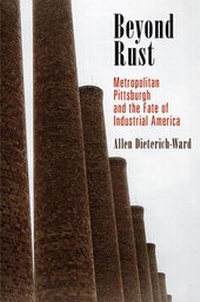
Beyond Rust
Metropolitan Pittsburgh and the Fate of Industrial America
Published on 11. December 2015
Book
Hardback
360 pages
978-0-8122-4767-1 (ISBN)
Description
Beyond Rust chronicles the rise, fall, and rebirth of metropolitan Pittsburgh, an industrial region that once formed the heart of the world's steel production and is now touted as a model for reviving other hard-hit cities of the Rust Belt. Writing in clear and engaging prose, historian and area native Allen Dieterich-Ward provides a new model for a truly metropolitan history that integrates the urban core with its regional hinterland of satellite cities, white-collar suburbs, mill towns, and rural mining areas.
Pittsburgh reached its industrial heyday between 1880 and 1920, as vertically integrated industrial corporations forged a regional community in the mountainous Upper Ohio River Valley. Over subsequent decades, metropolitan population growth slowed as mining and manufacturing employment declined. Faced with economic and environmental disaster in the 1930s, Pittsburgh's business elite and political leaders developed an ambitious program of pollution control and infrastructure development. The public-private partnership behind the "Pittsburgh Renaissance," as advocates called it, pursued nothing less than the selective erasure of the existing social and physical environment in favor of a modernist, functionally divided landscape: a goal that was widely copied by other aging cities and one that has important ramifications for the broader national story. Ultimately, the Renaissance vision of downtown skyscrapers, sleek suburban research campuses, and bucolic regional parks resulted in an uneven transformation that tore the urban fabric while leaving deindustrializing river valleys and impoverished coal towns isolated from areas of postwar growth.
Beyond Rust is among the first books of its kind to continue past the collapse of American manufacturing in the 1980s by exploring the diverse ways residents of an iconic industrial region sought places for themselves within a new economic order.
Pittsburgh reached its industrial heyday between 1880 and 1920, as vertically integrated industrial corporations forged a regional community in the mountainous Upper Ohio River Valley. Over subsequent decades, metropolitan population growth slowed as mining and manufacturing employment declined. Faced with economic and environmental disaster in the 1930s, Pittsburgh's business elite and political leaders developed an ambitious program of pollution control and infrastructure development. The public-private partnership behind the "Pittsburgh Renaissance," as advocates called it, pursued nothing less than the selective erasure of the existing social and physical environment in favor of a modernist, functionally divided landscape: a goal that was widely copied by other aging cities and one that has important ramifications for the broader national story. Ultimately, the Renaissance vision of downtown skyscrapers, sleek suburban research campuses, and bucolic regional parks resulted in an uneven transformation that tore the urban fabric while leaving deindustrializing river valleys and impoverished coal towns isolated from areas of postwar growth.
Beyond Rust is among the first books of its kind to continue past the collapse of American manufacturing in the 1980s by exploring the diverse ways residents of an iconic industrial region sought places for themselves within a new economic order.
Reviews / Votes
"Beyond Rust nails it: From building the all-consuming steel industry to its rebirth after decades of economic and environmental disintegration, Pittsburgh has always been in a cycle of transformation. Allen Dieterich-Ward's important book tracks the innovative methods-as well as the tragic missteps-of leaders who developed a mix of public-private partnerships, historic preservation, and collaboration with universities and foundations to create a model twenty-first-century city, which is still evolving."-Pittsburgh Mayor Bill Peduto "In Beyond Rust, Allen Dieterich-Ward captures the essence of major economic redevelopment strategies devised at the local level in response to the decline of basic industry after World War II. It is refreshing to read such clear and vivid prose about structural shifts in the political economy of American cities. This book will inform policy discussions about sprawl and regional development and make early twenty-first-century regional landscapes more legible."-Andrew Hurley, University of Missouri "The twentieth-century story of metropolitan Pittsburgh is fascinating and instructive, and nowhere is it told as completely as Dieterich-Ward has done here."-David Stradling, University of CincinnatiMore details
Series
Language
English
Place of publication
Pennsylvania
United States
Target group
College/higher education
Professional and scholarly
US School Grade: College Graduate Student
Illustrations
17 illus.
Dimensions
Height: 229 mm
Width: 152 mm
ISBN-13
978-0-8122-4767-1 (9780812247671)
Copyright in bibliographic data and cover images is held by Nielsen Book Services Limited or by the publishers or by their respective licensors: all rights reserved.
Schweitzer Classification
Other editions
Additional editions
E-Book
10/2015
1st Edition
University of Pennsylvania Press
€33.99
Available for download
Person
Allen Dieterich-Ward is Associate Professor of History at Shippensburg University.
Content
Prologue
Introduction. The City and Its Region
PART I. THE STEEL VALLEY
Chapter 1. Building the Region
Chapter 2. Mines and Mills
Chapter 3. The Pittsburgh Story
PART II. A REGION OF CONTRASTS
Chapter 4. Live on the Hills and Work in the City
Chapter 5. We're Appalachia, But We Don't Need to Be
Chapter 6. The New Metropolis of the Plateau
Chapter 7. No Development Beyond This Point
PART III. POSTINDUSTRIAL PITTSBURGH
Chapter 8. Rust Belt and Roboburgh
Chapter 9. Burbs of the 'Burgh
Chapter 10. Rivers of Steel
Epilogue
Sources
Notes
Index
Acknowledgments
Introduction. The City and Its Region
PART I. THE STEEL VALLEY
Chapter 1. Building the Region
Chapter 2. Mines and Mills
Chapter 3. The Pittsburgh Story
PART II. A REGION OF CONTRASTS
Chapter 4. Live on the Hills and Work in the City
Chapter 5. We're Appalachia, But We Don't Need to Be
Chapter 6. The New Metropolis of the Plateau
Chapter 7. No Development Beyond This Point
PART III. POSTINDUSTRIAL PITTSBURGH
Chapter 8. Rust Belt and Roboburgh
Chapter 9. Burbs of the 'Burgh
Chapter 10. Rivers of Steel
Epilogue
Sources
Notes
Index
Acknowledgments