

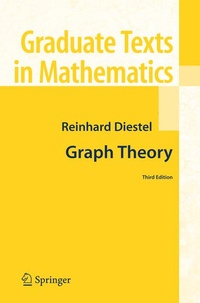
Graph Theory
Description
The third edition of this standard textbook of modern graph theory has been carefully revised, updated, and substantially extended. Covering all its major recent developments, Graph Theory can be used both as a reliable textbook for an introductory course and as a graduate text: on each topic it covers all the basic material in full detail, and adds one or two deeper results (again with detailed proofs) to illustrate the more advanced methods of that field.
Reviews / Votes
Graph Theory is a very well-written book, now in its third edition and the recipient of the according evolutionary benefits. It succeeds dramatically in its aims, which Diestel gives as "[providing] a reliable first introduction to graph theory that can be used for personal study or as a course text, [and] a graduate text that offers some depth in selected areas." ... Even the pictures and drawings are nice. This is a hell of a good book!
MAA, Reviews
More details
Other editions
New editions
Additional editions
Previous edition
Content
Preface
1: The Basics
1.1 Graphs*
1.2 The degree of a vertex*
1.3 Paths and cycles*
1.4 Connectivity*
1.5 Trees and forests*
1.6 Bipartite graphs*
1 7 Contraction and minors*
1.8 Euler tours*
1.9 Some linear algebra
1.10 Other notions of graphs
Exercises
Notes
2: Matching, Covering and Packing
2.1 Matching in bipartite graphs*
2.2 Matching in general graphs(*)
2.3 Packing and covering
2.4 Tree-packing and arboricity
2.5 Path covers
Exercises
Notes
3: Connectivity
3.1 2-Connected graphs and subgraphs*
3.2 The structure of 3-connected graphs(*)
3.3 Menger's theorem*
3.4 Mader's theorem
3.5 Linking pairs of vertices(*)
Exercises
Notes
4: Planar Graphs
4.1 Topological prerequisites*
4.2 Plane graphs*
4.3 Drawings
4.4 Planar graphs: Kuratowski's theorem*
4.5 Algebraic planarity criteria
4.6 Plane duality
Exercises
Notes
5: Colouring
5.1 Colouring maps and planar graphs*
5.2 Colouring vertices*
5.3 Colouring edges*
5.4 List colouring
5.5 Perfect graphs
Exercises
Notes
6: Flows
6.1 Circulations(*)
6.2 Flows in networks*
6.3 Group-valued flows
6.4 k-Flows for small k
6.5 Flow-colouring duality
6.6 Tutte's flow conjectures
Exercises
Notes
7: Extremal Graph Theory
7.1 Subgraphs*
7.2 Minors(*)
7.3 Hadwiger's conjecture*
7.4 Szemerédi's regularity lemma
7.5 Applying the regularity lemma
Exercises
Notes
8: Infinite Graphs
8.1 Basic notions, facts and techniques*
8.2 Paths, trees, and ends(*)
8.3 Homogeneous and universal graphs*
8.4 Connectivity and matching
8.5 The topological end space
Exercises
Notes
9: Ramsey Theory for Graphs
9.1 Ramsey's original theorems*
9.2 Ramsey numbers(*)
9.3 Induced Ramsey theorems
9.4 Ramsey properties and connectivity(*)
Exercises
Notes
10: Hamilton Cycles
10.1 Simple sufficient conditions*
10.2 Hamilton cycles and degree sequences*
10.3 Hamilton cycles in the square of a graph
Exercises
Notes
11: Random Graphs
11.1 The notion of a random graph*
11.2 The probabilistic method*
11.3 Properties of almost all graphs*
1 1.4 Threshold functions and second moments
Exercises
Notes
12: Minors, Trees and WQO
12.1 Well-quasi-ordering*
12.2 The graph minor theorem for trees*
12.3 Tree-decompositions
12.4 Tree-width and forbidden minors
12.5 The graph minor theorem(*)
Exercises
Notes
A. Infinite sets
B. Surfaces
Hints for all the exercises
Index
Symbol index
* Sections marked by an asterisk are recommended for a first course. Of sections marked (*), the beginning is recommended for a first course.