

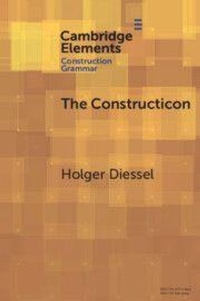
The Constructicon
Taxonomies and Networks
Published on 22. June 2023
Book
Paperback/Softback
102 pages
978-1-009-32781-7 (ISBN)
Description
It is one of the central claims of construction grammar that constructions are organized in some kind of network, commonly referred to as the constructicon. In the classical model of construction grammar, developed by Berkeley linguists in the 1990s, the constructicon is an inheritance network of taxonomically related grammatical patterns. However, recent research in usage-based linguistics has expanded the classical inheritance model into a multidimensional network approach in which constructions are interrelated by multiple types of associations. The multidimensional network approach challenges longstanding assumptions of linguistic research and calls for a reorganization of the constructivist approach. This Element describes how the conception of the constructicon has changed in recent years and elaborates on some central claims of the multidimensional network approach.
Reviews / Votes
'[An] excellent guide to current thinking about cognitive representations in usage-based construction grammar that brings it into much stronger, though incomplete alignment with connectionist / neural network models of cognition.' Ellena Moriarty, LINGUIST ListMore details
Series
Language
English
Place of publication
Cambridge
United Kingdom
Product notice
Paperback (trade)
Illustrations
Worked examples or Exercises
Dimensions
Height: 229 mm
Width: 152 mm
Thickness: 5 mm
Weight
145 gr
ISBN-13
978-1-009-32781-7 (9781009327817)
Copyright in bibliographic data and cover images is held by Nielsen Book Services Limited or by the publishers or by their respective licensors: all rights reserved.
Schweitzer Classification
Other editions
Additional editions
E-Book
06/2023
Cambridge University Press
€20.99
Available for download
Person
Content
1. Introduction; 2. From taxonomies to networks; 3. Constructions as networks; 4. Syntactic categories as networks; 5. The global network: paradigms, families and neighborhoods; 6. Concluding remarks.