

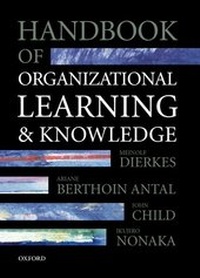
Handbook of Organizational Learning and Knowledge
Published on 2. August 2001
Book
Hardback
1006 pages
978-0-19-829583-9 (ISBN)
Description
In an era of far-reaching changes, issues of Organizational Learning are high on the agenda of social scientists, managers and consultants worldwide as they seek to adapt to new environments. The Handbook of Organizational Learning and Knowledge provides a comprehensive overview of how the concept of Organizational Learning emerged, how it has been used and debated, and where it may be going. It summarizes the state of the art and provides a full account of the diverse approaches, themes, issues, and debates of the field.
The handbook unites a distinguished team of international authors, who examine both the central themes and emerging issues. The coverage extends beyond the American tradition to include the experiences of Europe, Asia and the Middle East. The book opens with chapters drawing insights from various social science approaches. The following Sections examine fundamental issues concerning the external triggers, factors and conditions, agents, and processes of Organizational Learning. Subsequent chapters review the subject within a global context, looking in particular at inter-organizational collaboration. The next sections examine the development of learning practices and provides case studies to illustrate Organizational Learning and knowledge creation. The book concludes with an analysis of the state of the art and an agenda for the future.
This handbook will be an invaluable reference tool for scholars and students in the social sciences, as well as for professionals involved in organizational development, learning, and change.
The handbook unites a distinguished team of international authors, who examine both the central themes and emerging issues. The coverage extends beyond the American tradition to include the experiences of Europe, Asia and the Middle East. The book opens with chapters drawing insights from various social science approaches. The following Sections examine fundamental issues concerning the external triggers, factors and conditions, agents, and processes of Organizational Learning. Subsequent chapters review the subject within a global context, looking in particular at inter-organizational collaboration. The next sections examine the development of learning practices and provides case studies to illustrate Organizational Learning and knowledge creation. The book concludes with an analysis of the state of the art and an agenda for the future.
This handbook will be an invaluable reference tool for scholars and students in the social sciences, as well as for professionals involved in organizational development, learning, and change.
Reviews / Votes
`handsomely produced.'Journal of General Management `the Handbook is strong on theory and surveys of the literature in the field. A good number of chapters stand out as both excellent and illuminating here.'
Journal of General Management, Vol.27, No.2 `am impressive work of scholarship and teamwork'
Journal of General Management, Vol.27, No.2
More details
Language
English
Place of publication
Oxford
United Kingdom
Target group
Professional and scholarly
Illustrations
numerous figures and tables
Dimensions
Height: 257 mm
Width: 177 mm
Thickness: 55 mm
Weight
1592 gr
ISBN-13
978-0-19-829583-9 (9780198295839)
Copyright in bibliographic data and cover images is held by Nielsen Book Services Limited or by the publishers or by their respective licensors: all rights reserved.
Schweitzer Classification
Other editions
Additional editions
Meinolf Dierkes | Ariane Berthoin Antal | John Child
Handbook of Organizational Learning and Knowledge
Book
03/2003
Oxford University Press
€159.50
Shipment within 15-20 days
Persons
Meinolf Dierkes is Director of the Organization and Technology Research Unit at the Wissenschaftszentrum Berlin fuer Sozialforschung (WZB). In addition, he is Professor of the Sociology of Science and Technology at the Technische Universitaet, Berlin Visiting Professor at the Haas School of Business Administration, University of California, Berkeley and Specially Invited Research Professor at the Shanghai Academy of Social Sciences.
Professor Ariane Berthoin Antal is Program Leader in Organizational Learning at the Wissenschaftszentrum Berlin fuer Sozialforschung (WZB). Previously she served as the Founding Director of the Ashridge International Institute for Organizational Change in France. She remains an associate of Ashridge and is a visiting lecturer at the Leipzig Graduate School of Business, as well as at the Technical University of Berlin.
John Child is Chair of Commerce at the University of Birmingham. During his career in both industry and academia, Professor Child has taught in the UK, Europe, Hong Kong, and China. He was appointed Professor of Organisational Behaviour at Aston University in 1973, and, in 1986 became Dean of the newly-founded Aston Business School. In 1989, he was appointed Dean and Director of the China-European Community Management Centre in Beijing, with which he had been connected since 1985. In 1991, he took up the position of Diageo Professor of Management Studies at the University of Cambridge. He is author or co-author of 16 books including Strategies of Cooperation (OUP, 1998) and The Management of International Acquisitions (OUP, forthcoming).
Ikujiro Nonaka is Professor at the Graduate School of International Corporate Strategy, Hitotsubashi University, and Founding Dean of the Graduate School of Knowledge Science at Japan Advanced Institute of Science and Technology (JAIST). He is a senior editor of Organization Science, an international journal of the Institute of Management Science. From 1991 to 1995, he was a research group director of the National Institute of Science and Technology Policy (NISTEP). Nonaka is the Xerox Distinguished Professor of Knowledge at the Haas School of Business, University of California at Berkeley. His books include The Knowledge-Creating Company (OUP, 1995), which was awarded Best Book of the Year in Business and Management by the Association of American Publishers Professional and Scholarly Publishing Division, and more recently Enabling Knowledge Creation (OUP, 2000).
Professor Ariane Berthoin Antal is Program Leader in Organizational Learning at the Wissenschaftszentrum Berlin fuer Sozialforschung (WZB). Previously she served as the Founding Director of the Ashridge International Institute for Organizational Change in France. She remains an associate of Ashridge and is a visiting lecturer at the Leipzig Graduate School of Business, as well as at the Technical University of Berlin.
John Child is Chair of Commerce at the University of Birmingham. During his career in both industry and academia, Professor Child has taught in the UK, Europe, Hong Kong, and China. He was appointed Professor of Organisational Behaviour at Aston University in 1973, and, in 1986 became Dean of the newly-founded Aston Business School. In 1989, he was appointed Dean and Director of the China-European Community Management Centre in Beijing, with which he had been connected since 1985. In 1991, he took up the position of Diageo Professor of Management Studies at the University of Cambridge. He is author or co-author of 16 books including Strategies of Cooperation (OUP, 1998) and The Management of International Acquisitions (OUP, forthcoming).
Ikujiro Nonaka is Professor at the Graduate School of International Corporate Strategy, Hitotsubashi University, and Founding Dean of the Graduate School of Knowledge Science at Japan Advanced Institute of Science and Technology (JAIST). He is a senior editor of Organization Science, an international journal of the Institute of Management Science. From 1991 to 1995, he was a research group director of the National Institute of Science and Technology Policy (NISTEP). Nonaka is the Xerox Distinguished Professor of Knowledge at the Haas School of Business, University of California at Berkeley. His books include The Knowledge-Creating Company (OUP, 1995), which was awarded Best Book of the Year in Business and Management by the Association of American Publishers Professional and Scholarly Publishing Division, and more recently Enabling Knowledge Creation (OUP, 2000).
Editor
Director of the Organization and Technology Research UnitDirector of the Organization and Technology Research Unit, Wissenschaftszentrum Berlin fur Sozialforschung (WZB)
Program Leader in Organizational LearningProgram Leader in Organizational Learning, Wissenschaftszentrum Berlin fur Sozialforschung (WZB)
Chair of Commerce, University of Birmingham; Distinguished Visiting Professor, Chinese Management CentreChair of Commerce, University of Birmingham; Distinguished Visiting Professor, Chinese Management Centre, University of Hong Kong
Professor in the Graduate School of International Corporate Strategy, Hitotsubashi University, and Professor of KnowledgeProfessor in the Graduate School of International Corporate Strategy, Hitotsubashi University, and Professor of Knowledge, University of California, Berkeley
Content
PART I: INSIGHTS FROM MAJOR SOCIAL SCIENCE DISCIPLINES; PART II: EXTERNAL TRIGGERS FOR LEARNING; PART III: FACTORS AND CONDITIONS SHAPING ORGANIZATIONAL LEARNING; PART IV: AGENTS OF ORGANIZATIONAL LEARNING; PART V: PROCESSES OF ORGANIZATIONAL LEARNING AND KNOWLEDGE CREATION; PART V: PROCESSES OF ORGANIZATIONAL LEARNING AND KNOWLEDGE GLOBAL CONTEXT; PART VII: DEVELOPING LEARNING PRACTICES; PART VIII: PUTTING KNOWLEDGE INTO PRACTICE; PART IX: CONCLUSION