

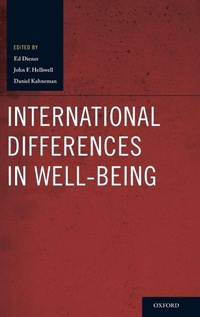
International Differences in Well-Being
Published on 29. April 2010
Book
Hardback
512 pages
978-0-19-973273-9 (ISBN)
Description
This book draws together the latest work from scholars around the world using subjective well-being data to understand and compare well-being across countries and cultures. Starting from many different vantage points, the authors reached a consensus that many measures of subjective well-being, ranging from life evaluations through emotional states, based on memories and current evaluations, merit broader collection and analysis. Using data from the Gallup World Poll, the World Values Survey, and other internationally comparable surveys, the authors document wide divergences among countries in all measures of subjective well-being, The international differences are greater for life evaluations than for emotions. Despite the well-documented differences in the ways in which subjective evaluations change through time and across cultures, the bulk of the very large international differences in life evaluations are due to differences in life circumstances rather than differences in the way these differences are evaluated.
Reviews / Votes
"...chapters in this book will motivate researchers to construe their scientific findings in avariety of ways...This book is highly recommended to anyone hoping to pursue research on well-being in an international context or planning to analyze international survey databases." --PsycCRITIQUES
More details
Series
Language
English
Place of publication
New York
United States
Target group
Professional and scholarly
The primary audiences will include students, researchers, and policy-makers in the fields of national and international development. With respect to the disciplines most likely to find the book relevant for teaching, the top candidates would be economics, psychology, political science and sociology, especially those courses with an international comparative focus. Scholars who might find the book interesting are those in economics, policy studies, psychology, culture, and political science, and especially those interested in 1. governance, 2. economic development, 3. well-being.
Dimensions
Height: 240 mm
Width: 161 mm
Thickness: 32 mm
Weight
922 gr
ISBN-13
978-0-19-973273-9 (9780199732739)
Copyright in bibliographic data and cover images is held by Nielsen Book Services Limited or by the publishers or by their respective licensors: all rights reserved.
Schweitzer Classification
Other editions
Additional editions
Ed Diener | Daniel Kahneman | John Helliwell
International Differences in Well-Being
E-Book
03/2010
1st Edition
OUP eBook
€53.99
Available for download
Ed Diener | Daniel Kahneman | John Helliwell
International Differences in Well-Being
E-Book
03/2010
1st Edition
OUP eBook
€53.99
Available for download
Persons
ED: Joseph R. Smiley Distinguished Professor of Psychology at the University of Illinois, and currently the president of IPPA, the International Positive Psychology Association (2008 & 2009).DK: Nobel Prize winner (2002, Economic Science), and Senior Scholar at the Woodrow Wilson School of Public and International Affairs. He is also Professor of Psychology and Public Affairs Emeritus at the Woodrow Wilson School, the Eugene Higgins Professor of Psychology Emeritus at Princeton University, and a fellow of the Center for Rationality at the Hebrew University in Jerusalem.JH: Arthur J.E. Child Foundation Fellow of the Canadian Institute for Advanced Research, and Professor Emeritus of Economics, University of British Columbia
Content
Introduction
Part I Measuring Well-Being in an International Context
Chapter 1: Diener, Kahneman, Tov and Arora
Chapter 2: Kahneman, Schkade, Fischler, Krueger and Krilla
Chapter 3: Oishi
Chapter 4: Kapteyn, Smith and van Soest
Chapter 5: Deaton, Fortson and Tortora
Part II International Comparisons of Income and Well-Being through Time
Chapter 6: Layard, Mayraz and Nickell
Chapter 7: Easterlin and Sawangfa
Chapter 8: Di Tella and MacCulloch
Chapter 9: Graham, Chattopadhyay and Picon
Part III International Differences in the Social Context of Well-Being
Chapter 10: Helliwell, Barrington-Leigh, Harris and Huang
Chapter 11: Veenhoven
Chapter 12: Inglehart
Chapter 13: Harter and Arora
Chapter 14: Clark
Part I Measuring Well-Being in an International Context
Chapter 1: Diener, Kahneman, Tov and Arora
Chapter 2: Kahneman, Schkade, Fischler, Krueger and Krilla
Chapter 3: Oishi
Chapter 4: Kapteyn, Smith and van Soest
Chapter 5: Deaton, Fortson and Tortora
Part II International Comparisons of Income and Well-Being through Time
Chapter 6: Layard, Mayraz and Nickell
Chapter 7: Easterlin and Sawangfa
Chapter 8: Di Tella and MacCulloch
Chapter 9: Graham, Chattopadhyay and Picon
Part III International Differences in the Social Context of Well-Being
Chapter 10: Helliwell, Barrington-Leigh, Harris and Huang
Chapter 11: Veenhoven
Chapter 12: Inglehart
Chapter 13: Harter and Arora
Chapter 14: Clark