

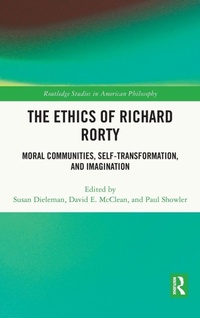
The Ethics of Richard Rorty
Moral Communities, Self-Transformation, and Imagination
1st Edition
Published on 6. May 2022
Book
Hardback
224 pages
978-1-032-07489-4 (ISBN)
Description
This book contains diverse and critical reflections on Richard Rorty's contributions to ethics, an aspect of his thought that has been relatively neglected. Together, they demonstrate that Rorty offers a compelling and coherent ethical vision. The book's chapters, grouped thematically, explore Rorty's emphasis on the importance of moral imagination, social relations, language, and literature as instrumental for ethical self-transformation, as well as for strengthening what Rorty called "social hope," which entails constant work toward a more democratic, inclusive, and cosmopolitan society and world.
Several contributors address the ethical implications of Rorty's commitment to a vision of political liberalism without philosophical foundations. Others offer critical examinations of Rorty's claim that our private or individual projects of self-creation can or should be held apart from our public goals of ameliorating social conditions and reducing cruelty and suffering. Some contributors explore hurdles that impede the practical applications of certain of Rorty's ideas.
The Ethics of Richard Rorty will appeal to scholars and advanced students interested in American philosophy and ethics.
Several contributors address the ethical implications of Rorty's commitment to a vision of political liberalism without philosophical foundations. Others offer critical examinations of Rorty's claim that our private or individual projects of self-creation can or should be held apart from our public goals of ameliorating social conditions and reducing cruelty and suffering. Some contributors explore hurdles that impede the practical applications of certain of Rorty's ideas.
The Ethics of Richard Rorty will appeal to scholars and advanced students interested in American philosophy and ethics.
More details
Series
Language
English
Place of publication
London
United Kingdom
Publishing group
Taylor & Francis Ltd
Target group
College/higher education
Professional and scholarly
Academic, Postgraduate, and Undergraduate Advanced
Dimensions
Height: 235 mm
Width: 157 mm
Thickness: 18 mm
Weight
504 gr
ISBN-13
978-1-032-07489-4 (9781032074894)
Copyright in bibliographic data and cover images is held by Nielsen Book Services Limited or by the publishers or by their respective licensors: all rights reserved.
Schweitzer Classification
Other editions
Additional editions
Susan Dieleman | David E. McClean | Paul Showler
The Ethics of Richard Rorty
Moral Communities, Self-Transformation, and Imagination
Book
08/2024
1st Edition
Routledge
€63.30
Shipment within 10-20 days
Susan Dieleman | David E. McClean | Paul Showler
The Ethics of Richard Rorty
Moral Communities, Self-Transformation, and Imagination
E-Book
05/2022
1st Edition
Routledge
€55.49
Available for download
Susan Dieleman | David E. McClean | Paul Showler
The Ethics of Richard Rorty
Moral Communities, Self-Transformation, and Imagination
E-Book
05/2022
1st Edition
Routledge
€55.49
Available for download
Persons
Susan Dieleman is Assistant Professor of Philosophy at Southern Illinois University Edwardsville, USA. She is the coeditor of Pragmatism and Justice (2017) and of the Conference Proceedings for the 2017 meeting of the Richard Rorty Society (2019). She is also coeditor of the entry on Richard Rorty for the Stanford Encyclopedia of Philosophy.
David E. McClean is a Senior Lecturer in Philosophy and Business and Professional Ethics at Rutgers University, Newark, USA. He is the editor of The Integrated Ethics Reader: Reconnecting Thought, Emotion, and Reverence in a World on the Brink (2020) and Understanding and Combating Global Corruptions: A Reader (2021). He is the author of Wall Street, Reforming the Unreformable: An Ethical Perspective (Routledge, 2015) and Richard Rorty, Liberalism, and Cosmopolitanism (Routledge, 2014).
Paul Showler is a PhD candidate in the Department of Philosophy at the University of Oregon, USA. His dissertation draws from recent work in pragmatism and philosophical genealogy to develop and defend a new approach for thinking about moral status.
David E. McClean is a Senior Lecturer in Philosophy and Business and Professional Ethics at Rutgers University, Newark, USA. He is the editor of The Integrated Ethics Reader: Reconnecting Thought, Emotion, and Reverence in a World on the Brink (2020) and Understanding and Combating Global Corruptions: A Reader (2021). He is the author of Wall Street, Reforming the Unreformable: An Ethical Perspective (Routledge, 2015) and Richard Rorty, Liberalism, and Cosmopolitanism (Routledge, 2014).
Paul Showler is a PhD candidate in the Department of Philosophy at the University of Oregon, USA. His dissertation draws from recent work in pragmatism and philosophical genealogy to develop and defend a new approach for thinking about moral status.
Content
Introduction: Stretched Thin: Rorty's Ethical Vision 1. Reading Rorty in Tehran 2. Self-Creation and Community 3. Richard Rorty, Ethnocentrism, and Moral Community 4. Rorty's Hope of Achieving a Global Civilization 5. Imagination as a Social Virtue 6. Can Trees Care? 7. Richard Rorty on the "Too Sane" 8. Scientific Method and Moral Virtue 9. Talking with the Better-Looking Animals 10. Rortyan Ethics 11. When is Desire Dangerous? 12. Speaking for Oneself 13. Pragmatism and the Tragic Sense of Death 14. The Importance of Words 15. The Ironic and Liberal Deficit in Rorty's Irony