

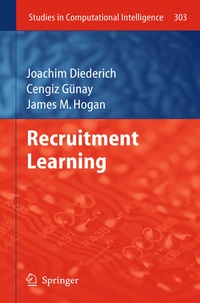
Recruitment Learning
Published on 1. December 2012
Book
Paperback/Softback
X, 314 pages
978-3-642-26547-1 (ISBN)
Description
This book presents a fascinating and self-contained account of "recruitment learning", a model and theory of fast learning in the neocortex. In contrast to the more common attractor network paradigm for long- and short-term memory, recruitment learning focuses on one-shot learning or "chunking" of arbitrary feature conjunctions that co-occur in single presentations. The book starts with a comprehensive review of the historic background of recruitment learning, putting special emphasis on the ground-breaking work of D.O. Hebb, W.A.Wickelgren, J.A.Feldman, L.G.Valiant, and L. Shastri.
Afterwards a thorough mathematical analysis of the model is presented which shows that recruitment is indeed a plausible mechanism of memory formation in the neocortex. A third part extends the main concepts towards state-of-the-art spiking neuron models and dynamic synchronization as a tentative solution of the binding problem. The book further discusses the possible role of adult neurogenesis for recruitment. These recent developments put the theory of recruitment learning at the forefront of research on biologically inspired memory models and make the book an important and timely contribution to the field.
More details
Series
Edition
2011 ed.
Language
English
Place of publication
Berlin
Germany
Publishing group
Springer Berlin
Target group
Professional and scholarly
Research
Illustrations
76 s/w Abbildungen, 33 farbige Abbildungen
X, 314 p. 109 illus., 33 illus. in color.
Dimensions
Height: 235 mm
Width: 155 mm
Thickness: 18 mm
Weight
493 gr
ISBN-13
978-3-642-26547-1 (9783642265471)
DOI
10.1007/978-3-642-14028-0
Schweitzer Classification
Other editions
Additional editions
Joachim Diederich | Cengiz Gunay | James M. Hogan
Recruitment Learning
Book
10/2010
1st Edition
Springer
€106.99
Shipment within 7-9 days
Content
PART I: Recruitment in Discrete Time Neural Networks .- Recruitment Learning - An Introduction.- One-shot learning - Specialization and Generalization.- Connectivity and Candidate Structures.- Representation and Recruitment.- Cognitive Applications .- PART II: Recruitment in Continuous Time Neural Networks.- Spiking Neural Networks and Temporal Binding .- Synchronised Recruitment in Cortical .- The Stability of Recruited Concepts.- Conclusions.