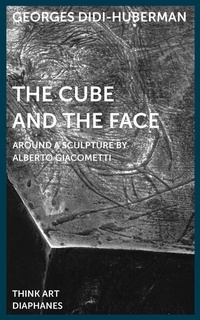
Alberto Giacometti's 1934
Cube
stands apart for many as atypical of the Swiss artist, the only abstract sculptural work in a wide oeuvre that otherwise had as its objective the exploration of reality. With
The Cube and the Face
, renowned French art historian and philosopher Georges Didi-Huberman has conducted a careful analysis of
Cube
, consulting the artist's sketches, etchings, texts, and other sculptural works in the years just before and after
Cube
was created.
Cube
, he finds, is indeed exceptional-a work without clear stylistic kinship to the works that came before or after it. At the same time, Didi-Huberman shows,
Cube
marks the transition between the artist's surrealist and realist phases and contains many elements of Giacometti's aesthetic consciousness, including his interest in dimensionality, the relation of the body to geometry, and the portrait-or what Didi-Huberman terms "abstract anthropomorphism." Drawing on Freud, Bataille, Leiris, and others whom Giacometti counted as influences, Didi-Huberman presents fans and collectors of Giacometti's art with a new approach to transitional work.
Reviews / Votes
"A spiral-shaped investigation of Giacometti's work revolving around various readings of one of his sculptures . Didi-Huberman exploits the formal presence of Cube to construct a metaphoric and polyphonic interplay of critical facets which allows him to engage with a range of Giacometti's aesthetical investigations." Timothy Mathews, excerpt from
Alberto Giacometti: The Art of Relation
.
Series
Language
Place of publication
Illustrations
81
85 s/w Photographien bzw. Rasterbilder
81 sw. Abb.
Dimensions
Height: 22.5 cm
Width: 14 cm
Thickness: 20 mm
Weight
ISBN-13
978-3-03734-520-7 (9783037345207)
Schweitzer Classification
Author
Georges Didi-Huberman ist Kunsthistoriker und Philosoph und lehrt an der École des Hautes Études en Sciences Sociales, Paris. Zudem ist er Kurator zahlreicher Ausstellungen.
Editor
Mira Fliescher (1971-2017) studierte Kunstgeschichte, Film- und Fernsehwissenschaft und Philosophie an der Ruhr-Universität Bochum. Nach einem Stipendium am Graduiertenkolleg >Identität und Differenz< an der Universität Trier promovierte sie an der Hochschule für Bildende Künste Braunschweig im Fach Kunstwissenschaft zu »Signaturen der Alterität«. Von 2011-2013 war sie Postdoc am Graduiertenkolleg >Sichtbarkeit und Sichtbarmachung. Hybride Formen des Bildwissens< in Potsdam. 2014-2016 wissenschaftliche Mitarbeiterin an der Zürcher Hochschule der Künste, 2016-2017 Assistentin am kunsthistorischen Institut der Universität Graz. Ihre Forschungsschwerpunkte waren ästhetisches Denken, Verzeichnung, Signatur, Autorschaft, Alterität und die Eigenart des Denkens der Kunst. Wichtigste Publikationen sind: Signaturen der Alterität (2013), Der Witz der Kunst (2020) sowie zus. mit Florian Dombois, Dieter Mersch und Julia Rintz Ästhetisches Denken. Nichtpropositionalität, Episteme, Kunst (2014).
Elena Vogman ist Autorin, Literatur- und Medienwissenschaftlerin und Kuratorin. Sie promovierte in 2016 über »Sinnliches Denken. Eisensteins exzentrische Methode« und war seitdem Postdoc im Forschungsprojekt »Rhythmus und Projektion« an der Freien Universität sowie Fellow am IKKM an der Universität Weimar. Sie lehrt Geschichte und Theorie der Medien an der Kunsthochschule Berlin Weißensee und arbeitet an einem Forschungsprojekt zu »Madness, Media, Milieus. Reconfiguring the Humanities in Postwar Europe«. Im Fokus ihrer Forschung stehen Formen des visuellen Denkens, Anthropologien des Rhythmus, Montagepraxis sowie Medien und Milieus in der Praxis der Institutionellen Psychotherapie. Gemeinsam mit Marie Rebecchi und Till Gathmann kuratierte sie die Ausstellung »Sergei Eisenstein: The Anthropology of Rhythm« bei Nomas Foundation in Rom.
Translation
9
-
10
Note
(Georges Didi-Huberman)
11
-
14
Buried Face
(Georges Didi-Huberman)
15
-
23
Face of the Orientation that Cannot Be Found
(Georges Didi-Huberman)
25
-
35
Face of the Drawing that Seeks its Volume
(Georges Didi-Huberman)
37
-
41
Face of the Cage and the Transparent Crystal
(Georges Didi-Huberman)
43
-
48
Face of the Bodies that Come Apart
(Georges Didi-Huberman)
49
-
62
Face of the Impossible Dimension
(Georges Didi-Huberman)
63
-
85
Face of the Dead Heads
(Georges Didi-Huberman)
87
-
101
Lost Face, Face of the Father
(Georges Didi-Huberman)
103
-
121
Face of Opacity and the Blind Crystal
(Georges Didi-Huberman)
123
-
131
Face of Shadow and Spacing
(Georges Didi-Huberman)
133
-
136
Melancholic Face
(Georges Didi-Huberman)
137
-
145
Face of the Drawing that Seeks its Notch
(Georges Didi-Huberman)
147
-
156
Face for Finishing with the Object
(Georges Didi-Huberman)
157
-
198
Buried Face
(Georges Didi-Huberman)
199
-
224
Notes
225
-
245
In the Face of the Unface
(Mira Fliescher, Elena Vogman)
247
Credits