

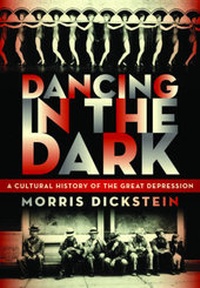
Dancing in the Dark
A Cultural History of the Great Depression
Published on 6. October 2009
Book
Hardback
624 pages
978-0-393-07225-9 (ISBN)
Description
Only yesterday the Great Depression seemed like a bad memory, receding into the hazy distance with little relevance to our own flush times. Economists assured us that the calamities that befell our grandparents could not happen again, yet the recent economic meltdown has once again riveted the world's attention on the 1930s.
Now, in this timely and long-awaited cultural history, Morris Dickstein, whom Norman Mailer called "one of our best and most distinguished critics of American literature," explores the anxiety and hope, the despair and surprising optimism of a traumatized nation. Dickstein's fascination springs from his own childhood, from a father who feared a pink slip every Friday and from his own love of the more exuberant side of the era: zany screwball comedies, witty musicals, and the lubricious choreography of Busby Berkeley. Whether analyzing the influence of film, design, literature, theater, or music, Dickstein lyrically demonstrates how the arts were then so integral to the fabric of American society.
While any lover of American literature knows Fitzgerald and Steinbeck, Dickstein also reclaims the lives of other novelists whose work offers enduring insights. Nathanael West saw Los Angeles as a vast dream dump, a Sargasso Sea of tawdry longing that exposed the pinched and disappointed lives of ordinary people, while Erskine Caldwell, his books Tobacco Road and God's Little Acre festooned with lurid covers, provided the most graphic portrayal of rural destitution in the 1930s. Dickstein also immerses us in the visions of Zora Neale Hurston and Henry Roth, only later recognized for their literary masterpieces.
Just as Dickstein radically transforms our understanding of Depression literature, he explodes the prevailing myths that 1930s musicals and movies were merely escapist. Whether describing the undertone of sadness that lurks just below the surface of Cole Porter's bubbly world or stressing the darker side of Capra's wildly popular films, he shows how they delivered a catharsis of pain and an evangel of hope. Dickstein suggests that the tragic and comic worlds of Broadway and Hollywood preserved a radiance and energy that became a bastion against social suffering. Dancing in the Dark describes how FDR's administration recognized the critical role that the arts could play in enabling "the helpless to become hopeful, the victims to become agents." Along with the WPA, the photography unit of the FSA represented a historic partnership between government and art, and the photographers, among them Walker Evans and Dorothea Lange, created the defining look of the period.
The symbolic end to this cultural flowering came finally with the New York World's Fair of 1939-40, a collective event that presented a vision of the future as a utopia of streamlined modernity and, at long last, consumer abundance. Retrieving the stories of an entire generation of performers and writers, Dancing in the Dark shows how a rich, panoramic culture both exposed and helped alleviate the national trauma. This luminous work is a monumental study of one of America's most remarkable artistic periods.
Now, in this timely and long-awaited cultural history, Morris Dickstein, whom Norman Mailer called "one of our best and most distinguished critics of American literature," explores the anxiety and hope, the despair and surprising optimism of a traumatized nation. Dickstein's fascination springs from his own childhood, from a father who feared a pink slip every Friday and from his own love of the more exuberant side of the era: zany screwball comedies, witty musicals, and the lubricious choreography of Busby Berkeley. Whether analyzing the influence of film, design, literature, theater, or music, Dickstein lyrically demonstrates how the arts were then so integral to the fabric of American society.
While any lover of American literature knows Fitzgerald and Steinbeck, Dickstein also reclaims the lives of other novelists whose work offers enduring insights. Nathanael West saw Los Angeles as a vast dream dump, a Sargasso Sea of tawdry longing that exposed the pinched and disappointed lives of ordinary people, while Erskine Caldwell, his books Tobacco Road and God's Little Acre festooned with lurid covers, provided the most graphic portrayal of rural destitution in the 1930s. Dickstein also immerses us in the visions of Zora Neale Hurston and Henry Roth, only later recognized for their literary masterpieces.
Just as Dickstein radically transforms our understanding of Depression literature, he explodes the prevailing myths that 1930s musicals and movies were merely escapist. Whether describing the undertone of sadness that lurks just below the surface of Cole Porter's bubbly world or stressing the darker side of Capra's wildly popular films, he shows how they delivered a catharsis of pain and an evangel of hope. Dickstein suggests that the tragic and comic worlds of Broadway and Hollywood preserved a radiance and energy that became a bastion against social suffering. Dancing in the Dark describes how FDR's administration recognized the critical role that the arts could play in enabling "the helpless to become hopeful, the victims to become agents." Along with the WPA, the photography unit of the FSA represented a historic partnership between government and art, and the photographers, among them Walker Evans and Dorothea Lange, created the defining look of the period.
The symbolic end to this cultural flowering came finally with the New York World's Fair of 1939-40, a collective event that presented a vision of the future as a utopia of streamlined modernity and, at long last, consumer abundance. Retrieving the stories of an entire generation of performers and writers, Dancing in the Dark shows how a rich, panoramic culture both exposed and helped alleviate the national trauma. This luminous work is a monumental study of one of America's most remarkable artistic periods.
Reviews / Votes
"What will they be writing about our cultural endeavors 70 years from now? That's the question that keeps coming up when you read Dancing in the Dark, Morris Dickstein's fascinating examination of how the Great Depression influenced art, music, and literature." "The Big Books of Fall" "[A] judiciously researched, persuasively argued, elegant analysis of Depression culture... Dickstein is...exhaustive without being exhausting, and his book is a commendable compression of a complex decade." -- Saul Austerlitz "Starred Review. His scintillating commentary illuminates an important dimension of a decade too often considered only in political or economic terms...It's hard to imagine a more astute, more graceful guide to a remarkably creative period." "[A] bighearted, rambling new survey of American culture in the nineteen-thirties... Dickstein...values the popular culture of the Depression, and writes with enthusiasm about Cole Porter's wit, George Gershwin's jazz cadences, and the racing stripes and shiny surfaces of Art Deco." -- Caleb Crain "Dickstein looks beyond the mainstream to the nation's minorities, whose powerlessness made economic hardships even harder to bear, and he details the contributions of African Americans and immigrant Jews to American culture. Parallels to contemporary economic conditions mark this as an exceptionally relevant book." -- Mark Knoblauch "A significant historical work. A wonderful cultural historian, Morris Dickstein has written a book that lends testimony to the perseverance of the nation at that time." -- Gay TaleseMore details
Language
English
Place of publication
New York
United States
Target group
College/higher education
Professional and scholarly
Product notice
Rough front
Illustrations
24 illustrations
Dimensions
Height: 244 mm
Width: 170 mm
Thickness: 43 mm
Weight
1007 gr
ISBN-13
978-0-393-07225-9 (9780393072259)
Copyright in bibliographic data and cover images is held by Nielsen Book Services Limited or by the publishers or by their respective licensors: all rights reserved.
Schweitzer Classification
Other editions
New editions
Book
10/2010
WW Norton & Co
€29.40
Article not available at the moment
Additional editions
E-Book
09/2009
W. W. Norton & Company
€32.49
Available for download