

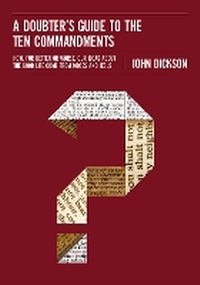
A Doubter's Guide to the Ten Commandments
How, for Better or Worse, Our Ideas about the Good Life Come from Moses and Jesus
Published on 28. July 2016
Book
Paperback/Softback
224 pages
978-0-310-52259-1 (ISBN)
Description
The Ten Commandments have influenced non-religious Western culture more than it might imagine. This guide to the famous rules does more than explain what they are or what they say, but why we need them.
This moral code in the Old Testament of the Bible-from which sprang ideas of justice, compassion, human rights, and freedom-has had such a strong impact on our society that it seems to represent what most of us think of as basic ethical reasoning. Even atheists like Richard Dawkins have offered up their own version of the Ten Commandments, and the strange thing is that many of them don't stray very far from the ethical teachings of Moses and Jesus.
Bestselling author and apologist John Dickson explores how these ten rules have changed our world and how they show us what the "Good" (as Socrates called it) looks like in practice. Whether or not one believes in the Bible, these ten ancient instructions open a window to Western thought and civilization-and to our own souls.
In each chapter, Dickson unpacks one of the ten famous commandments to show how they're not simply outdated rules but apply directly to our lives today. Along the way, he discusses broader philosophical implications, such as:
Why do humans try to be good at all? What's the point of ethics, and why do we systematically seek them out?
Why the Ten Commandments have outlived the moral codes of the ancient world, such as the Code of Hammurabi and the Maxims of Delphi.
What does the Bible actually say about punishment and reward?
How the teachings of Jesus relate to the much older instructions of Moses.
This moral code in the Old Testament of the Bible-from which sprang ideas of justice, compassion, human rights, and freedom-has had such a strong impact on our society that it seems to represent what most of us think of as basic ethical reasoning. Even atheists like Richard Dawkins have offered up their own version of the Ten Commandments, and the strange thing is that many of them don't stray very far from the ethical teachings of Moses and Jesus.
Bestselling author and apologist John Dickson explores how these ten rules have changed our world and how they show us what the "Good" (as Socrates called it) looks like in practice. Whether or not one believes in the Bible, these ten ancient instructions open a window to Western thought and civilization-and to our own souls.
In each chapter, Dickson unpacks one of the ten famous commandments to show how they're not simply outdated rules but apply directly to our lives today. Along the way, he discusses broader philosophical implications, such as:
Why do humans try to be good at all? What's the point of ethics, and why do we systematically seek them out?
Why the Ten Commandments have outlived the moral codes of the ancient world, such as the Code of Hammurabi and the Maxims of Delphi.
What does the Bible actually say about punishment and reward?
How the teachings of Jesus relate to the much older instructions of Moses.
More details
Language
English
Place of publication
United States
Publishing group
Zondervan
Product notice
Paperback (trade)
Unsewn / adhesive bound
Dimensions
Height: 180 mm
Width: 127 mm
Thickness: 13 mm
Weight
136 gr
ISBN-13
978-0-310-52259-1 (9780310522591)
Copyright in bibliographic data and cover images is held by Nielsen Book Services Limited or by the publishers or by their respective licensors: all rights reserved.
Schweitzer Classification
Other editions
Additional editions
John Dickson
A Doubter's Guide to the Ten Commandments
How, for Better or Worse, Our Ideas about the Good Life Come from Moses and Jesus
E-Book
06/2016
Zondervan Academic
€8.99
Available for download
Person
John Dickson (PhD, Macquarie University) serves as the Jean Kvamme Distinguished Professor of Biblical Evangelism and Distinguished Scholar in Public Christianity at Wheaton College. A speaker, historian, and media presenter, John is the author of more than 20 books, two of which became television documentaries. He also cohosted the documentary For the Love of God: How the Church is Better and Worse Than you Ever Imagined. He is an Honorary Research Associate at the University of Sydney, a Visiting Academic in the Faculty of Classics at Oxford University (2016-2021), and Distinguished Fellow in Public Christianity at Ridley College Melbourne. John presents Australia's no.1 religion podcast, Undeceptions, exploring aspects of life, faith, history, culture, or ethics that are either much misunderstood or mostly forgotten.
Content
INTRODUCTION
The introduction speaks partly to the believer and partly to the enquirer, setting both the tone and intent of the book: whether or not one quite believes in the Bible, these ten ancient instructions open up a window to the Western world and on our own soul.
1. A CULTURAL ICON
This chapter traces the cultural references to the Ten Commandments, in art, monument, and culture, even including Richard Dawkins' famed Ten Atheist Commandments.
2. THE PREMISE OF THE TEN
This chapter explains from within the Old Testament law itself that 'grace'---God's unmerited favour---is the premise of the Commandments. No one was ever meant to hear these commandments as the path to a moral life or divine acceptability. Along the way, alternative theories for ethical conduct and motivation are explored.
3. THE PROMISE OF THE TEN
This chapter explains how the Bible 'works', from the Christian point of view---how Christ is the promise of the Law. The West has received the commandments not directly from Judaism but via their 'refraction' in the teachings of Jesus and the New Testament.
4. THE SHAPE OF THE TEN
This chapter discusses the twofold shape of the commandments, stressing a Godward and humanward life as envisaged by Moses (and Jesus). While ethics today are principally concerned with behaviour at the 'horizontal' level (kindness to others), the Ten Commandments insist that the 'vertical' (concern for God) is key to the good life.
5. A CHARTER OF FREEDOM
This chapter examines the inadequacy of the modern notion of 'freedom' and contrasts it with the biblical notion of pursuing the Good for which we are made. "We are free not merely because we can choose," writes David Bentley Hart, "but only when we have chosen well."
6. MONOTHEISM AND MORALITY
This chapter focuses on the First Commandment and makes the connection between the existence of God and the logical ground of morality. Reverencing God is the highest calling of the human being and the only way philosophically to find a rational basis for the 'good life'. Atheism and polytheism are found to fall short.
7. IDOLS ANCIENT AND MODERN
Looking at the Second Commandment this chapter examines idol worship in both historical and contemporary perspective, exploring in particular Jesus' and Paul's insistence that materialism is the equivalent of idolatry. Links between idolatry---reverencing created things over the Creator---and injustice are also explored: if one can worship an object of creation, one can easily tread down other creatures.
8. WHAT'S IN A NAME?
Looking at the Third Commandment this chapter highlights the importance of honouring God's name. Along the way, phony, materialistic religion is critiqued. And the extreme judgment language of this commandment ("punishing the children for the sin of the parents to the third and fourth generation") is dealt with in a sensitive way.
9. THANK GOD FOR HOLIDAYS
This chapter explores the Fourth Commandment (Sabbath) and highlights the history of 'holidays' and the importance of 'rest'. Uniquely in the ancient world, Jews believed that all should work (elites as well as peasants) and that all should rest (peasants as well as elites). The New Testament 'refraction' of the Sabbath command, as a picture of salvation, becomes a special focus.
10. EVERYONE LOVES THEIR MOM?
This chapter examines the Fifth Commandment and its implications for our notion of family---interacting briefly with 'alternative' models. After exploring Jesus' teaching about parents, it also raises questions about our society's care for the elderly.
11. KILL, LUST, STEAL, LIE
Grouping the Sixth to Ninth Commandments together, this chapter shows how Jesus took the most basic ethical commands of humanity, found in multiple cultures around the world, and intensifies their sense. The result is an ethical outlook unparalleled in the history of moral discourse---where even 'hate' is equated with murder, and 'lust' with adultery.
12. DES
The introduction speaks partly to the believer and partly to the enquirer, setting both the tone and intent of the book: whether or not one quite believes in the Bible, these ten ancient instructions open up a window to the Western world and on our own soul.
1. A CULTURAL ICON
This chapter traces the cultural references to the Ten Commandments, in art, monument, and culture, even including Richard Dawkins' famed Ten Atheist Commandments.
2. THE PREMISE OF THE TEN
This chapter explains from within the Old Testament law itself that 'grace'---God's unmerited favour---is the premise of the Commandments. No one was ever meant to hear these commandments as the path to a moral life or divine acceptability. Along the way, alternative theories for ethical conduct and motivation are explored.
3. THE PROMISE OF THE TEN
This chapter explains how the Bible 'works', from the Christian point of view---how Christ is the promise of the Law. The West has received the commandments not directly from Judaism but via their 'refraction' in the teachings of Jesus and the New Testament.
4. THE SHAPE OF THE TEN
This chapter discusses the twofold shape of the commandments, stressing a Godward and humanward life as envisaged by Moses (and Jesus). While ethics today are principally concerned with behaviour at the 'horizontal' level (kindness to others), the Ten Commandments insist that the 'vertical' (concern for God) is key to the good life.
5. A CHARTER OF FREEDOM
This chapter examines the inadequacy of the modern notion of 'freedom' and contrasts it with the biblical notion of pursuing the Good for which we are made. "We are free not merely because we can choose," writes David Bentley Hart, "but only when we have chosen well."
6. MONOTHEISM AND MORALITY
This chapter focuses on the First Commandment and makes the connection between the existence of God and the logical ground of morality. Reverencing God is the highest calling of the human being and the only way philosophically to find a rational basis for the 'good life'. Atheism and polytheism are found to fall short.
7. IDOLS ANCIENT AND MODERN
Looking at the Second Commandment this chapter examines idol worship in both historical and contemporary perspective, exploring in particular Jesus' and Paul's insistence that materialism is the equivalent of idolatry. Links between idolatry---reverencing created things over the Creator---and injustice are also explored: if one can worship an object of creation, one can easily tread down other creatures.
8. WHAT'S IN A NAME?
Looking at the Third Commandment this chapter highlights the importance of honouring God's name. Along the way, phony, materialistic religion is critiqued. And the extreme judgment language of this commandment ("punishing the children for the sin of the parents to the third and fourth generation") is dealt with in a sensitive way.
9. THANK GOD FOR HOLIDAYS
This chapter explores the Fourth Commandment (Sabbath) and highlights the history of 'holidays' and the importance of 'rest'. Uniquely in the ancient world, Jews believed that all should work (elites as well as peasants) and that all should rest (peasants as well as elites). The New Testament 'refraction' of the Sabbath command, as a picture of salvation, becomes a special focus.
10. EVERYONE LOVES THEIR MOM?
This chapter examines the Fifth Commandment and its implications for our notion of family---interacting briefly with 'alternative' models. After exploring Jesus' teaching about parents, it also raises questions about our society's care for the elderly.
11. KILL, LUST, STEAL, LIE
Grouping the Sixth to Ninth Commandments together, this chapter shows how Jesus took the most basic ethical commands of humanity, found in multiple cultures around the world, and intensifies their sense. The result is an ethical outlook unparalleled in the history of moral discourse---where even 'hate' is equated with murder, and 'lust' with adultery.
12. DES