

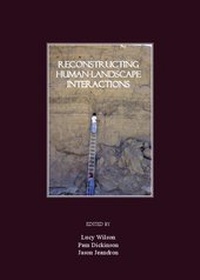
Reconstructing Human-Landscape Interactions
Published on 14. November 2007
Book
Hardback
291 pages
978-1-84718-188-6 (ISBN)
Description
Reconstructing Human-Landscape Interactions demonstrates the high quality of work presented at the first Developing International Geoarchaeology conference (DIG 2005), held in Saint John, New Brunswick, Canada, and exemplifies the over-riding theme of this discipline. People have always used the landscape in many ways: as a place to live, as a place to grow crops, as a source of natural resources. Those actions leave their traces. The characteristics of the landscape constrain which activities are possible, just as social and cultural habits condition people's connection with the environment. Geoarchaeology is about finding the traces of these interactions, and using them to reconstruct how people in the past behaved in their environmental context.The material covered in the proceedings ranges from broad themes of climate change and landscape use, to more specific subjects such as river avulsion and the use of tidal ponds. The papers move us from the land to the coastal margin and back onto land to examine particular techniques. The final paper leads us beyond archaeology and points out that geoarchaeological data must contribute to the debate about the sustainability of present-day land-use practices: a fitting challenge to take us into the future.
More details
Edition
Unabridged edition
Language
English
Place of publication
Newcastle upon Tyne
United Kingdom
Target group
College/higher education
Professional and scholarly
Edition type
Unabridged edition
Product notice
With dust jacket
Dimensions
Height: 212 mm
Width: 148 mm
ISBN-13
978-1-84718-188-6 (9781847181886)
Copyright in bibliographic data and cover images is held by Nielsen Book Services Limited or by the publishers or by their respective licensors: all rights reserved.
Schweitzer Classification
Other editions
Additional editions
Jason Jeandron Pam Dickinson Lucy Wilson
Reconstructing Human-Landscape Interactions
E-Book
03/2009
1st Edition
Cambridge Scholars Publishing
€106.79
Available for download
Persons
Lucy Wilson, Pam Dickinson and Jason Jeandron co-organised the Developing International Geoarchaeology 2005 conference, and together have over 40 years experience in geoarchaeology. Lucy is an Associate Professor at the University of New Brunswick (Saint John). Pam is a doctoral student at UNB (Fredericton), and Jason is a consultant with Archaeological Prospectors."This book shows the breadth and range of topics now being examined by geoarchaeologists. It has been clearly edited and very well presented, producing an excellent final volume." -Matthew Canti, English Heritage'The volume is composed of 14 chapters and an Index. Each chapter is well-referenced and where appropriate well-illustrated. Very many facets of, and approaches to, Geoarchaeology, are covered in these proceedings. Not only are the site locations worldwide, but also the technical content covers most mainstream approaches, namely: remote sensing - both on the ground and underwater, fieldwork, a variety of laboratory techniques and GIS. Papers clearly demonstrate a variety of methodologies and successfully report site location patterns and regional scale interpretations based upon geoarchaeological findings. I was intrigued, however, to note the absence of any soil micromorphology in the studies, a technique employed almost universally in Europe, and totally missing from Rapp's Chapter 1 ('Prologue: The Organisation, Development, and Future of Geoarchaeology). As a European I found the chapters (especially 4, 5, 6, 7 and 8) dealing with hunter-gatherer site location, environmental and sea level changes in northern North America, most interesting, because these are approaches that can be applied to our Palaeolithic and Mesolithic sites, especially in the North Sea and Baltic regions. Clearly the content fully reflects the title of the volume - Reconstructing Human-Landscape Interactions.I recommend this volume to all geoarchaeologists.'-Dr Richard I Macphail, Senior Research Fellow, Institute of Archaeology, University College London