

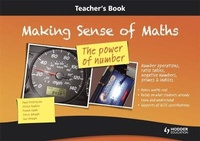
Making Sense of Maths: The Power of Number - Teacher Book
Number operations, ratio tables, negative numbers, primes & indices
Published on 30. November 2012
Book
Spiral bound
152 pages
978-1-4441-8013-8 (ISBN)
Description
Making Sense of Maths is the only series that develops conceptual understanding.
This series will motivate, engage and develop the conceptual understanding of students at KS3 and KS4.
Students build their own problem solving strategies based on their understanding of the world around them which then support them to tackle functional questions.
The Teacher's Book provides support for the activities in the student book which develop the student's understanding of number operations, conversions, negative numbers, primes & indices. It also contains answers for the workbook questions which consolidate learning.
Making Sense of Maths has been based on Realistic Maths Education (RME) and extensively trialled in KS3 and KS4 classrooms in the UK by a team from Manchester Metropolitan University.
- Use alongside existing resources or on its own
- Ideal for Year 10s heading for the C/D borderline
- Ideal for intervention groups
- Supports the move from modular to linear specifications by improving knowledge retention
- Provides support for good teaching and learning under the current Ofsted criteria
This series will motivate, engage and develop the conceptual understanding of students at KS3 and KS4.
Students build their own problem solving strategies based on their understanding of the world around them which then support them to tackle functional questions.
The Teacher's Book provides support for the activities in the student book which develop the student's understanding of number operations, conversions, negative numbers, primes & indices. It also contains answers for the workbook questions which consolidate learning.
Making Sense of Maths has been based on Realistic Maths Education (RME) and extensively trialled in KS3 and KS4 classrooms in the UK by a team from Manchester Metropolitan University.
- Use alongside existing resources or on its own
- Ideal for Year 10s heading for the C/D borderline
- Ideal for intervention groups
- Supports the move from modular to linear specifications by improving knowledge retention
- Provides support for good teaching and learning under the current Ofsted criteria
More details
Language
English
Place of publication
United Kingdom
Publishing group
Hachette Learning
Target group
Primary & secondary/elementary & high school
Illustrations
Full colour illustrations throughout
Dimensions
Height: 303 mm
Width: 210 mm
Thickness: 11 mm
Weight
468 gr
ISBN-13
978-1-4441-8013-8 (9781444180138)
Copyright in bibliographic data and cover images is held by Nielsen Book Services Limited or by the publishers or by their respective licensors: all rights reserved.
Schweitzer Classification
Persons
Paul Dickinson taught maths in UK Comprehensive schools for over 20 years. He is now a Senior Lecturer at Manchester Metropolitan University, where he works with trainee teachers and develops and trials classroom materials based on RME(Realistic Maths Education).
Stella Dudzic taught for 22 years in secondary schools, including 9 years as head of department. She is currently Programme Leader for Curriculum at MEI and regularly leads CPD for teachers. She is also a Principal Examiner.
Frank Eade has worked in mathematics education for over 25 years. He is particularly interested in using realistic situations to give students access to mathematics and in using students beliefs and misconceptions to help them move forward in mathematics.
Steve Gough taught maths for 20 years, 10 years as Head of Maths, in schools in Greater Manchester. Since 2008 he has been a Senior Lecturer in Maths Education at Manchester Metropolitan University and has worked with teachers to develop the 'Making Sense of Maths' series.
Sue Hough is a Senior Lecturer at Manchester Metropolitan University and has spent the last 6 years developing materials for 'Making Sense of Maths'. Previously Sue spent 18 years teaching maths in 11 - 18 schools and worked as a head of Maths.
Stella Dudzic taught for 22 years in secondary schools, including 9 years as head of department. She is currently Programme Leader for Curriculum at MEI and regularly leads CPD for teachers. She is also a Principal Examiner.
Frank Eade has worked in mathematics education for over 25 years. He is particularly interested in using realistic situations to give students access to mathematics and in using students beliefs and misconceptions to help them move forward in mathematics.
Steve Gough taught maths for 20 years, 10 years as Head of Maths, in schools in Greater Manchester. Since 2008 he has been a Senior Lecturer in Maths Education at Manchester Metropolitan University and has worked with teachers to develop the 'Making Sense of Maths' series.
Sue Hough is a Senior Lecturer at Manchester Metropolitan University and has spent the last 6 years developing materials for 'Making Sense of Maths'. Previously Sue spent 18 years teaching maths in 11 - 18 schools and worked as a head of Maths.
Content
Acknowledgements Introduction Chapter 1: Whole numbers Introduction, Sub sections, Resources Lesson 1: A new computer game. Historical events. Jumps on a number line Lesson 2: How many? Multiplications Lesson 3: Multiplications (continued). Divisions Lesson 4: Buying ribbon Lesson 5: Buying tickets. The rules for calculations. Summary Chapter 2: Measure for measure Introduction, Sub sections, Resources Lesson 1: Measuring instruments. Ten thousand steps a day Lesson 2: Height Lesson 3: Motorway routes Lesson 4: A real bargain? Lesson 5: Watch your speed Lesson 6: Weighing it up Lesson 7: Rounding. Summary Chapter 3: Using ratio tables Introduction, Sub sections, Resources Lesson 1: Recipes Lesson 2: Recipes (continued) Lesson 3: Fuel consumption. Speed Lesson 4: Mobile phone density. Summary Chapter 4: The positives and the negatives Introduction, Sub sections, Resources Lesson 1: The highs and lows on Earth. Time is moving along Lesson 2: Hubble, bubble, toil and trouble Lesson 3: Hubble, bubble, toil and trouble (continued) Chapter 5: The building blocks of numbers Introduction, Sub sections, Resources Lesson 1: A numbers game Lesson 2: Using primes to build other numbers Lesson 3: Playing out. Packing boxes Lesson 4: Finding the highest common factor Lesson 5: Finding the lowest common multiple. Summary Chapter 6: Big numbers Introduction, Sub sections, Resources Lesson 1: Writing big numbers. Writing mathematically - power notation. Big cities? Lesson 2: A strange reward? Lesson 3: A strange reward? (continued) Lesson 4: Problems with tiling. A special power. Summary GCSE exam-style questions Answers Solution and strategies