

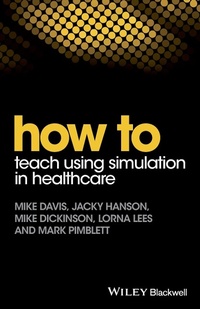
How to Teach Using Simulation in Healthcare
1st Edition
Published on 6. October 2017
Book
Paperback/Softback
192 pages
978-1-119-13071-0 (ISBN)
Description
How to Teach Using Simulation in Healthcare provides an ideal introduction and easy-to-use guide to simulation in medical education. Written by a team of experienced medical educators, this practical text - packed full of case examples and tips - is underpinned by the theory of simulation in education, and explores how to integrate simulation into teaching.
Key topics include:
* Use of low, medium and high fidelity equipment
* Issues of simulation mapping and scenario design
* Role of human factors
* Formative and summative assessment
* New social media and technologies
* Detailed explorations of some examples of simulation.
How to Teach Using Simulation in Healthcare is invaluable reading for all healthcare professionals interested and involved in the origins, theoretical underpinnings, and design implications of the use of simulation in medical education.
Reviews / Votes
"It utilises an undeniable wealth of knowledge from the authors, leading to a book which is well written and informative, covering a diverse range of subjects" - Journal of Perioperative PracticeMore details
Other editions
Additional editions
Mike Davis | Jacky Hanson | Mike Dickinson
How to Teach Using Simulation in Healthcare
E-Book
07/2017
Wiley-Blackwell
€38.99
Available for download
Mike Davis | Jacky Hanson | Mike Dickinson
How to Teach Using Simulation in Healthcare
E-Book
07/2017
Wiley-Blackwell
€38.99
Available for download
Persons
Mike Davis, Freelance Consultant in Continuing Medical Education and Honorary Senior Lecturer in Medical Education at Keele University, UK
Jacky Hanson, Emergency Medicine Consultant and Director of Simulation and Associate Undergraduate Dean at Lancashire Teaching Hospitals, UK
Mike Dickinson, Manager of the Simulation and Clinical Skills Unit at Blackpool Teaching Hospitals NHS Foundation Trust, UK
Lorna Lees, Administrator, Simulation Centre, Lancashire Teaching Hospitals, UK
Mark Pimblett, High Tech Clinical Skills Facilitator, Simulation Centre, Lancashire Teaching Hospitals, UK
Content
List of figures, vii
List of tables, ix
About the authors, xi
Preface, xv
Chapter 1: Introduction, 1
Chapter 2: Simulation?]based medical education (SBME): some specifics, 3
Chapter 3: Simulation in (medical) education: some background, 13
Chapter 4: Equipment in SBME: more than just a mannikin?, 27
Chapter 5: Physical and psychological realism, 37
Chapter 6: Simulation mapping and scenario design, 45
Chapter 7: Running a simulation session: some practicalities, 55
Chapter 8: Formative assessment and feedback, 65
Chapter 9: Summative assessment, 73
Chapter 10: Human factors, ergonomics and non?]technical skills, 83
Chapter 11: Five case examples, 97
Chapter 12: Using new technology to enhance learning, 119
Chapter 13: Commissioning a simulation centre, 139
Chapter 14: Training for simulation faculty, 151
Chapter 15: Conclusions and next steps, 157
Chapter 16: Annotated bibliography, 159
Index, 163