

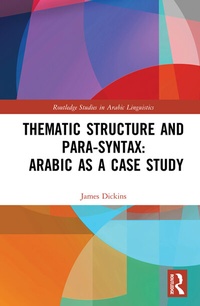
Thematic Structure and Para-Syntax: Arabic as a Case Study
1st Edition
Published on 17. March 2020
Book
Hardback
166 pages
978-0-367-36750-3 (ISBN)
Description
Thematic Structure and Para-Syntax: Arabic as a Case Study presents a structural analysis of Arabic, providing an alternative to the traditional notions of theme and rheme.
Taking Arabic as a case study, this book claims that approaches to thematic structure propounded in universalist linguistic theories, of which Hallidayan systemic functional linguistics is taken as an illustrative example, are profoundly wrong. It argues that in order to produce an analysis of thematic structure and similar phenomena which is not undermined by its own theoretical presuppositions, it is necessary to remove such notions from the domain of linguistic and semiotic theory. The book initially focuses on Sudanese Arabic, because this allows for a beautifully clear exposition of general principles, before applying these principles to Modern Standard Arabic, and some other Arabic varieties.
This book will be of interest to scholars in Arabic linguistics, linguistic theory, and information structure.
Taking Arabic as a case study, this book claims that approaches to thematic structure propounded in universalist linguistic theories, of which Hallidayan systemic functional linguistics is taken as an illustrative example, are profoundly wrong. It argues that in order to produce an analysis of thematic structure and similar phenomena which is not undermined by its own theoretical presuppositions, it is necessary to remove such notions from the domain of linguistic and semiotic theory. The book initially focuses on Sudanese Arabic, because this allows for a beautifully clear exposition of general principles, before applying these principles to Modern Standard Arabic, and some other Arabic varieties.
This book will be of interest to scholars in Arabic linguistics, linguistic theory, and information structure.
More details
Series
Language
English
Place of publication
London
United Kingdom
Publishing group
Taylor & Francis Ltd
Target group
College/higher education
Illustrations
14 s/w Abbildungen, 14 s/w Zeichnungen, 2 s/w Tabellen
2 Tables, black and white; 14 Line drawings, black and white; 14 Illustrations, black and white
Dimensions
Height: 234 mm
Width: 156 mm
Weight
384 gr
ISBN-13
978-0-367-36750-3 (9780367367503)
Copyright in bibliographic data and cover images is held by Nielsen Book Services Limited or by the publishers or by their respective licensors: all rights reserved.
Schweitzer Classification
Other editions
Additional editions
Book
08/2022
1st Edition
Routledge
€66.90
Shipment within 10-20 days
E-Book
03/2020
1st Edition
Routledge
€60.49
Available for download
E-Book
03/2020
1st Edition
Routledge
€60.49
Available for download
Person
James Dickins is Professor of Arabic at the University of Leeds.
Content
Chapter 1: Introduction
Chapter 2: Signs, syntax, para-syntax, theme and rheme
2.1 Introduction
2.2 Signs
2.3 Grammar (morphology and syntax) as sign-level analysis
2.4 Syntax and para-syntax
Chapter 3: Issues in defining 'theme'
3.1 Introduction
3.2 Theme as starting point of the utterance
Chapter 4: Recursion
4.1 Introduction
4.2 Recursion
Chapter 5: Summary of arguments so far
Chapter 6: Traditional Arabic grammar analysis of Arabic clause structure
6.1 Introduction
6.2 Traditional Arabic grammar analysis of Arabic clause structure
Chapter 7: Peri/Thema-Nuc/Rhema analysis of Standard Arabic
7.1 Introduction
7.2 Application of Peri/Thema-Nuc/Rhema analysis to Standard Arabic
7.3 Comparison with Baker's (2011) analysis of Standard Arabic
7.4 Nuc/Rhema-markers and Peri/Thema-markers in Standard Arabic
7.5 A comparison with Arabic dialects and other languages
Chapter 8: Phrase-structural para-syntax in Arabic: beyond theme and rheme
8.1 Introduction
8.2 Initiality as non-thematic discourse marker in Arabic
8.3 Initiality as non-thematic discourse marker: Standard Arabic compared to other languages
Chapter 9: Phrase-structural para-syntactic notions vs. (real) semantic notions
9.1 Introduction
9.2 The necessity of separating phrase-structural para-syntactic from (real) semantic notions
Chapter 10: Distinguishing syntax from para-syntax
10.1 Introduction
10.2 The necessity of distinguishing syntax from para-syntax in Standard Arabic
Chapter 11: Conclusions
Technical Appendix: Endnotes
References
Index
Chapter 2: Signs, syntax, para-syntax, theme and rheme
2.1 Introduction
2.2 Signs
2.3 Grammar (morphology and syntax) as sign-level analysis
2.4 Syntax and para-syntax
Chapter 3: Issues in defining 'theme'
3.1 Introduction
3.2 Theme as starting point of the utterance
Chapter 4: Recursion
4.1 Introduction
4.2 Recursion
Chapter 5: Summary of arguments so far
Chapter 6: Traditional Arabic grammar analysis of Arabic clause structure
6.1 Introduction
6.2 Traditional Arabic grammar analysis of Arabic clause structure
Chapter 7: Peri/Thema-Nuc/Rhema analysis of Standard Arabic
7.1 Introduction
7.2 Application of Peri/Thema-Nuc/Rhema analysis to Standard Arabic
7.3 Comparison with Baker's (2011) analysis of Standard Arabic
7.4 Nuc/Rhema-markers and Peri/Thema-markers in Standard Arabic
7.5 A comparison with Arabic dialects and other languages
Chapter 8: Phrase-structural para-syntax in Arabic: beyond theme and rheme
8.1 Introduction
8.2 Initiality as non-thematic discourse marker in Arabic
8.3 Initiality as non-thematic discourse marker: Standard Arabic compared to other languages
Chapter 9: Phrase-structural para-syntactic notions vs. (real) semantic notions
9.1 Introduction
9.2 The necessity of separating phrase-structural para-syntactic from (real) semantic notions
Chapter 10: Distinguishing syntax from para-syntax
10.1 Introduction
10.2 The necessity of distinguishing syntax from para-syntax in Standard Arabic
Chapter 11: Conclusions
Technical Appendix: Endnotes
References
Index