

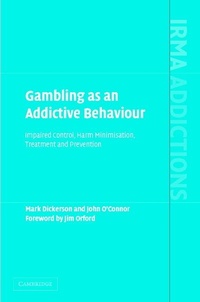
Gambling as an Addictive Behaviour
Impaired Control, Harm Minimisation, Treatment and Prevention
Published on 27. February 2006
Book
Hardback
206 pages
978-0-521-84701-8 (ISBN)
Description
'If thinking about addiction is going to change, the study of excessive gambling is likely to be one of the richest sources of new ideas' (Jim Orford). In this book, the authors present research into gambling, showing the psychological variables that govern the erosion or maintenance of self-control over gambling behaviour. These studies provide an empirical basis for a model of impaired control of gambling. Impaired control, in its broadest sense, is considered to be the defining psychological construct of all the addictive behaviours and occupies a central position in conceptualising the addictive aspects of gambling.
Reviews / Votes
Review of the hardback: ' ... a good read ... this book is likely to be of value to those with an interest in gambling research and policy.' British Journal of PsychiatryMore details
Series
Language
English
Place of publication
Cambridge
United Kingdom
Target group
Professional and scholarly
Dimensions
Height: 235 mm
Width: 157 mm
Thickness: 17 mm
Weight
493 gr
ISBN-13
978-0-521-84701-8 (9780521847018)
Copyright in bibliographic data and cover images is held by Nielsen Book Services Limited or by the publishers or by their respective licensors: all rights reserved.
Schweitzer Classification
Other editions
Additional editions
Mark Dickerson | John O'Connor
Gambling as an Addictive Behaviour
Impaired Control, Harm Minimisation, Treatment and Prevention
Book
07/2011
Cambridge University Press
€52.40
Shipment within 15-20 days
Mark Dickerson | John O'Connor
Gambling as an Addictive Behaviour
Impaired Control, Harm Minimisation, Treatment and Prevention
E-Book
03/2006
1st Edition
Cambridge University Press
€49.99
Available for download
Persons
D.O.B 20 February 1958
Content
Foreword Jim Orford; 1. The research context; 2. Research into impaired control of gambling behaviour: definition and measurement: traditional psychometric and mathematical psychology approaches; 3. Impaired control and its relationship to other variables implicated in the development of pathological gambling; 4. Models of impaired self-control of gambling; 5. Implications for treatment approaches to problem gambling arising from the model of impaired control; 6. Implications for harm minimisation in the management of problem gambling: making sense of 'responsible gambling'; 7. A case study of 'responsible gambling' strategies within a single jurisdiction: Victoria, Australia; 8. Conclusions; Index.