

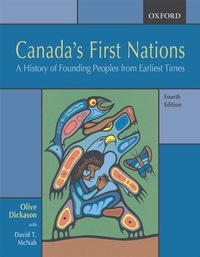
Canada's First Nations
A History of Founding Peoples from Earliest Times
4th Edition
Published on 20. November 2008
Book
Paperback/Softback
606 pages
978-0-19-542892-6 (ISBN)
Description
Canada's First Nations uses an interdisciplinary approach-drawing on research in archaeology, anthropology, biology, sociology, political science, and history-to give an account of Canada's past. Olive Dickason's widely acclaimed history of Canada's founding peoples is augmented by David McNab's updates and in-depth examination of recent events, including the Ipperwash inquiry and global warming's effect on Innu of Canada's the north.
This text describes how Canada's Aboriginal peoples were radically altered by the arrival of Europeans. They fought as allies beside the French and English during the battles of the eighteenth and nineteenth centuries; they were hunted to the point of extermination in Newfoundland; and their numbers were decimated by European diseases. In the nineteenth and early twentieth centuries Canada tried to legislate Aboriginal cultures out of existence, as the official assumption remained that assimilation would bring an end to any Indian 'Problem'.
From Nescambiouit and Potiac, to Pound Maker, Abe Okpik, and Elijah Harper, Amerindians and Inuit have responded to persistent colonial pressure in various ways, including attempts at co-operation, episodes of resistances, and politically sophisticated efforts to preserve their territoriy and culture. The revitalization of today's Aboriginal communities-dramatically expressed by the Mohawk at Oka in 1990 and by members of the six nations in Caledonia in 2005-reminds us that accurate perception of the past is essential to a just shaping of Canada's future.
This text describes how Canada's Aboriginal peoples were radically altered by the arrival of Europeans. They fought as allies beside the French and English during the battles of the eighteenth and nineteenth centuries; they were hunted to the point of extermination in Newfoundland; and their numbers were decimated by European diseases. In the nineteenth and early twentieth centuries Canada tried to legislate Aboriginal cultures out of existence, as the official assumption remained that assimilation would bring an end to any Indian 'Problem'.
From Nescambiouit and Potiac, to Pound Maker, Abe Okpik, and Elijah Harper, Amerindians and Inuit have responded to persistent colonial pressure in various ways, including attempts at co-operation, episodes of resistances, and politically sophisticated efforts to preserve their territoriy and culture. The revitalization of today's Aboriginal communities-dramatically expressed by the Mohawk at Oka in 1990 and by members of the six nations in Caledonia in 2005-reminds us that accurate perception of the past is essential to a just shaping of Canada's future.
More details
Edition
4th Revised edition
Language
English
Place of publication
Toronto
Canada
Target group
College/higher education
Professional and scholarly
Edition type
Revised edition
Product notice
Paperback (trade)
Unsewn / adhesive bound
Illustrations
105 photographs, 25 maps
Dimensions
Height: 229 mm
Width: 179 mm
Thickness: 24 mm
Weight
843 gr
ISBN-13
978-0-19-542892-6 (9780195428926)
Copyright in bibliographic data and cover images is held by Nielsen Book Services Limited or by the publishers or by their respective licensors: all rights reserved.
Schweitzer Classification
Other editions
Previous edition
Book
11/2001
3rd Edition
Oxford University Press, Canada
€28.51
Article exhausted; check for reprint
Persons
Olive Patricia Dickason is Professor Emeritus, University of Alberta. She is the author of several books, including The Myth of the Savage (1984, 1997) and, with L.C. Green, The Laws of Nations and the New World (1989). Dr Dickason was named a Member of the Order of Canada in 1996 and received the Aboriginal Life Achievement Award, Canadian Native Arts Foundation, in 1997. Throughout her distinguished career she has remained proud of her Metis heritage. David T. McNab is an Associate Professor of Native Studies at York University. He has written widely on the topics of Aboriginal history and literature, Aboriginal land and treaty rights, British imperial history, Canadian history, and Ontario history. Professor McNab also serves as an advisor on land and treaty rights and governance issues for a number of First Nations and other Aboriginal organizations in Ontario and Newfoundland.
Content
PART I: AT THE BEGINNING; PART II: THE OUTSIDE WORLD INTRUDES; PART III: SPREAD ACROSS THE CONTINENT; PART IV: SPREAD ACROSS THE CONTINENT; PART V: SPREAD ACROSS THE CONTINENT