

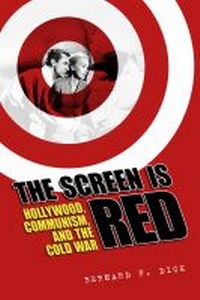
The Screen Is Red
Hollywood, Communism, and the Cold War
Published on 28. February 2018
Book
Paperback/Softback
308 pages
978-1-4968-1493-7 (ISBN)
Description
The Screen Is Red portrays Hollywood's ambivalence toward the former Soviet Union before, during, and after the Cold War. In the 1930s, communism combated its alter ego, fascism, yet both threatened to undermine the capitalist system, the movie industry's foundational core value. Hollywood portrayed fascism as the greater threat and communism as an aberration embraced by young idealists unaware of its dark side. In Ninotchka, all a female commissar needs is a trip to Paris to convert her to capitalism and the luxuries it can offer.
The scenario changed when Nazi Germany invaded the Soviet Union in 1941, making Russia a short-lived ally. The Soviets were quickly glorified in such films as Song of Russia, The North Star, Mission to Moscow, Days of Glory, and Counter-Attack. But once the Iron Curtain fell on Eastern Europe, the scenario changed again. America was now swarming with Soviet agents attempting to steal some crucial piece of microfilm. On screen, the atomic detonations in the Southwest produced mutations in ants, locusts, and spiders, and revived long-dead monsters from their watery tombs. The movies did not blame the atom bomb specifically but showed what horrors might result in addition to the iconic mushroom cloud.Through the lens of Hollywood, a nuclear war might leave a handful of survivors (Five), none (On the Beach, Dr. Strangelove), or cities in ruins (Fail-Safe). Today the threat is no longer the Soviet Union, but international terrorism. Author Bernard F. Dick argues, however, that the Soviet Union has not lost its appeal, as evident from the popular and critically acclaimed television series The Americans. More than eighty years later, the screen is still red.
The scenario changed when Nazi Germany invaded the Soviet Union in 1941, making Russia a short-lived ally. The Soviets were quickly glorified in such films as Song of Russia, The North Star, Mission to Moscow, Days of Glory, and Counter-Attack. But once the Iron Curtain fell on Eastern Europe, the scenario changed again. America was now swarming with Soviet agents attempting to steal some crucial piece of microfilm. On screen, the atomic detonations in the Southwest produced mutations in ants, locusts, and spiders, and revived long-dead monsters from their watery tombs. The movies did not blame the atom bomb specifically but showed what horrors might result in addition to the iconic mushroom cloud.Through the lens of Hollywood, a nuclear war might leave a handful of survivors (Five), none (On the Beach, Dr. Strangelove), or cities in ruins (Fail-Safe). Today the threat is no longer the Soviet Union, but international terrorism. Author Bernard F. Dick argues, however, that the Soviet Union has not lost its appeal, as evident from the popular and critically acclaimed television series The Americans. More than eighty years later, the screen is still red.
Reviews / Votes
Bernard Dick's The Screen Is Red is an important and valuable addition to an already crowded field. It stands out because of its erudition and its encyclopedic scope. It is also beautifully contextualized, immensely readable, and judicious in its analyses."" - Phillip Deery, author of Red Apple: Communism and McCarthyism in Cold War New York""A superbly rendered account of a time in American history all too reminiscent of the toxic rhetoric so much in the air today. Drawing on philosophy, literary theory, and a comprehensive knowledge of cinema, Bernard Dick provides a vivid, crystal-clear report of media and society always in partnership and at bay."" - Paul Levinson, author of The Plot to Save Socrates and McLuhan in an Age of Social Media
More details
Language
English
Place of publication
Jackson
United States
Target group
Professional and scholarly
Dimensions
Height: 229 mm
Width: 152 mm
Thickness: 17 mm
Weight
425 gr
ISBN-13
978-1-4968-1493-7 (9781496814937)
Copyright in bibliographic data and cover images is held by Nielsen Book Services Limited or by the publishers or by their respective licensors: all rights reserved.
Schweitzer Classification
Other editions
Additional editions
E-Book
03/2016
Princeton University Press
€29.49
Available for download
Person
Bernard F. Dick, Teaneck, New Jersey, attended the University of Scranton and Fordham University, from which he received a PhD in classical philology. He has taught classics, world literature, film, and writing during his fifty years in higher education. He has also written a number of books, including Forever Mame: The Life of Rosalind Russell, Claudette Colbert: She Walked in Beauty, and Hollywood Madonna: Loretta Young in University Press of Mississippi's Hollywood Legends Series.