

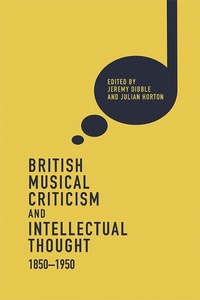
British Musical Criticism and Intellectual Thought, 1850-1950
Published on 15. June 2018
Book
Hardback
390 pages
978-1-78327-287-7 (ISBN)
Description
This collection provides an in-depth look at musical criticism between the mid-nineteenth and the mid-twentieth century.
British music between the mid-nineteenth and the mid-twentieth century reflected changes and developments in society, education, philosophy, aesthetics, politics and the upheaval of wars, often signifying a distinctively British national history. All of these changes informed the published work of contemporary music critics. This collection provides an in-depth look at musical criticism during this period. It focusses on major figures such as Grove,Parry, Shaw, Dent, Newman, Heseltine, Vaughan Williams, Dyson, Lambert and Keller, yet does not neglect less influential but nevertheless significant critics. Sometimes a seminal work forms the subject of investigation; in otherchapters, a writer's particular stance is highlighted. Further contributions closely analyse the now famous polemics by Shaw, Heseltine and Lambert. The book covers a range of themes from the historical, scientific and philosophical to matters of repertoire, taste, interdisciplinary influence, musical democratisation and analysis. It will be of interest to scholars and students of nineteenth- and early twentieth-century British music and music in Britain as well as to music enthusiasts attracted to standard works of popular music criticism.
JEREMY DIBBLE is Professor of Music at Durham University.
JULIAN HORTON is Professor of Music at Durham University.
Contributors: KAREN ARRANDALE, SEAMAS DE BARRA, PHILIP ROSS BULLOCK, JONATHAN CLINCH, SARAH COLLINS, JEREMY DIBBLE, JULIAN HORTON, PETER HORTON, CHRISTOPHER MARK, AIDAN J. THOMSON, PAUL WATT, HARRY WHITE, BENNETT ZON, PATRICKZUK
British music between the mid-nineteenth and the mid-twentieth century reflected changes and developments in society, education, philosophy, aesthetics, politics and the upheaval of wars, often signifying a distinctively British national history. All of these changes informed the published work of contemporary music critics. This collection provides an in-depth look at musical criticism during this period. It focusses on major figures such as Grove,Parry, Shaw, Dent, Newman, Heseltine, Vaughan Williams, Dyson, Lambert and Keller, yet does not neglect less influential but nevertheless significant critics. Sometimes a seminal work forms the subject of investigation; in otherchapters, a writer's particular stance is highlighted. Further contributions closely analyse the now famous polemics by Shaw, Heseltine and Lambert. The book covers a range of themes from the historical, scientific and philosophical to matters of repertoire, taste, interdisciplinary influence, musical democratisation and analysis. It will be of interest to scholars and students of nineteenth- and early twentieth-century British music and music in Britain as well as to music enthusiasts attracted to standard works of popular music criticism.
JEREMY DIBBLE is Professor of Music at Durham University.
JULIAN HORTON is Professor of Music at Durham University.
Contributors: KAREN ARRANDALE, SEAMAS DE BARRA, PHILIP ROSS BULLOCK, JONATHAN CLINCH, SARAH COLLINS, JEREMY DIBBLE, JULIAN HORTON, PETER HORTON, CHRISTOPHER MARK, AIDAN J. THOMSON, PAUL WATT, HARRY WHITE, BENNETT ZON, PATRICKZUK
Reviews / Votes
[A] welcome addition to the growing literature on the writers who sought in one way or another to shape public opinion during an extraordinary period in the evolution of the role of music in British life, marked by radical transformations in musical culture both at home and abroad. . . . [A] major and timely contribution to the field of British music studies. -- Alain Frogley * NABMSA REVIEWS * A well thought-out publication and a substantial contribution to an as yet under-represented area of British music studies. * BRIO * Will be primarily of interest to scholars who wish to gain a quick overview of a particular figure's work. * THE JOURNAL OF MUSIC *More details
Series
Language
English
Place of publication
Woodbridge
United Kingdom
Publishing group
Boydell & Brewer Ltd
Target group
Professional and scholarly
College/higher education
Product notice
Cloth over boards
Illustrations
19 b/w, 3 line illus.
Dimensions
Height: 152 mm
Width: 239 mm
Thickness: 30 mm
Weight
816 gr
ISBN-13
978-1-78327-287-7 (9781783272877)
Copyright in bibliographic data and cover images is held by Nielsen Book Services Limited or by the publishers or by their respective licensors: all rights reserved.
Schweitzer Classification
Other editions
Additional editions
Jeremy Dibble | Julian Horton
British Musical Criticism and Intellectual Thought, 1850-1950
E-Book
06/2018
1st Edition
De Gruyter
€48.99
Available for download
Persons
JEREMY DIBBLE is an Emeritus Professor of Music at Durham University where he taught for 30 years. He is the author of C. Hubert H. Parry: His Life and Music (1998), Charles Villers Stanford: Man and Musician (original edition, 2002), Michele Esposito (2010). With the Boydell Press, Dibble has published John Stainer: A Life in Music (2007), Hamilton Harty: Musical Polymath (2013), British Musical Criticism and Intellectual Thought, 1850-1950 (2018) (with Julian Horton) and The Music of Frederick Delius (2021). HARRY WHITE is Professor of Music at University College Dublin, a Fellow of the Royal Irish Academy of Music and Series Editor (with Lorraine Byrne Bodley) of Irish Musical Studies. JEREMY DIBBLE is an Emeritus Professor of Music at Durham University where he taught for 30 years. He is the author of C. Hubert H. Parry: His Life and Music (1998), Charles Villers Stanford: Man and Musician (original edition, 2002), Michele Esposito (2010). With the Boydell Press, Dibble has published John Stainer: A Life in Music (2007), Hamilton Harty: Musical Polymath (2013), British Musical Criticism and Intellectual Thought, 1850-1950 (2018) (with Julian Horton) and The Music of Frederick Delius (2021). KAREN ARRANDALE is a Life Member of Clare Hall, University of Cambridge, and former Senior Associate of King's College, Cambridge. PAUL WATT is Adjunct Professor of Musicology in The University of Adelaide. He is the author of Ernest Newman: A Critical Biography (The Boydell Press, 2017) and editor of The Symphonic Poem in Britain, 1850-1950 (with Michael Allis) (The Boydell Press, 2020). PHILIP ROSS BULLOCK is Professor of Russian and Music at the University of Oxford, and Fellow and Tutor in Russian at Wadham College, Oxford. Previously for Boydell,he has published a translation of the correspondencence between Rosa Newmarch and Jean Sibelius, and in 2016, his biography of Tchaikovsky was published in the Critical Lives series by Reaktion.
Content
Introduction: Trends in British Musical Thought, 1850-1950 - Jeremy Dibble and Julian Horton
Avoiding 'Coarse Invective' and 'Unseemly Vehemence': English Music Criticism, 1850-1870 - Peter Horton
Spencer, Sympathy and the Oxford School of Music Criticism - Bennett Zon
Free Thought and the Musician: Ernest Walker, the 'English Hanslick' - Jeremy Dibble
Ernest Newman and the Promise of Method in Biography, Criticism and History - Paul Watt
'Making Symphony Articulate': Bernard Shaw's Sense of Music History - Harry White
Analysis and Value Judgment: Schumann, Bruckner and Tovey's Essays in Musical Analysis - Julian Horton
The Scholar as Critic: Edward J. Dent - Karen Arrandale
Russia and Eastern Europe - Philip Ross Bullock
Anti-Intellectualism and the Rhetoric of 'National Character' in Music: The Vulgarity of Over-Refinement - Sarah Collins
Chosen Causes: Writings on Music by Bernard van Dieren, Peter Warlock and Cecil Gray - Seamas de Barra
'Es klang so alt und war doch so neu': Vaughan Williams, Aesthetics and History - Aidan J. Thomson
Constant Lambert: A Critic for Today? A Commentary on Music Ho! - Christopher Mark
The Challenge to Goodwill: Herbert Howells, Alban Berg and 'The Modern Problem' - Jonathan Clinch
Hans Keller: The Making of an 'Anti-Critic' -
Select Bibliography
Avoiding 'Coarse Invective' and 'Unseemly Vehemence': English Music Criticism, 1850-1870 - Peter Horton
Spencer, Sympathy and the Oxford School of Music Criticism - Bennett Zon
Free Thought and the Musician: Ernest Walker, the 'English Hanslick' - Jeremy Dibble
Ernest Newman and the Promise of Method in Biography, Criticism and History - Paul Watt
'Making Symphony Articulate': Bernard Shaw's Sense of Music History - Harry White
Analysis and Value Judgment: Schumann, Bruckner and Tovey's Essays in Musical Analysis - Julian Horton
The Scholar as Critic: Edward J. Dent - Karen Arrandale
Russia and Eastern Europe - Philip Ross Bullock
Anti-Intellectualism and the Rhetoric of 'National Character' in Music: The Vulgarity of Over-Refinement - Sarah Collins
Chosen Causes: Writings on Music by Bernard van Dieren, Peter Warlock and Cecil Gray - Seamas de Barra
'Es klang so alt und war doch so neu': Vaughan Williams, Aesthetics and History - Aidan J. Thomson
Constant Lambert: A Critic for Today? A Commentary on Music Ho! - Christopher Mark
The Challenge to Goodwill: Herbert Howells, Alban Berg and 'The Modern Problem' - Jonathan Clinch
Hans Keller: The Making of an 'Anti-Critic' -
Select Bibliography