

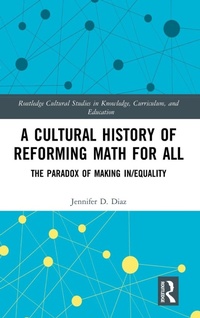
A Cultural History of Reforming Math for All
The Paradox of Making In/equality
1st Edition
Published on 3. October 2017
Book
Hardback
134 pages
978-1-138-63840-2 (ISBN)
Description
While many accept that math is a universal, culturally indifferent subject in school, this book demonstrates that this is anything but true. Building off of a historically conscious understanding of school reform, Diaz makes the case that the language of mathematics, and the symbols through which it is communicated, is not merely about the alleged cultural indifference of mathematical thinking; rather, mathematical teaching relates to historical, cultural, political, and social understandings of equality that order who the child is and should be. Focusing on elementary math for all education reforms in America since the mid-twentieth century, Diaz offers an alternative way of thinking about the subject that recognizes the historical making of contemporary notions of inequality and difference.
More details
Series
Language
English
Place of publication
London
United Kingdom
Publishing group
Taylor & Francis Ltd
Target group
College/higher education
Dimensions
Height: 235 mm
Width: 157 mm
Thickness: 12 mm
Weight
356 gr
ISBN-13
978-1-138-63840-2 (9781138638402)
Copyright in bibliographic data and cover images is held by Nielsen Book Services Limited or by the publishers or by their respective licensors: all rights reserved.
Schweitzer Classification
Other editions
Additional editions
Book
12/2019
1st Edition
Routledge
€62.30
Shipment within 15-20 days
E-Book
09/2017
Routledge
€55.49
Available for download
E-Book
09/2017
Routledge
€55.49
Available for download
Person
Jennifer D. Diaz is Assistant Professor of Education at Augsburg University, USA.
Content
1. Introduction: The Study of School Mathematics is Not About Mathematics 2. The Cultural Politics of School Math: The Problem of In/Equality in the Equal Sign 3. Post War Planning, Reforming Mathematics, and the Cultural (Re)production of Children 4. Creating the Great Society: Making New Math, the Mathematical Citizen, and the Problem of Disadvantage 5. Civil Rights, Fears of Failure, and the Motivation of Basic Skills: Fabricating the Mathematically Dis/abled Individual 6. Planning the 21st Century Future: Standardizing Mathematical Kinds of People to Manage Risk 7. The Alchemy of School Subjects and the Im/Possibilities of Reform