

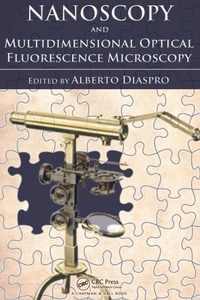
Nanoscopy and Multidimensional Optical Fluorescence Microscopy
1st Edition
Published on 26. April 2010
Book
Hardback
448 pages
978-1-4200-7886-2 (ISBN)
Description
"Alberto Diaspro has been choreographing light's dance for over 20 years,
and in Nanoscopy and Multidimensional Optical Fluorescence Microscopy, he has assembled a diverse group of experts to explain the methods they use to coax light to reveal biology's secrets."
- From the Foreword by Daniel Evanko, editor, Nature Methods
Nanoscopy and Multidimensional Optical Fluorescence Microscopy demonstrates that the boundaries between sciences do blur at the bottom, especially those that might separate the optical work of physicists and the cellular work of microbiologists. In 18 chapters written by pioneering researchers, this work offers the first comprehensive and current documentation of the cutting-edge research being accomplished in a wide range of photonic devices with revolutionary application.
The highlight of the book is its coverage of optical nanoscopy and super-resolution microscopy. The rapid advances in this area over the past few years offer researchers in both photonics and molecular biologya wealth of accomplishment upon which they can build.
Offering a complete treatment of this emerging field, this volume:
Describes how scientists have exploited the properties of light and its fluorophore partners to overcome the resolution limit of conventional light microscopy
Delves into recent ways to minimize the photobleaching that has long hampered many methods including those that have the potential to capture previously unobtainable information on the movements of single molecules
Discusses the principles, benefits, and implementation of fluorescence correlation spectroscopy and related methods, which simplifies analysis by limiting light to stationary focal points in a sample
Considers the most basic as well as emerging methods for improving three-dimensional optical sectioning microscopy
Reviews the basics of FRET (
and in Nanoscopy and Multidimensional Optical Fluorescence Microscopy, he has assembled a diverse group of experts to explain the methods they use to coax light to reveal biology's secrets."
- From the Foreword by Daniel Evanko, editor, Nature Methods
Nanoscopy and Multidimensional Optical Fluorescence Microscopy demonstrates that the boundaries between sciences do blur at the bottom, especially those that might separate the optical work of physicists and the cellular work of microbiologists. In 18 chapters written by pioneering researchers, this work offers the first comprehensive and current documentation of the cutting-edge research being accomplished in a wide range of photonic devices with revolutionary application.
The highlight of the book is its coverage of optical nanoscopy and super-resolution microscopy. The rapid advances in this area over the past few years offer researchers in both photonics and molecular biologya wealth of accomplishment upon which they can build.
Offering a complete treatment of this emerging field, this volume:
Describes how scientists have exploited the properties of light and its fluorophore partners to overcome the resolution limit of conventional light microscopy
Delves into recent ways to minimize the photobleaching that has long hampered many methods including those that have the potential to capture previously unobtainable information on the movements of single molecules
Discusses the principles, benefits, and implementation of fluorescence correlation spectroscopy and related methods, which simplifies analysis by limiting light to stationary focal points in a sample
Considers the most basic as well as emerging methods for improving three-dimensional optical sectioning microscopy
Reviews the basics of FRET (
Reviews / Votes
This book certainly appears at the right time ... . The book should be useful for senior research students in optical microscopy and biophotonics. -Professor Min Gu, Swinburne University of Technology, Melbourne, Australia A very useful book for the microscopy field. Alberto Diaspro has done a great job as editor, and I'm sure this book will be appreciated by its readers. -Professor Peter Saggau, Baylor College of Medicine, Texas, USA ... with over sixty contributing authors, this elegant book should impress many optical manufacturers ... -Optical World, August 2010More details
Language
English
Place of publication
Oxford
United Kingdom
Publishing group
Taylor & Francis Ltd
Target group
Professional and scholarly
Academic and Professional Practice & Development
Product notice
Paper over boards
Illustrations
180 b/w images, 26 color images and 5 tables
Dimensions
Height: 260 mm
Width: 183 mm
Thickness: 29 mm
Weight
1035 gr
ISBN-13
978-1-4200-7886-2 (9781420078862)
Copyright in bibliographic data and cover images is held by Nielsen Book Services Limited or by the publishers or by their respective licensors: all rights reserved.
Schweitzer Classification
Other editions
Additional editions
Alberto Diaspro
Nanoscopy and Multidimensional Optical Fluorescence Microscopy
Book
10/2019
1st Edition
Chapman & Hall/CRC
€130.10
Shipment within 15-20 days
Alberto Diaspro
Nanoscopy and Multidimensional Optical Fluorescence Microscopy
E-Book
04/2010
1st Edition
Chapman & Hall/CRC
€89.99
Available for download
Alberto Diaspro
Nanoscopy and Multidimensional Optical Fluorescence Microscopy
E-Book
04/2010
Chapman and Hall
€89.99
Available for download
Person
Alberto Diaspro
Content
Optical Microsopy and Nanoscopy. Basis if Fluorescence Spectroscopy. Basis of Optics for Microscopy. Scanning Microscopy at the Nanoscale. 3D Computational Optical Sectioning Microscopy. Multiphoton Microscopy at the Nanoscale. Confocal Microscopy at the Nanoscale. 7D Microscopy. Lifetime Imaging Microscopy. Fluorescence Correlation Spectroscopy. FRET/FRAP. Single Molecule Microscopy. Single Particle Tracking (SPT). Fluorescent Probe. Fluorescence Photoactivation and Photoswitching. Fluorescent Nanotubes and Nanowires. Scattering Processes. SHG/THG (Second/Third Harmonic Generation) Microscopy. Near Field Microscopy. TIRF (Total Internal Reflection Fluorescence) Microscopy.