

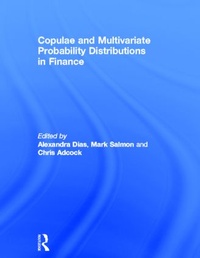
Copulae and Multivariate Probability Distributions in Finance
1st Edition
Published on 21. March 2013
Book
Hardback
206 pages
978-0-415-81485-0 (ISBN)
Description
Portfolio theory and much of asset pricing, as well as many empirical applications, depend on the use of multivariate probability distributions to describe asset returns. Traditionally, this has meant the multivariate normal (or Gaussian) distribution. More recently, theoretical and empirical work in financial economics has employed the multivariate Student (and other) distributions which are members of the elliptically symmetric class. There is also a growing body of work which is based on skew-elliptical distributions. These probability models all exhibit the property that the marginal distributions differ only by location and scale parameters or are restrictive in other respects. Very often, such models are not supported by the empirical evidence that the marginal distributions of asset returns can differ markedly. Copula theory is a branch of statistics which provides powerful methods to overcome these shortcomings. This book provides a synthesis of the latest research in the area of copulae as applied to finance and related subjects such as insurance. Multivariate non-Gaussian dependence is a fact of life for many problems in financial econometrics. This book describes the state of the art in tools required to deal with these observed features of financial data.
This book was originally published as a special issue of the European Journal of Finance.
This book was originally published as a special issue of the European Journal of Finance.
More details
Language
English
Place of publication
London
United Kingdom
Publishing group
Taylor & Francis Ltd
Target group
College/higher education
Dimensions
Height: 246 mm
Width: 189 mm
Weight
540 gr
ISBN-13
978-0-415-81485-0 (9780415814850)
Copyright in bibliographic data and cover images is held by Nielsen Book Services Limited or by the publishers or by their respective licensors: all rights reserved.
Schweitzer Classification
Other editions
Additional editions
Alexandra Dias | Mark Salmon | Chris Adcock
Copulae and Multivariate Probability Distributions in Finance
Book
08/2018
1st Edition
Routledge
€62.08
Shipment within 10-20 days

Alexandra Dias | Mark Salmon | Chris Adcock
Copulae and Multivariate Probability Distributions in Finance
E-Book
08/2013
Routledge
€47.49
Available for download

Alexandra Dias | Mark Salmon | Chris Adcock
Copulae and Multivariate Probability Distributions in Finance
E-Book
08/2013
Routledge
€47.49
Available for download
Persons
Alexandra Dias is Lecturer in Finance at the University of Leicester, UK. She has previously been Lecturer at Warwick Business School, UK, a Credit Analyst at Credit Suisse (Zurich) and a Research Associate at RiskLab, ETH-Zurich. She holds a PhD in Mathematics, an MSc in Actuarial Science and Financial Risk Management and a 'Licenciatura' in Mathematics. Her research interests include financial risk management, portfolio selection, extreme events in finance, and dependence modelling with copulas.
Mark Salmon is Senior Scientist at BH-DG Systematic Trading, UK, Visiting Professor in the Economics Faculty at Cambridge University, UK, and Advisor to Old Mutual Asset Managers, UK. He has served as a consultant to a number of city institutions and was an advisor to the Bank of England for 6 years. He was also a member of a "Task Force" set up by the European Commission to consider exchange rate policy for the EURO. Mark has been a member of the European Financial Markets Advisory Panel and has worked with the National Bank of Hungary on transition policies towards membership of the European Union. His research interests lie in Financial Econometrics, Behavioural Finance and International Macroeconomics.
Chris Adcock is Professor of Financial Econometrics in the University of Sheffield, UK, and Visiting Professor of quantitative finance at the University of Southampton, UK. He is the founding editor of the European Journal of Finance and is one of the founding Associate Editors of the Journal of Mathematical Finance. Chris has acted as an advisor to a number of international investment managers and algorithms he has designed have been used by Citibank and DSI International Investment Management, now part of UBS, as well as to several other asset management groups. His current research interests are centred around the development of portfolio selection and asset pricing theory.
Mark Salmon is Senior Scientist at BH-DG Systematic Trading, UK, Visiting Professor in the Economics Faculty at Cambridge University, UK, and Advisor to Old Mutual Asset Managers, UK. He has served as a consultant to a number of city institutions and was an advisor to the Bank of England for 6 years. He was also a member of a "Task Force" set up by the European Commission to consider exchange rate policy for the EURO. Mark has been a member of the European Financial Markets Advisory Panel and has worked with the National Bank of Hungary on transition policies towards membership of the European Union. His research interests lie in Financial Econometrics, Behavioural Finance and International Macroeconomics.
Chris Adcock is Professor of Financial Econometrics in the University of Sheffield, UK, and Visiting Professor of quantitative finance at the University of Southampton, UK. He is the founding editor of the European Journal of Finance and is one of the founding Associate Editors of the Journal of Mathematical Finance. Chris has acted as an advisor to a number of international investment managers and algorithms he has designed have been used by Citibank and DSI International Investment Management, now part of UBS, as well as to several other asset management groups. His current research interests are centred around the development of portfolio selection and asset pricing theory.
Content
Preface Chris Adcock, Alexandra Dias and Mark Salmon 1. The Advent of Copulas in Finance Christian Genest, Michel Gendron and Michael Bourdeau-Brien 2. Testing for structural changes in exchange rates' dependence beyond linear correlation Alexandra Dias and Paul Embrechts 3. Models for construction of multivariate dependence - a comparison study Kjersti Aas and Daniel Berg 4. Dependency without copulas or ellipticity William T. Shaw and Asad Munir 5. Copula goodness-of-fit testing: an overview and power comparison Daniel Berg 6. Asymmetric dependence patterns in financial time series Manuel Ammann and Stephan Suess 7. Dynamic copula quantile regressions and tail area dynamic dependence in Forex markets Eric Bouye and Mark Salmon 8. Risk and return of reinsurance contracts under copula models Martin Eling and Denis Toplek 9. Pricing bivariate option under GARCH-GH model with dynamic copula: application for Chinese market Dominique Guegan and Jing Zang