

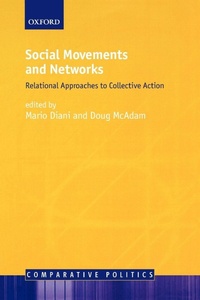
Social Movements and Networks
Relational Approaches to Collective Action
Published on 13. February 2003
Book
Paperback/Softback
370 pages
978-0-19-925178-0 (ISBN)
Description
This text examines the extent to which a network approach should inform research on collective action. Leading social movements researchers systematically map out and assess the contribution of social network approaches to their field of enquiry in light of broader theoretical perspective. By exploring how networks affect individual contributions to collective action in both democratic and non-democratic organizations, and how patterns of inter-organizational linkages affect the circulation of resources within and between movements, the authors show how network concepts improve our grasp of the relationship between social movements and elites and of the dynamics of the political processes.
More details
Series
Language
English
Place of publication
Oxford
United Kingdom
Target group
Professional and scholarly
Illustrations
numerous figures
Dimensions
Height: 234 mm
Width: 156 mm
Thickness: 21 mm
Weight
562 gr
ISBN-13
978-0-19-925178-0 (9780199251780)
Copyright in bibliographic data and cover images is held by Nielsen Book Services Limited or by the publishers or by their respective licensors: all rights reserved.
Schweitzer Classification
Other editions
Additional editions
Book
02/2003
Oxford University Press
€246.50
Shipment within 15-20 days
Persons
Mario Diani is Professor of Sociology at the University of Trento, Italy, and the European Editor of Mobilization.
Doug McAdam is Professor of Sociology at Stanford University, and Director of the Center for Advanced Study in the Behavioral Sciences.
Doug McAdam is Professor of Sociology at Stanford University, and Director of the Center for Advanced Study in the Behavioral Sciences.
Content
PART I. INDIVIDUAL NETWORKS; PART II. INTERORGANIZATIONAL NETWORKS; PART III. NETWORKING THE POLITICAL PROCESS; PART IV. THEORIES OF NETWORKS, MOVEMENTS, AND COLLECTIVE ACTION