

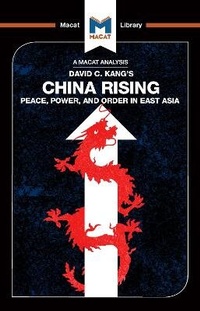
China Rising
Peace, Power and Order in East Asia
1st Edition
Published on 15. July 2017
Book
Hardback
112 pages
978-1-912303-31-1 (ISBN)
Description
A critical analysis of David C. Kang's China Rising, which is a fine example of an author making use of creative thinking skills to reach a conclusion that flies in the face of traditional thinking.
The conventional view that the book opposed, known in international relations as 'realism,' was that the rise of any new global power results in global or regional instability. As such, China's development as a world economic powerhouse worried mainstream western geopolitical scholars, whose concerns were based on the realist assumption that individual countries will inevitably compete for dominance. Evaluating these arguments, and finding both their relevance and adequacy wanting, Kang instead turned traditional thinking on its head by looking at Asian history without preconceptions, and with analytical open-mindedness.
Producing several novel explanations for existing evidence, Kang concludes that China's neighbors do not want to compete with it in the way that realist interpretations predict. Rather than creating instability by jockeying for position, he argues, surrounding countries are happy for China to be acknowledged as a leader, believing that its dominant position will stabilize Asia, and give the whole region more of a hand in international relations.
Though critics have taken issue with Kang's conclusions, his paradigm-shifting approach is nevertheless an excellent example of developing fresh new conclusions through creative thinking.
The conventional view that the book opposed, known in international relations as 'realism,' was that the rise of any new global power results in global or regional instability. As such, China's development as a world economic powerhouse worried mainstream western geopolitical scholars, whose concerns were based on the realist assumption that individual countries will inevitably compete for dominance. Evaluating these arguments, and finding both their relevance and adequacy wanting, Kang instead turned traditional thinking on its head by looking at Asian history without preconceptions, and with analytical open-mindedness.
Producing several novel explanations for existing evidence, Kang concludes that China's neighbors do not want to compete with it in the way that realist interpretations predict. Rather than creating instability by jockeying for position, he argues, surrounding countries are happy for China to be acknowledged as a leader, believing that its dominant position will stabilize Asia, and give the whole region more of a hand in international relations.
Though critics have taken issue with Kang's conclusions, his paradigm-shifting approach is nevertheless an excellent example of developing fresh new conclusions through creative thinking.
More details
Series
Language
English
Place of publication
London
United Kingdom
Dimensions
Height: 198 mm
Width: 129 mm
Weight
340 gr
ISBN-13
978-1-912303-31-1 (9781912303311)
Copyright in bibliographic data and cover images is held by Nielsen Book Services Limited or by the publishers or by their respective licensors: all rights reserved.
Schweitzer Classification
Other editions
Additional editions
Book
07/2017
1st Edition
Macat International Limited
€12.70
Shipment within 3-4 weeks
Matteo Dian | Jason Xidias
An Analysis of David C. Kang's China Rising
Peace, Power and Order in East Asia
E-Book
07/2017
Routledge
€8.99
Available for download
Matteo Dian | Jason Xidias
An Analysis of David C. Kang's China Rising
Peace, Power and Order in East Asia
E-Book
07/2017
Routledge
€8.99
Available for download
Person
Dr Matteo Dian holds a PhD in international relations from the Scuola Normale Superiore di Pisa, where he research focused on the evolution of the US-Japanese alliance after World War II. He is currently a research fellow at the University of Bologna, where he continues to work on international relations with a special focus on the place of China in world politics.
Dr Jason Xidias has held positions at King's College London, the University of California, Berkeley, and the New College of the Humanities in London.
Dr Jason Xidias has held positions at King's College London, the University of California, Berkeley, and the New College of the Humanities in London.
Content
Ways In to the Text Who was David C. Kang? What does China Rising Say? Why does China Rising Matter? Section 1: Influences Module 1: The Author and the Historical Context Module 2: Academic Context Module 3: The Problem Module 4: The Author's Contribution Section 2: Ideas Module 5: Main Ideas Module 6: Secondary Ideas Module 7: Achievement Module 8: Place in the Author's Work Section 3: Impact Module 9: The First Responses Module 10: The Evolving Debate Module 11: Impact and Influence Today Module 12: Where Next? Glossary of Terms People Mentioned in the Text Works Cited