

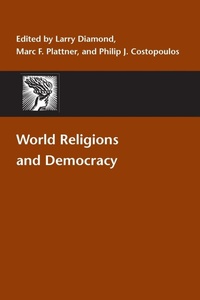
World Religions and Democracy
Published on 27. April 2005
Book
Paperback/Softback
288 pages
978-0-8018-8080-3 (ISBN)
Description
Can religion be compatible with liberal democracy? World Religions and Democracy brings together insights from renowned scholars and world leaders in a provocative and timely discussion of religions' role in the success or failure of democracy. An essay by Alfred Stepan outlines the concept of "twin tolerations" and differentiation, and creates a template that can be applied to all of the religion-democracy relationships observed and analyzed throughout the volume. "Twin tolerations" means that there is a clear distinction and a mutual respect between political authorities and religious leaders and bodies. When true differentiation is accomplished, the religious sector enjoys freedom of activity and the ability to peacefully influence its members but does not wield direct political power. A country's ability to implement the principle of differentiation directly affects the successful development of democracy. Part two focuses on eastern religions-Confucianism, Hinduism, and Buddhism-and includes contributions from Nobel Prize winner Aung San Suu Kyi and His Holiness the Dalai Lama.
The third part addresses democracy in relationship to Judaism and the three branches of Christianity-Catholicism, Protestantism, and Eastern Orthodoxy. Sociologist Peter Berger offers a global perspective of Christianity and democracy. The volume's final section discusses what is perhaps the most challenging example of the struggling relationship between religion and democracy today: Islam and the governments of the Muslim nations. Abdou Filali-Ansary, Bernard Lewis, and others present a comprehensive exploration of Muslim thought and faith in an increasingly secular, modern world. It is in this volatile political and religious climate that solutions are most urgently needed but also most elusive. Contributors: Alfred Stepan, Hahm Chaibong, Francis Fukuyama, Pratap Mehta, His Holiness the Dalai Lama, Aung San Suu Kyi, Hillel Fradkin, Daniel Philpott, Tim Shah, Robert Woodberry, Elizabeth Prodromou, Peter Berger, Abdou Filali-Ansary, Bernard Lewis, Robin Wright, Abdelwahab El-Affendi, Radwan A. Masmoudi, Laith Kubba, Ladan Boroumand, Roya Boroumand.
The third part addresses democracy in relationship to Judaism and the three branches of Christianity-Catholicism, Protestantism, and Eastern Orthodoxy. Sociologist Peter Berger offers a global perspective of Christianity and democracy. The volume's final section discusses what is perhaps the most challenging example of the struggling relationship between religion and democracy today: Islam and the governments of the Muslim nations. Abdou Filali-Ansary, Bernard Lewis, and others present a comprehensive exploration of Muslim thought and faith in an increasingly secular, modern world. It is in this volatile political and religious climate that solutions are most urgently needed but also most elusive. Contributors: Alfred Stepan, Hahm Chaibong, Francis Fukuyama, Pratap Mehta, His Holiness the Dalai Lama, Aung San Suu Kyi, Hillel Fradkin, Daniel Philpott, Tim Shah, Robert Woodberry, Elizabeth Prodromou, Peter Berger, Abdou Filali-Ansary, Bernard Lewis, Robin Wright, Abdelwahab El-Affendi, Radwan A. Masmoudi, Laith Kubba, Ladan Boroumand, Roya Boroumand.
Reviews / Votes
A rich feast of the topic. -- Majid Tehranian Journal of Interdisciplinary Studies 2007More details
Series
Language
English
Place of publication
Baltimore, MD
United States
Target group
Professional and scholarly
College/higher education
Product notice
Paperback (trade)
Dimensions
Height: 229 mm
Width: 152 mm
Thickness: 17 mm
Weight
474 gr
ISBN-13
978-0-8018-8080-3 (9780801880803)
DOI
10.56021/9780801880797
Copyright in bibliographic data and cover images is held by Nielsen Book Services Limited or by the publishers or by their respective licensors: all rights reserved.
Schweitzer Classification
Other editions
Additional editions
Larry Diamond | Marc F. Plattner | Philip J. Costopoulos
World Religions and Democracy
Book
04/2005
Johns Hopkins University Press
€52.00
Article not available for order
Persons
Larry Diamond, senior fellow at the Hoover Institution, is codirector, with Marc F. Plattner, of the International Forum for Democratic Studies. He is also coeditor, with Marc Plattner, of the Journal of Democracy and of other collections of essays available from Johns Hopkins, including The Global Resurgence of Democracy, Consolidating the Third Wave Democracies, and The Global Divergence of Democracies. Philip J. Costopoulos is executive editor of the Journal of Democracy.
Content
Acknowledgements
Introduction
Part I: A Conceptual Framework
Chapter 1. Religion, Democracy, and the "Twin Tolerations"
Part II: Eastern Religions
Chapter 2. The Ironies of Confucianism
Chapter 3. Confucianism and Democracy
Chapter 4. Hinduism and Self-Rule
Chapter 5. Buddhism, Asian Values, and Democracy
Chapter 6. Burma's Quest for Democracy
Part III: Judaism and Christianity
Chapter 7. Judaism and Political Life
Chapter 8. The Catholic Wave
Chapter 9. The Pioneering Protestants
Chapter 10. The Ambivalent Orthodox
Chapter 11. Christianity: The Global Picture
Part IV: Islam
Chapter 12. Muslims and Democracy
Chapter 13. A Historical Overview
Chapter 14. Two Visions of Reformation
Chapter 15. The Challenge of Secularization
Chapter 16. The Sources of Enlightened Muslim Thought
Chapter 17. The Elusive Reformation
Chapter 18. The Silent Majority
Chapter 19. Faith and Modernity
Chapter 20. Terror, Islam, and Democracy
Epilogue: Does Democracy Need Religion
Index
Introduction
Part I: A Conceptual Framework
Chapter 1. Religion, Democracy, and the "Twin Tolerations"
Part II: Eastern Religions
Chapter 2. The Ironies of Confucianism
Chapter 3. Confucianism and Democracy
Chapter 4. Hinduism and Self-Rule
Chapter 5. Buddhism, Asian Values, and Democracy
Chapter 6. Burma's Quest for Democracy
Part III: Judaism and Christianity
Chapter 7. Judaism and Political Life
Chapter 8. The Catholic Wave
Chapter 9. The Pioneering Protestants
Chapter 10. The Ambivalent Orthodox
Chapter 11. Christianity: The Global Picture
Part IV: Islam
Chapter 12. Muslims and Democracy
Chapter 13. A Historical Overview
Chapter 14. Two Visions of Reformation
Chapter 15. The Challenge of Secularization
Chapter 16. The Sources of Enlightened Muslim Thought
Chapter 17. The Elusive Reformation
Chapter 18. The Silent Majority
Chapter 19. Faith and Modernity
Chapter 20. Terror, Islam, and Democracy
Epilogue: Does Democracy Need Religion
Index