

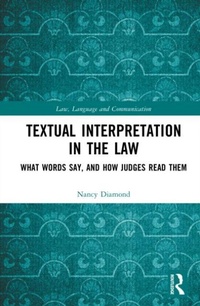
Textual Interpretation in the Law
What Words Say, and How Judges Read Them
1st Edition
Will be published approx. on 30. October 2026
Book
Hardback
350 pages
978-1-032-96486-7 (ISBN)
Description
How do courts choose among competing readings of a text? This work draws on linguistics, philosophy of language, hermeneutics, and literary criticism for insights into how texts impart meaning. Through vivid examples and in-depth case studies-of reported judicial decisions rather than stylized hypotheticals-it translates learnings into practical guidance.
Many interpretive disputes arise from ordinary linguistic indeterminacy. Part I develops a taxonomy of linguistic features that create uncertainty, including issues overlooked in legal scholarship. It demonstrates that, despite a rich literature on the very problems that courts grapple with, judges rely primarily on their own intuitions, often reaching conclusions that diverge from current theory. Part II describes processes by which implicit meaning is inferred, and marshals evidence that judicial reasoning reflects these processes. It shows that presuppositional content, though rarely recognized as such, can be outcome-determinative, and challenges the orthodoxy that implicature plays only a minimal role in judicial reasoning.
Readers will emerge with a toolkit-diagnostic tests, checklists, analytic methods, and heuristics-for categorizing linguistic phenomena, resolving ambiguities, and constructing (or spotting fallacies in) text-based arguments. This book will be a valuable resource for academics, researchers, and practitioners-in law, philosophy, pragmatics, communications, and forensic linguistics.
Many interpretive disputes arise from ordinary linguistic indeterminacy. Part I develops a taxonomy of linguistic features that create uncertainty, including issues overlooked in legal scholarship. It demonstrates that, despite a rich literature on the very problems that courts grapple with, judges rely primarily on their own intuitions, often reaching conclusions that diverge from current theory. Part II describes processes by which implicit meaning is inferred, and marshals evidence that judicial reasoning reflects these processes. It shows that presuppositional content, though rarely recognized as such, can be outcome-determinative, and challenges the orthodoxy that implicature plays only a minimal role in judicial reasoning.
Readers will emerge with a toolkit-diagnostic tests, checklists, analytic methods, and heuristics-for categorizing linguistic phenomena, resolving ambiguities, and constructing (or spotting fallacies in) text-based arguments. This book will be a valuable resource for academics, researchers, and practitioners-in law, philosophy, pragmatics, communications, and forensic linguistics.
Reviews / Votes
"Textual Interpretation in the Law is a must read for lawyers, who need to learn what language is really like, a highly recommended read for linguists, who need to learn how their theories play out in judicial discourse, and a pleasure to read for just about anybody."Mira Ariel, Professor Emeritus, Department of Linguistics,Tel Aviv University
More details
Series
Language
English
Place of publication
London
United Kingdom
Publishing group
Taylor & Francis Ltd
Target group
College/higher education
Postgraduate
Illustrations
11 s/w Zeichnungen, 11 s/w Abbildungen
11 Line drawings, black and white; 11 Illustrations, black and white
Dimensions
Height: 234 mm
Width: 156 mm
ISBN-13
978-1-032-96486-7 (9781032964867)
Copyright in bibliographic data and cover images is held by Nielsen Book Services Limited or by the publishers or by their respective licensors: all rights reserved.
Schweitzer Classification
Person
N. H. E. Diamond studied Linguistics and Applied Mathematics at Harvard University, holds a law degree from the University of Virginia, and spent more than twenty years as a transactional lawyer specializing in franchise, retail, and sales and distribution.
Content
Introduction Part I: Linguistic Indeterminacy and its resolution Chapter 1. Why linguistics? Chapter 2. Lexical ambiguity Chapter 3. Syntactic ambiguity Chapter 4. Scope ambiguity Chapter 5. Indeterminacy of reference: definite descriptions and names Chapter 6. Indeterminacy of reference: indefinite descriptions Chapter 7. Anaphora and discourse deixis Part II: Pragmatic Processes in Interpretation Chapter 8. Implication and Inference Chapter 9. Presupposition Chapter 10. Implicature Chapter 11. Literal meaning.