

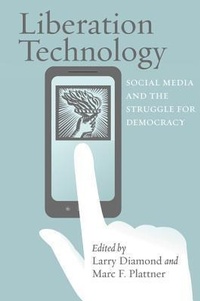
Liberation Technology
Social Media and the Struggle for Democracy
Will be published approx. on 24. September 2012
Book
Hardback
208 pages
978-1-4214-0567-4 (ISBN)
Description
The revolutions sweeping the Middle East provide dramatic evidence of the role that technology plays in mobilizing citizen protest and upending seemingly invulnerable authoritarian regimes. A grainy cell phone video of a Tunisian street vendor's self-immolation helped spark the massive protests that toppled longtime ruler Zine El Abidine Ben Ali, and Egypt's "Facebook revolution" forced the ruling regime out of power and into exile. While such "Liberation Technology" has been instrumental in freeing Egypt and Tunisia, other cases - such as China and Iran - demonstrate that it can be deployed just as effectively by authoritarian regimes seeking to control the Internet, stifle protest, and target dissenters. This two-sided dynamic has set off an intense technological race between "netizens" demanding freedom and authoritarians determined to retain their grip on power. "Liberation Technology" brings together cutting-edge scholarship from scholars and practitioners at the forefront of this burgeoning field of study.
An introductory section defines the debate with a foundational piece on liberation technology and is then followed by essays discussing the popular dichotomy of "liberation" versus "control" with regard to the Internet and the sociopolitical dimensions of such controls. Additional chapters delve into the cases of individual countries: China, Egypt, Iran, and Tunisia. This book also includes in-depth analysis of specific technologies such as Ushahidi - a platform developed to document human-rights abuses in the wake of Kenya's 2007 elections - and alkasir - a tool that has been used widely throughout the Middle East to circumvent cyber-censorship. "Liberation Technology" will prove an essential resource for all students seeking to understand the intersection of information and communications technology and the global struggle for democracy. Contributors: Walid Al-Saqaf, Daniel Calingaert, Ronald Deibert, Larry Diamond, Elham Gheytanchi, Philip N. Howard, Muzammil M. Hussain, Rebecca MacKinnon, Patrick Meier, Evgeny Morozov, Xiao Qiang, Rafal Rohozinski and Mehdi Yahyanejad.
An introductory section defines the debate with a foundational piece on liberation technology and is then followed by essays discussing the popular dichotomy of "liberation" versus "control" with regard to the Internet and the sociopolitical dimensions of such controls. Additional chapters delve into the cases of individual countries: China, Egypt, Iran, and Tunisia. This book also includes in-depth analysis of specific technologies such as Ushahidi - a platform developed to document human-rights abuses in the wake of Kenya's 2007 elections - and alkasir - a tool that has been used widely throughout the Middle East to circumvent cyber-censorship. "Liberation Technology" will prove an essential resource for all students seeking to understand the intersection of information and communications technology and the global struggle for democracy. Contributors: Walid Al-Saqaf, Daniel Calingaert, Ronald Deibert, Larry Diamond, Elham Gheytanchi, Philip N. Howard, Muzammil M. Hussain, Rebecca MacKinnon, Patrick Meier, Evgeny Morozov, Xiao Qiang, Rafal Rohozinski and Mehdi Yahyanejad.
More details
Series
Language
English
Place of publication
Baltimore, MD
United States
Target group
College/higher education
Product notice
sewn/stitched
Cloth over boards
Illustrations
2 Schaubilder
2 Figures
Dimensions
Height: 233 mm
Width: 159 mm
Thickness: 20 mm
Weight
413 gr
ISBN-13
978-1-4214-0567-4 (9781421405674)
DOI
10.1353/book.72079
Copyright in bibliographic data and cover images is held by Nielsen Book Services Limited or by the publishers or by their respective licensors: all rights reserved.
Schweitzer Classification
Other editions
Additional editions
Book
09/2012
Johns Hopkins University Press
€30.00
Article not available at the moment

E-Book
09/2012
Johns Hopkins University Press
€20.99
Available for download
Persons
Larry Diamond is senior fellow at the Hoover Institution and at Stanford's Freeman Spogli Institute for International Studies, where he directs the Center on Democracy, Development, and the Rule of Law. Marc F. Plattner is vice president for research and studies at the National Endowment for Democracy. Plattner and Diamond are coeditors of the Journal of Democracy.
Content
Acknowledgments
Introduction
Part I: Liberation vs. Control in Cyberspace
Chapter 1. Liberation Technology
Chapter 2. Liberation vs. Control: The Future of Cyberspace
Chapter 3. International Mechanisms of Cyberspace Controls
Chapter 4. Whither Internet Control?
Part II: Liberation Technology in China
Chapter 5. The Battle for the Chinese Internet
Chapter 6. China's "Networked Authoritarianism"
Part III: Liberation Technology in the Middle East
Chapter 7. Ushahidi as a Liberation Technology
Chapter 8. Egypt and Tunisia: The Role of Digital Media
Chapter 9. Circumventing Internet Censorship in the Arab World
Chapter 10. Social Media, Dissent, and Iran's Green Movement
Part IV: Policy Recommendations
Chapter 11. Challenges for International Policy
Index
Introduction
Part I: Liberation vs. Control in Cyberspace
Chapter 1. Liberation Technology
Chapter 2. Liberation vs. Control: The Future of Cyberspace
Chapter 3. International Mechanisms of Cyberspace Controls
Chapter 4. Whither Internet Control?
Part II: Liberation Technology in China
Chapter 5. The Battle for the Chinese Internet
Chapter 6. China's "Networked Authoritarianism"
Part III: Liberation Technology in the Middle East
Chapter 7. Ushahidi as a Liberation Technology
Chapter 8. Egypt and Tunisia: The Role of Digital Media
Chapter 9. Circumventing Internet Censorship in the Arab World
Chapter 10. Social Media, Dissent, and Iran's Green Movement
Part IV: Policy Recommendations
Chapter 11. Challenges for International Policy
Index