

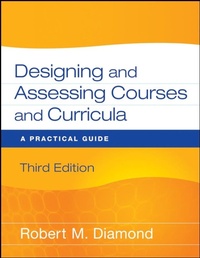
Designing and Assessing Courses and Curricula
A Practical Guide
3rd Edition
Will be published approx. on 22. August 2008
Book
Paperback/Softback
512 pages
978-0-470-26134-7 (ISBN)
Description
Designing and Assessing Courses and Curricula reflects the most current knowledge and practice in course and curriculum design and connects this knowledge with the critical task of assessing learning outcomes at both course and curricular levels. This thoroughly revised and expanded third edition of the best-selling book positions course design as a tool for educational change and contains a wealth of new material including new chapters, case examples, and resources.
More details
Edition
3rd edition
Language
English
Place of publication
New York
United States
Publishing group
John Wiley & Sons Inc
Target group
Professional and scholarly
Product notice
Paperback (trade)
Unsewn / adhesive bound
Dimensions
Height: 279 mm
Width: 215 mm
Thickness: 30 mm
Weight
1281 gr
ISBN-13
978-0-470-26134-7 (9780470261347)
Copyright in bibliographic data and cover images is held by Nielsen Book Services Limited or by the publishers or by their respective licensors: all rights reserved.
Schweitzer Classification
Other editions
Additional editions
E-Book
01/2011
3rd Edition
Jossey-Bass
€45.99
Available for download
E-Book
12/2009
3rd Edition
Jossey-Bass
€45.99
Available for download
Previous edition

Book
11/1997
Jossey-Bass
€49.70
Article exhausted; check for reprint
Person
Robert M. Diamond was president of the National Academy for Academic Leadership and professor emeritus at Syracuse University.
Content
Preface. Acknowledgments.
About the Authors.
PART I: A FRAME OF REFERENCE.
1. A Learning-Centered Approach to Course and Curriculum Design.
2. The Expanding Role of Faculty in Accreditation and Accountability.
3. Staying Informed.
4. Scholarship and Faculty Rewards.
5. An Introduction to the Model and Its Benefits.
6. Diagramming.
PART II: THE PROCESS.
7. Making the Decision to Go Ahead.
8. Getting Started.
9. Linking Goals, Courses, and Curricula.
10. Gathering and Analyzing Essential Data.
11. Thinking in the Ideal.
12. Adjusting from the Ideal to the Possible.
13. Clarifying Instructional Goals and Learning Outcomes.
14. Designing and Implementing Your Assessment Plan: Overview and Assessing a Curriculum.
15. Designing and Implementing Your Assessment Plan: Assessing a Course.
PART III: DESIGNING, IMPLEMENTING, AND ASSESSING THE LEARNING EXPERIENCE.
16. Designing the Learning Experience: The Research on Teaching and Learning.
17. Designing the Learning Experience: Your Instructional Options.
18. Using Technology to Support Learning.
Wallace Hannum.
19. Distance Learning.
Wallace Hannum.
20. Meeting the Needs of Adult Learners.
G. Roger Sell.
21. Addressing Diversity.
G. Roger Sell.
22. Developing a Learning-Centered Syllabus.
PART IV: YOUR NEXT STEPS.
23. Using Your Data: Curriculum and Course Revision.
24. Learning from Experience.
Resources.
References.
Index.
About the Authors.
PART I: A FRAME OF REFERENCE.
1. A Learning-Centered Approach to Course and Curriculum Design.
2. The Expanding Role of Faculty in Accreditation and Accountability.
3. Staying Informed.
4. Scholarship and Faculty Rewards.
5. An Introduction to the Model and Its Benefits.
6. Diagramming.
PART II: THE PROCESS.
7. Making the Decision to Go Ahead.
8. Getting Started.
9. Linking Goals, Courses, and Curricula.
10. Gathering and Analyzing Essential Data.
11. Thinking in the Ideal.
12. Adjusting from the Ideal to the Possible.
13. Clarifying Instructional Goals and Learning Outcomes.
14. Designing and Implementing Your Assessment Plan: Overview and Assessing a Curriculum.
15. Designing and Implementing Your Assessment Plan: Assessing a Course.
PART III: DESIGNING, IMPLEMENTING, AND ASSESSING THE LEARNING EXPERIENCE.
16. Designing the Learning Experience: The Research on Teaching and Learning.
17. Designing the Learning Experience: Your Instructional Options.
18. Using Technology to Support Learning.
Wallace Hannum.
19. Distance Learning.
Wallace Hannum.
20. Meeting the Needs of Adult Learners.
G. Roger Sell.
21. Addressing Diversity.
G. Roger Sell.
22. Developing a Learning-Centered Syllabus.
PART IV: YOUR NEXT STEPS.
23. Using Your Data: Curriculum and Course Revision.
24. Learning from Experience.
Resources.
References.
Index.