

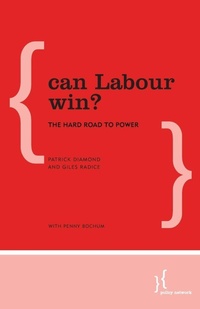
Can Labour Win?
The Hard Road to Power
Published on 15. September 2015
Book
Paperback/Softback
82 pages
978-1-78348-544-4 (ISBN)
Description
After its disastrous defeat in 2015, Labour is at grave risk of throwing away the 2020 general election. The party has to understand why it suffered such a devastating defeat and learn crucial lessons if it is to recover. The reasons appear obvious enough: the British public did not believe that Ed Miliband was a credible prime minister; people feared that a Labour government would plunge the British economy back into chaos; and they perceived that the party was out of touch on issues like immigration and welfare. Labour was not just narrowly defeated in 2015, it was overwhelmingly rejected by an electorate who no longer trust the party.
Underlying all of this is a sense that Labour is a party that does not understand the modern world, wedded to an outdated 'cloth cap' image of heavy industry and the monolithic public sector. The risk for the Labour party, like social democratic parties across Europe, is further electoral defeat and then inevitably, permanent irrelevance. As of today, there are few signs that the party grasps why it lost and, in particular, why swing voters in marginal seats were not prepared to vote Labour. A party that does not understand why it was defeated scarcely deserves to be taken seriously by the electorate. This book examines why Labour so overwhelmingly lost the trust of voters, and crucially how the party under a new leader can win them back by 2020 - charting Labour's path to power.
Underlying all of this is a sense that Labour is a party that does not understand the modern world, wedded to an outdated 'cloth cap' image of heavy industry and the monolithic public sector. The risk for the Labour party, like social democratic parties across Europe, is further electoral defeat and then inevitably, permanent irrelevance. As of today, there are few signs that the party grasps why it lost and, in particular, why swing voters in marginal seats were not prepared to vote Labour. A party that does not understand why it was defeated scarcely deserves to be taken seriously by the electorate. This book examines why Labour so overwhelmingly lost the trust of voters, and crucially how the party under a new leader can win them back by 2020 - charting Labour's path to power.
More details
Language
English
Place of publication
United States
Publishing group
Bloomsbury Publishing PLC
Target group
Professional and scholarly
Illustrations
16 b/w illustrations; 4 tables; 12 graphs
Dimensions
Height: 216 mm
Width: 140 mm
Thickness: 5 mm
Weight
119 gr
ISBN-13
978-1-78348-544-4 (9781783485444)
Copyright in bibliographic data and cover images is held by Nielsen Book Services Limited or by the publishers or by their respective licensors: all rights reserved.
Schweitzer Classification
Other editions
Additional editions
E-Book
09/2015
1st Edition
Policy Network, London
€20.49
Available for download
E-Book
09/2015
1st Edition
Policy Network, London
€20.49
Available for download
Persons
Patrick Diamond is lecturer in public policy at Queen Mary, University of London. He was formerly an adviser to Tony Blair and Gordon Brown covering policy and strategy. He is author of Labour's Economic Path to Power (2013), co-author of The Social State of Europe (2015) and co-editor of Progressive Capitalism in Britain (2015).
Giles Radice is a member of the House of Lords and a former MP in the Labour Party.
Penny Bochum is an experienced interviewer and researcher who has worked on the Southern Discomfort pamphlets since 1992.
Giles Radice is a member of the House of Lords and a former MP in the Labour Party.
Penny Bochum is an experienced interviewer and researcher who has worked on the Southern Discomfort pamphlets since 1992.
Content
Acknowledgements / About the Authors / Introduction: Why Did Labour Lose? / The Electoral Battleground: Polling Analysis and the Views of Wavering Voters / Why Labour Lost: Party Views / What Labour Must Do / Conclusion: Labour's Path to Power